Monochrome means ‘one colour’, so art created in monochrome uses only one colour. Most would think that using one colour would restrict the freedom of the artist but might it not also focus the intent of the artist and thereby produce something more which if colours were used would not be achievable. 
 Do we when looking at the seascape miss colour? I think not for this painting exudes an image of the sea which has depth and life, movement and presence. Would that all art even using colours could be so evocative.
Painting in #blackandwhite or #grisaille was predominately religious based from the Middle Ages to the 17th century. The art produced this way might not be paintings but might be done using charcoal, crayon, graphite, or ink. From Dutchman Adriaen van de Venne to artists like Van Eyck, Giacometti, Picasso, Velasquez, Goya, Ingres, Richter, and Pollock all have produced works in grisaille.
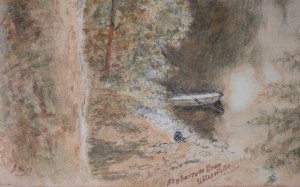
The pieces, I present here some of which I have talked about previously are all watercolour paintings. 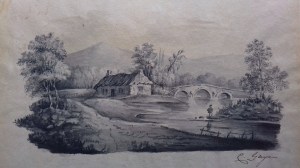 They span from a 20th century Cornwall? coastal scene to a 19th century Welsh?landscape to an 18th century ( maybe earlier yet) portrait (Hagar and Ishmael) – all done in monochrome. Each trying to invoke some response from the onlooker. They all display excellence but the last is still possibly one of the best pieces of art that I own.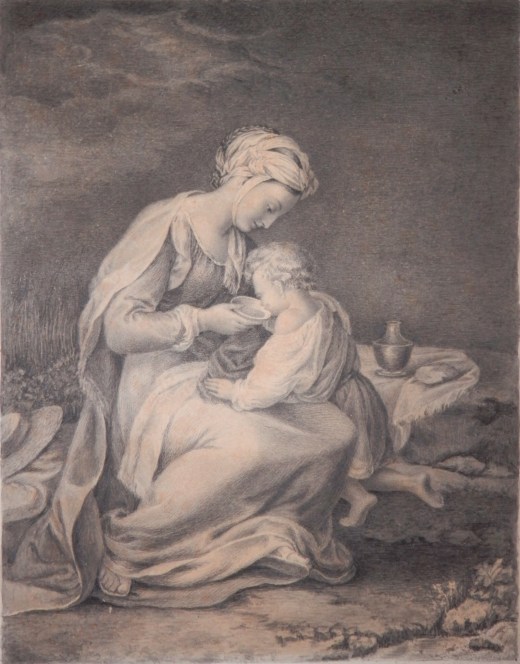
 In London, he used his skills to produce wood engravings for illustrated publications. Henry contributed to PUNCH magazine for 3 years and then went to work for the Illustrated London News. Hine returned to painting landscapes. He was elected to the Institute of Painters in Watercolour in 1863 and exhibited regularly with the Institute until his death in 1895.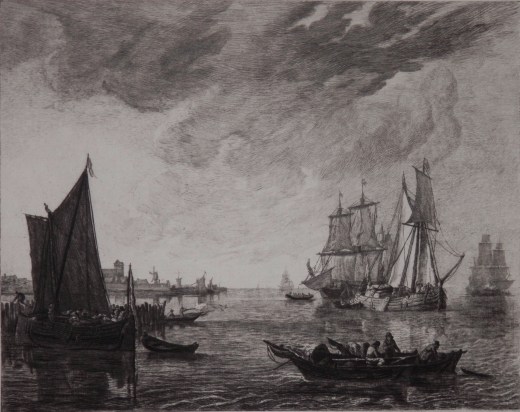
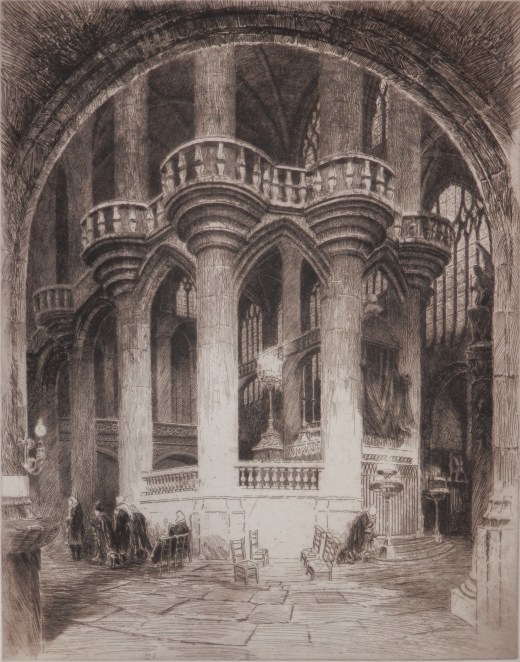 St Etienne du Mont etching
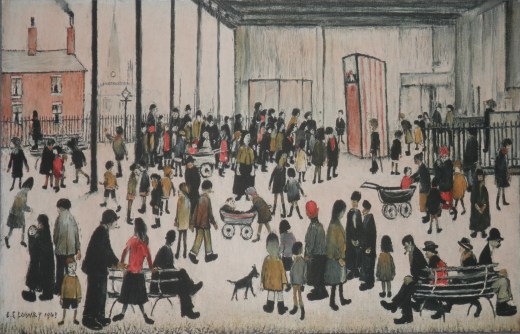 Lowry is best known for images of ‘match-stick’ men and animals within the backdrop of industry. Urban landscapes of factory walls, belching chimneys, looming mills, with streets teeming with figures, moving in waves towards, or away from, mill gateways, mines, football matches, and political meetings. This is the classic image of the North of England from years past. Wonderfully executed in stunning colours and an expert hand.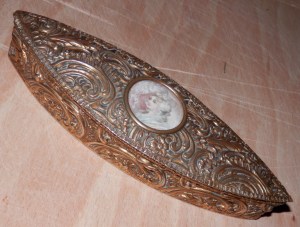
 We begin with an ormolu box with a ladies portrait on the lid. #Ormolu is a technique for applying finely ground high carat gold onto bronze. The process which is not used anymore involved the use of mercury. This usually led to the early death of practitioners of the process. The oblong box was most likely meant to hold trinkets or possibly jewellery. Items like this one often bear the semblance of the recipient. I cannot say who the young lady in the hat is (slight semblance to Marie Antoinette) and the painting is unsigned. The only clue to the maker are the initials ‘AF’ on the inner lip of the lid.
  The second item today is another trinket box which comes from Germany. It bears the portrait of Napoleon. The mark on the bottom is the St Kilian hallmark. It was used by the Oscar Schlegelmilch factory in Thuringia, Germany. The trinket box dates to the early 1900’s. Here once again one can see the finesse of the artist. The fine brush work and colouring.
 A great number of his works were after fellow artists, especially Cipriani and Angelica Kauffman. At some point in his career, he worked on a series of etchings portraying children playing. I have seen nine different portrayals: swinging, playing at marbles, playing shuttle-cock, playing at hot cockles, playing thread the needle, playing with a mouse, playing trap ball, playing hunt the slipper, and feeding chickens. The engraving I came across is called ‘Seesaw’ (title in pencil on a separate backing sheet of paper). It shows the same set of children from the other engravings enjoying themselves. The engraving is an early pressing for no title nor accreditation to artist has yet been etched onto the plate. A fine example of the masters workmanship.
 Pocock gave up the sea and became a full-time artist in 1778 and within four years he was exhibiting at the Royal Academy. His reputation grew and he moved to London in 1789 where he flourished. Eventually being appointed Marine Painter to King George. Pocock’s naval paintings were extensively researched. He interviewed eyewitnesses about weather and wind conditions, the positions, condition, and appearance of their ships. He then drew detailed plans of the battles and preliminary sketches of individual ships. He was even onboard the frigate HMS Pegasus at the Glorious First of June in 1794.
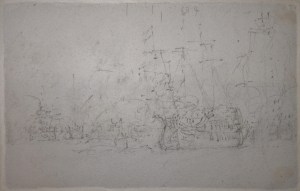 The sketch on the verso is of a naval action. I have not yet tied it to a finished work but am still studying. Being known for his naval works, the verso side of this work is possibly the more interesting although it is less finished than than the face side. And finally the label on the back for the gallery through whose hands this work was sold.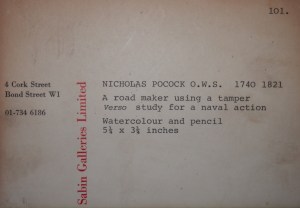
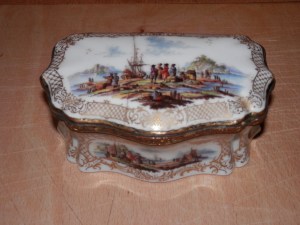
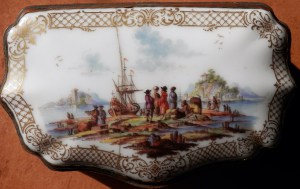 Often with items such as this, one artist would decorate the outside of the piece and another would paint the interior – if it were decorated. The artist doing the interior was always the better artist.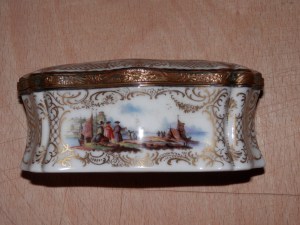
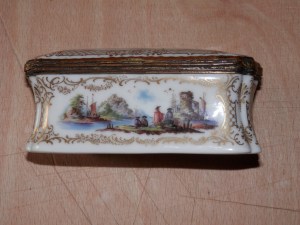 We see images of the top, front, and rear of the box, all showing coastal/nautical scenes. All three done with exquisite finesse. Superb brush work and the colours still so vibrant for I place the making of this piece around 1760. Even the bottom is decorated not with an image as some tabatieres are but with wonderful scroll and line work.
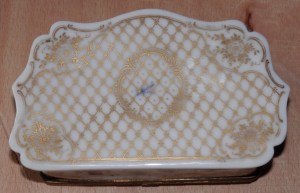 The piece also bears the crossed swords mark of the Meissen factory – although somewhat indistinct.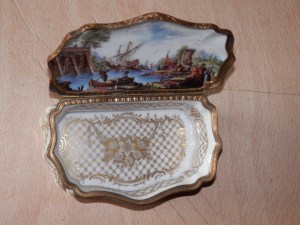
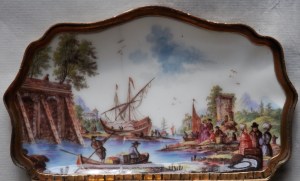 When one opens the lid, we are greeted with another nautical/coastal scene. The finest work of the four painted. I believe that the same artist has painted all four scenes on this snuff box but it is possible that a second artist might have performed all the gold scroll and let line work.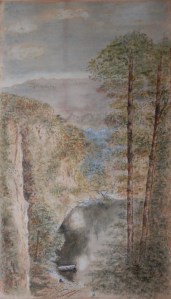

 ronsartblog