As I have have been collecting , I have come across some superb etchings. It is true that I think the art of etching/engraving is under-valued by the art world and general public. There are, of course, those few like Rembrandt, Hollar, Holl, Bartolozzi whose name you might recognise but even their etchings are usually a side display rather than the focus of an exhibition. I cannot attribute the etching we will look at in this chapter, but suffice it to say that it is a truly fine piece of work.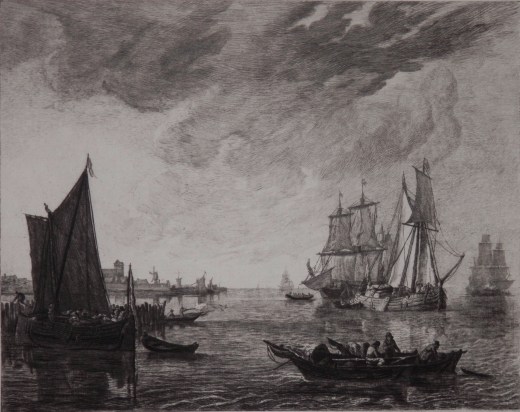
A marine etching. A harbour view – possibly Dordrecht harbour. I am guessing that this work is of Dutch origin and since it is on laid paper printed prior to 1850. What one does see when your look at this work is the sublime tonal quality achieved by this artist. The exactness and finesse allows one to enlarge the image and see the individuals in the boats and ships. The workmanship seen in the clouds, the rippling water, and the shadows is sublime. It presents a depth and variance of tone which is only seen in the work of a master.
After more research, I believe, I can attribute this etching to #EgideFrancoisLeemans (1839-1883). He was a Belgian painter and engraver who lived in Antwerp and is best know now for his realistic waterscapes, harbour scenes, and seascapes. He specialised in evening and moonlit scenes with special attention to the reflections on the water. The title for this etching is #KanalinDordrecht.
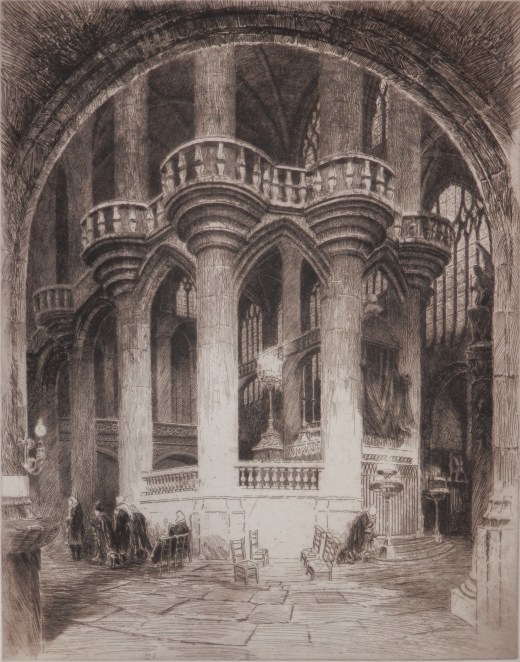 St Etienne du Mont etching
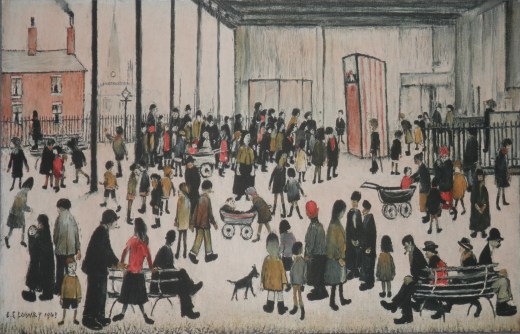 Lowry is best known for images of ‘match-stick’ men and animals within the backdrop of industry. Urban landscapes of factory walls, belching chimneys, looming mills, with streets teeming with figures, moving in waves towards, or away from, mill gateways, mines, football matches, and political meetings. This is the classic image of the North of England from years past. Wonderfully executed in stunning colours and an expert hand.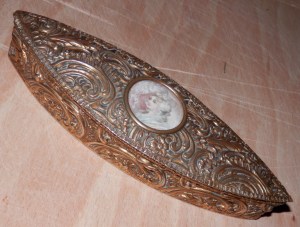
 We begin with an ormolu box with a ladies portrait on the lid. #Ormolu is a technique for applying finely ground high carat gold onto bronze. The process which is not used anymore involved the use of mercury. This usually led to the early death of practitioners of the process. The oblong box was most likely meant to hold trinkets or possibly jewellery. Items like this one often bear the semblance of the recipient. I cannot say who the young lady in the hat is (slight semblance to Marie Antoinette) and the painting is unsigned. The only clue to the maker are the initials ‘AF’ on the inner lip of the lid.
  The second item today is another trinket box which comes from Germany. It bears the portrait of Napoleon. The mark on the bottom is the St Kilian hallmark. It was used by the Oscar Schlegelmilch factory in Thuringia, Germany. The trinket box dates to the early 1900’s. Here once again one can see the finesse of the artist. The fine brush work and colouring.
 A great number of his works were after fellow artists, especially Cipriani and Angelica Kauffman. At some point in his career, he worked on a series of etchings portraying children playing. I have seen nine different portrayals: swinging, playing at marbles, playing shuttle-cock, playing at hot cockles, playing thread the needle, playing with a mouse, playing trap ball, playing hunt the slipper, and feeding chickens. The engraving I came across is called ‘Seesaw’ (title in pencil on a separate backing sheet of paper). It shows the same set of children from the other engravings enjoying themselves. The engraving is an early pressing for no title nor accreditation to artist has yet been etched onto the plate. A fine example of the masters workmanship.
 Pocock gave up the sea and became a full-time artist in 1778 and within four years he was exhibiting at the Royal Academy. His reputation grew and he moved to London in 1789 where he flourished. Eventually being appointed Marine Painter to King George. Pocock’s naval paintings were extensively researched. He interviewed eyewitnesses about weather and wind conditions, the positions, condition, and appearance of their ships. He then drew detailed plans of the battles and preliminary sketches of individual ships. He was even onboard the frigate HMS Pegasus at the Glorious First of June in 1794.
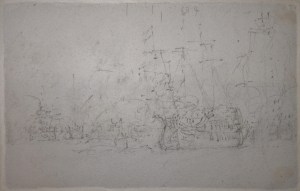 The sketch on the verso is of a naval action. I have not yet tied it to a finished work but am still studying. Being known for his naval works, the verso side of this work is possibly the more interesting although it is less finished than than the face side. And finally the label on the back for the gallery through whose hands this work was sold.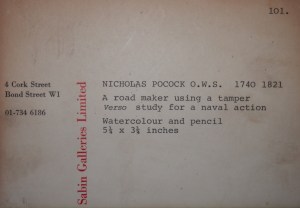
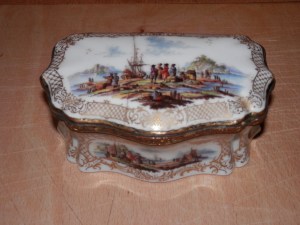
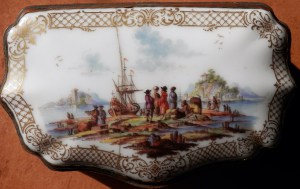 Often with items such as this, one artist would decorate the outside of the piece and another would paint the interior – if it were decorated. The artist doing the interior was always the better artist.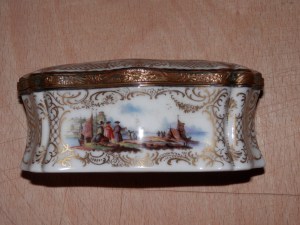
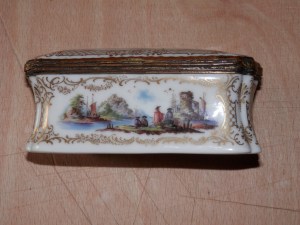 We see images of the top, front, and rear of the box, all showing coastal/nautical scenes. All three done with exquisite finesse. Superb brush work and the colours still so vibrant for I place the making of this piece around 1760. Even the bottom is decorated not with an image as some tabatieres are but with wonderful scroll and line work.
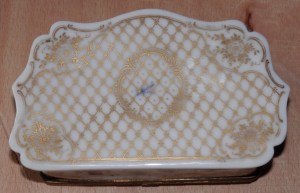 The piece also bears the crossed swords mark of the Meissen factory – although somewhat indistinct.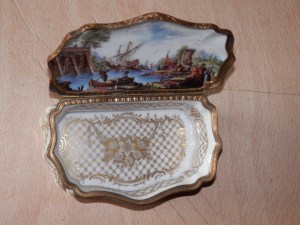
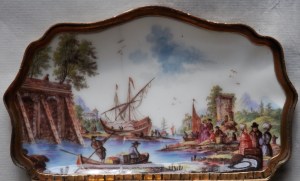 When one opens the lid, we are greeted with another nautical/coastal scene. The finest work of the four painted. I believe that the same artist has painted all four scenes on this snuff box but it is possible that a second artist might have performed all the gold scroll and let line work.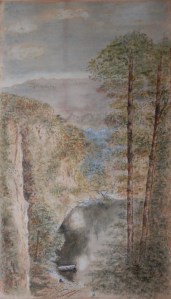
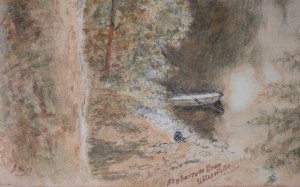

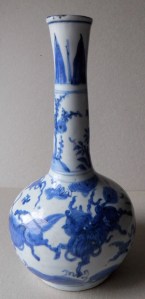
 Blue and white porcelain wares appear to have their beginning in the Tang dynasty (618-907). The quality of both porcelain and artwork improved and some believe peaked during the Yuan dynasty (1271-1368). During the 14th century this blue and white porcelain began to be mass produced with quality being carefully monitored.
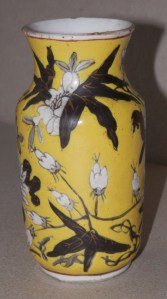
 The blue and white pottery industry became more important during the Ming (1368-1644) and Qing (1644-1911) dynasties. It was at this time that it became a commodity on the international trade market and expanding to become a worldwide commodity. Blue and white wares are common to this day in daily life in forms ranging from dinner sets to vases.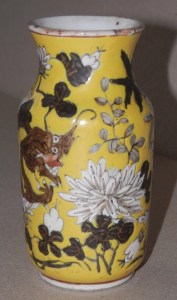


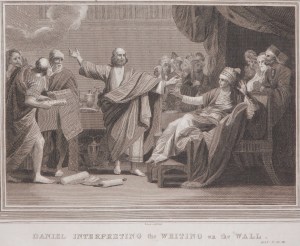 His publishing house was equipped for copperplate engraving, etching, mezzotinting, aquatinting, and lithography. Scott introduced the art of steel engraving to Edinburgh. He died early in 1841.
 ronsartblog