We visit the Lake District to consider the work of #WilliamTaylorLongmire (1841-1914). He was born in #Troutbeck near Ambleside and he was expected to carry on his fathers trade as a farmer and butcher. After the family move to Stavely, William was prompted, by the local vicar, to take up and then study drawing. As a young lad of just 10 years, he suffered an accident. 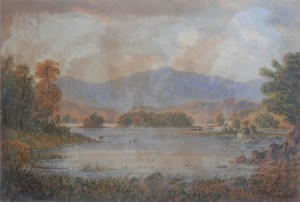 A fall into the lake led to complications resulting in the total loss of hearing. Longmire is most widely known for his paintings of the Lake District mostly in watercolour but he did paint in oils also. By the age of 30, this mostly self-taught painter had set up his own studio in Ambleside.
I have two of Longmire paintings in my collection. The first of an unknown lake ( I think Grasmere) painted in 1891. It has lived a hard life, like many of his works today, it has faded and stained due to being hung in a sunny front room. The second work is of #Buttermere and was executed in 1878.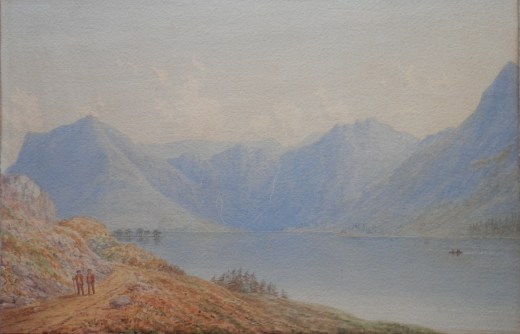 Here, we see a picture in far better condition. From these two works, one comes to understand why Longmire was a well appreciated artist. They are colourful and atmospheric, displaying both the beauty and harshness which the local residents experienced in everyday life. I have been to Ambleside and the Lake District. Things have moved on but the area retains it’s beauty.
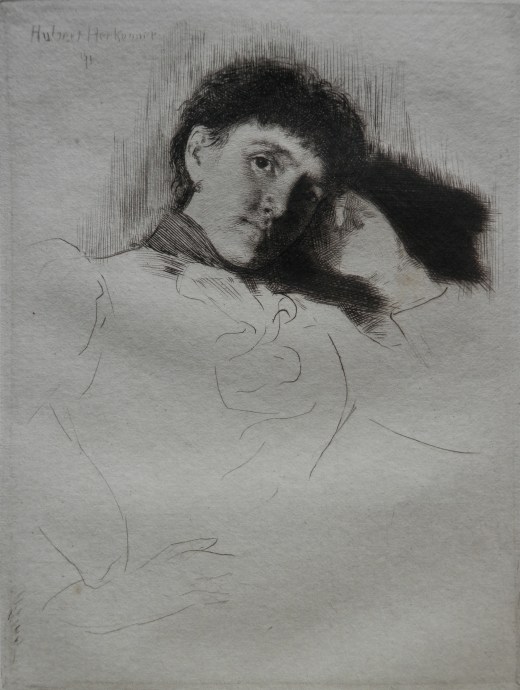 For a number of years, he was an illustrator for The Graphic a London based paper. With his success secure, Herkomer broadened his artistic fields by dabbling in other fields of interest. Proficient in oils, watercolours, etching, engraving, mezzotinting, and works in enamel he was also a film producer, a playwright and a composer of some quality.
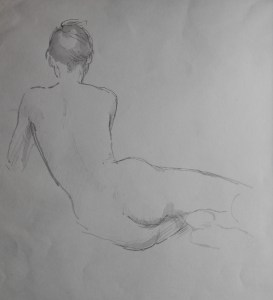 Guthrie’s studies brought him to the Slade School of Art where he studied under Philip Wilson Steer and Henry Tonks. He was a superb draughtsman which can best be seen in his portraiture. He drew and painted landscapes and portraits and even illustrated books including his fathers A Wild Garden (1924). He exhibited through the New English Art Club, Royal Academy, Goupil Gallery, Leicester Gallery, Arthur Tooth & Sons, Tate Gallery and many more. For two years Guthrie took the post of director at the School of the Museum of Fine Art in Boston in the USA. During WWII, he was given a commission as an artist to record the workings of the Army cookery School and the activities at the Auxiliary Territorial Service training bases. After the war Guthrie tutored at a number of schools and illustrated several books. His works are held by The Tate, British Museum, Victoria & Albert Museum, National Portrait Gallery and many others both public and private.
 Indeed Ada came from good artistic stock. Her father was #JulesFrederickLessore and her grandfather was #ÉmileLessore – a designer and painter for Wedgwood during e 1860’s. Her sister Thérèse was a very fine painter in oils and watercolours ( in some ways this work identifies better with Thérèse than Louise) and was married to #WalterSickert (of Camden Town Group fame). Her brother Frederick Lessore was a sculptor and founder of the Beaux Arts Gallery in London.
 The bowl bears a #Chenghua mark (1465-1487) within a double circle on it’s base but this bowl was most likely made during the #Kangxi period (1662-1722) some 200 years later than its’ date mark. Real Chenghua porcelain is very, very rare and stunningly expensive. The decoration which is continuous around the bowl is more suitable to the later time.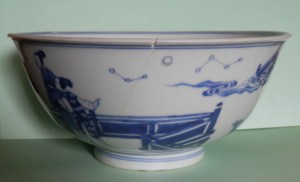
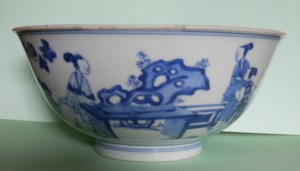
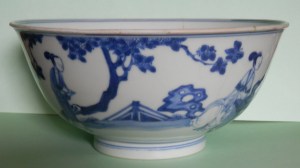
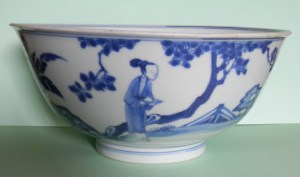
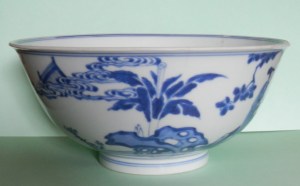 The scene shows a female servant bringing tea to a scholar/musician who sits by a table upon which a guqin lies as two other ladies look on. A guqin is a seven stringed instrument (although they have been known to have anywhere from 5 to 10 strings) which is plucked and known for its’ subtlety and refinement. Not a loud instrument – much more intimate/personal covering a four octave range.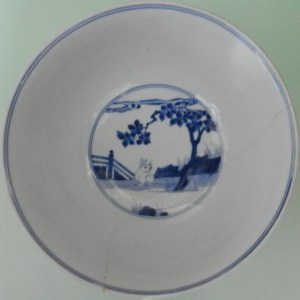
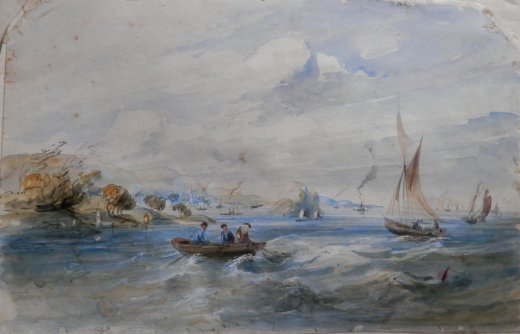 The roiling sea, the wind-bent trees, the billowed clouds fleeing across the sky -it all works. There truly is a feeling of motion – of turmoil – an impending storm. The colours of the sea weave together to bring forth temperamental waves and whitecaps. Look closely at the next two images and you will realise that the white tops are achieved by scratching away the colour (sgraffito) on the paper and not by adding white body colour.
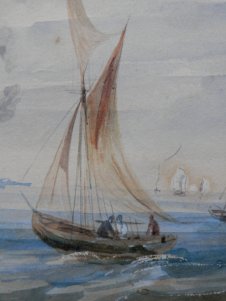 The overall effect truly is amazing. Up close there is, one might think, a lack of finesse but this little work is meant to be appreciated in the whole not in small sections. This wee thing is 6 1/2″ x 9 5/8″ (165mm x 245mm). I think this might be #TenbyHarbour. One artist who worked in this style was JMW Turner. If you want to see his coastal watercolours just google #JMWTurner #PortsofEngland and enjoy. The Turner watercolours are the same size as the one in my collection.
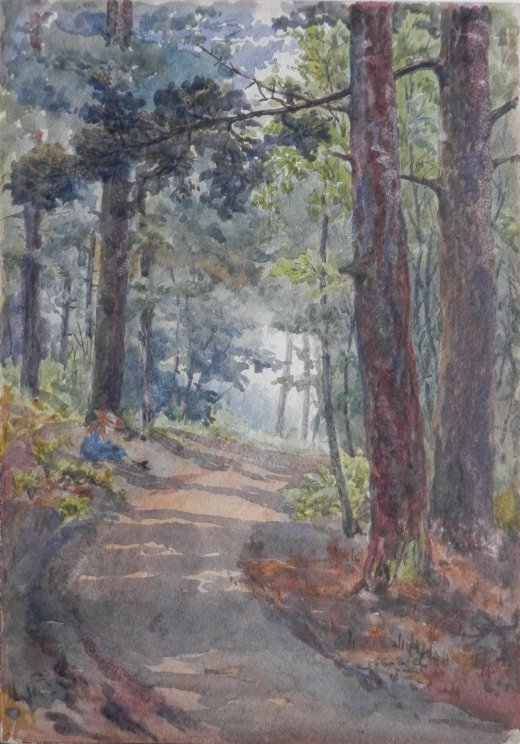 At the young age of 15, he was sent to study under #JohnVarley in London. At that time, Williams’ fellow students under Varley were William Henry Hunt and John Linnell.
  He retired after being diagnosed with incurable cancer in 2016. He remains as Chairman of #ChristianityExplored,PastorTrainingInternational and #ChristianBooksWorldwide.
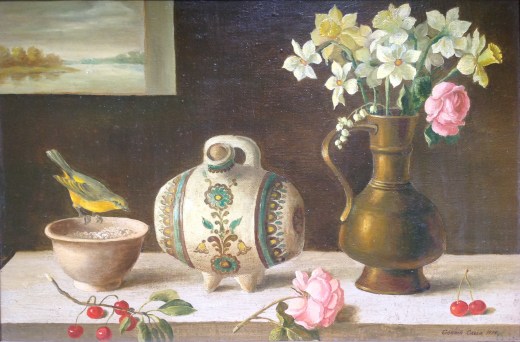
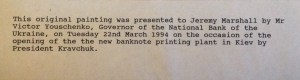 The painting is a still-life. The artwork is signed and dated 1990. The pottery in the work is certainly typical of that produced in the Ukraine. I do not know what the other symbols such as the flowers, wren and fruit mean if they are symbols at all.

 A nicely painted piece with an interesting story to hold with it.
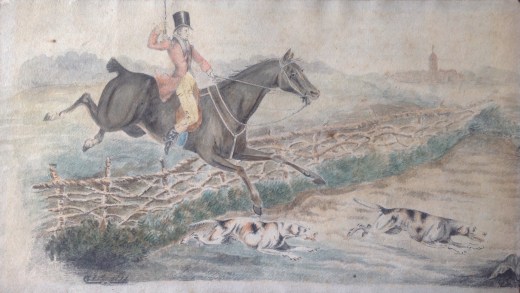 His early studies were with his father and JT Beaumont – a painter of miniature portraits which Henry abandoned to paint sporting scenes. Alken was a prolific artist. Producing a continuous run of paintings, drawings, and engravings from 1816 to 1831. During this time, he lived over the printing shop and was employed by #ThomasMcLean – publisher of the “Repository of Wit and Humour”.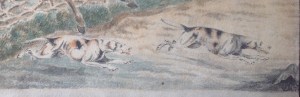
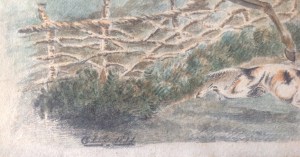 It maybe by a follower or friend who admired the work of the Alken family. Whomever painted this did capture the style perfectly. The postures and expressions of the horse and hounds and the rider are exactly correct. Nicely drawn in pencil and then coloured with watercolour, it is a fine piece from more than 200 years ago.
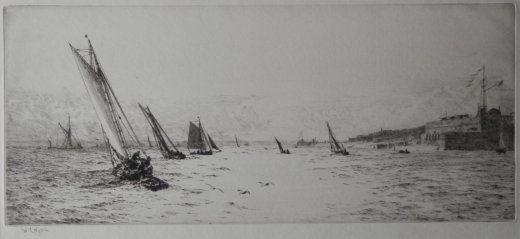 It was his love of the sea that continuously inspired his art. Wylie was a great supporter of the Royal Navy. So much so, that his funeral was with full naval honours. His coffin was rowed up Portsmouth Harbour with battleships’ colours dipped and bugles calling. The quayside was lined with dockyard workers in respect. His panorama of the Battle of Trafalgar which hangs in the #RoyalNavalMuseum in Portsmouth sees more than 100,000 visitors a year.
 ronsartblog