I have written in regards to Dante in a couple of other chapters and today we look at an image by artist #HenryGeorgeHoliday (1839-1927). Perhaps Henry Holiday’s best known painting is that of Dante and Beatrice at Ponte Santa Trinitas in Florence. Holiday was a landscape and historical scene painter who also designed and worked in stained glass, sculpture and illustrating. In the timeline of art, he would be considered a Pre-Raphaelite.
The painting #DanteandBeatrice is based on Dante’s work La Vita Nuova. The work describes Dante’s love for Beatrice Portina. Dante tries to conceal his love for Beatrice by pretending to be attracted to other women. But this backfires when Beatrice learns of his affections and his pretence and snubs him by refusing to speak to him. The event is shown as Beatrice and two other women walk past Dante at the Ponte Santa Trinita. Beatrice in the white dress walks beside her friend Monna Vanna, with Beatrice’s maidservant slightly behind. To assure authenticity in regards to the image portrayed, Dante traveled to Florence in 1881 to study buildings and architecture. He even created small clay models of the buildings and persons. Although the pigeons appear here, they were painted by #JohnTrivettNettleship for Dante’s large oil painting created in 1883.
The small watercolour in my collection is unsigned. It appears to be old enough to be by Holiday but it is in rough shape. Woodworm have eaten the backing wooden boards and paper artist board and left even a few holes in the image. This is what happens when art is not cared for. There are a couple of charcoal sketches which Holiday created in study for his large work and maybe this was created for colour reference as well as architectural accuracy.

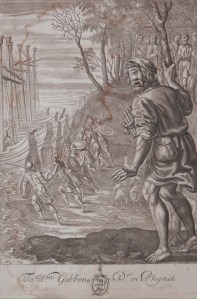 The etching comes from Hollar’s work illustrating Virgil’s Aeneid. It was translated by John Ogilby and to finance the epic undertaking wealthy patrons were approached for support. In return they would receive an etching with text removed and a commendation to the patron. One hundred and three full-page illustrations were commissioned from a number of the best known artists of the time. They include Francis Cleyn, Wenceslaus (Vacaville) Hollar, Pierre Lombard, Ludwig Richer, and William Faithorne.
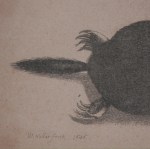
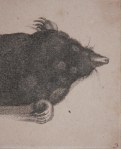
 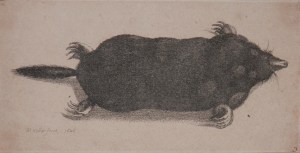 From a folio size etching to a much smaller one (2 3/4 x 5 1/2″ – cut on plate mark). Hollar was in Antwerp, in 1646, where he produced many of his most renowned works. Dutch cityscapes, seascapes, depictions of nature, still-life’s, and his ‘muffs’ and ‘shells’ series. My version (#3) of the run (full number unknown) has the two mishap scratch lines which occurred late in the etching process. A line coming from the top of the mole’s snout (toward top right)and a line coming out of the lower foot can be seen. It is signed by Hollar in the plate as well as the year of creation and there is a small number three in the bottom right corner.
  .
. 

 ronsartblog