Art at Sea

The sea as plays a big part in the of history of this area.  The first etching portrays King Edmund as he comes ashore at Hunstanton in East Anglia.  Edmund landed on Hunstanton beach in 855AD.  This son of a German King, Edmund, then aged 14, claimed his kingdom, East Anglia, and reigned peacefully for 14 years until the invasion by the Vikings.

Edmund, King, of the East Angles, landing at Hunstanton
coloured etching by Page

King Edmund was a Christian and believed he was called to pacifism so would not wage war against the Vikings.  The Vikings scoffed at Edmund’s faith, tied him to a tree and whipped him.  Edmund continued to call out to Christ.  This enraged the Vikings even more and they decided to fire arrows at Edmund.  When finished he was covered with arrows much as a hedgehog has bristles but still he called on Christ.  Angered even further the Vikings beheaded Edmund.  The tale has it that his head was discarded in the forest but found by his searching friends guarded by a wolf, untouched.  He was buried but later exhumed to be re-interred at Bury St. Edmunds. Upon exhumation it was found that the wounds from the arrows had healed and that his head had reattached to the body although a thin scar could be seen circling his neck.  King Edmund became the first patron saint of England.

The etching is a small 4.25″ by 7.5″.

Next comes a recent find which is very nautical indeed. The etching was done by David Law (1831-1901) one of the foremost etchers in Britain in the 1800’s.  He was an etcher and landscape artist.  He was born in Edinburgh, moved to London in the 1850’s and became  a founder of the Royal Society of Painters, Etchers, and Engravers in 1881. David Law spent 20 years as a map engraver for the British Ordnance Survey. As a watercolourist, he painted landscapes, detailed scenes of ships and architectural subjects.  His etchings of the paintings of Turner and Corot are well known, but it is with etchings of his own work , such as his series of British castles, that he found real and justifiable success.

The Spanish Armada Sailing from Ferrol – 12th July 1588
1882 etching by David Law after Oswald W Brierly

‘The Spanish Armada sailing from Ferrol _ 12th July 1588

(Starting for the Conquest of England)

The scene as the fleet passed out of the harbour must have been singularly beautiful.  It was a treacherous interval of real summer. The early sun was lighting the long chain of the Gallician mountains, marking with shadows the cleft defiles, and shining softly on the white walls and vineyards of Coruna.  The wind was light and falling towards a calm; the great galleons drifted slowly with the tide on the purple water, the long streamers trailing from the trucks, the red crosses, the emblem of the crusade, showing bright upon the hanging sails.  The fruit boats were bringing off the last fresh supplies, and the pinnaces hastening to the ships with the last loiterers on shore.  Out of 30,000 men who that morning stood upon the decks of the proud armada, 20,000 and more were never again to see the hills of Spain.

The above was from ‘Froude’s History of England’

This etching is an amazing 19″ by 29″. Superbly etched and wonderfully coloured, it well deserves a wall all to itself, but my house is small and it may have to share a place.
Posted in Etching | Tagged , , , , , , , , , , , , , , , , | Leave a comment

Art of Neighbourhood

Down the road a number of mile lies a city called Cambridge. It is well known world wide for the Colleges of the University of Cambridge. The most famous is of course Kings’ College with its’ chapel. I have in my collection two original art works which I would like to share with you which show two of Cambridge’s many facets .

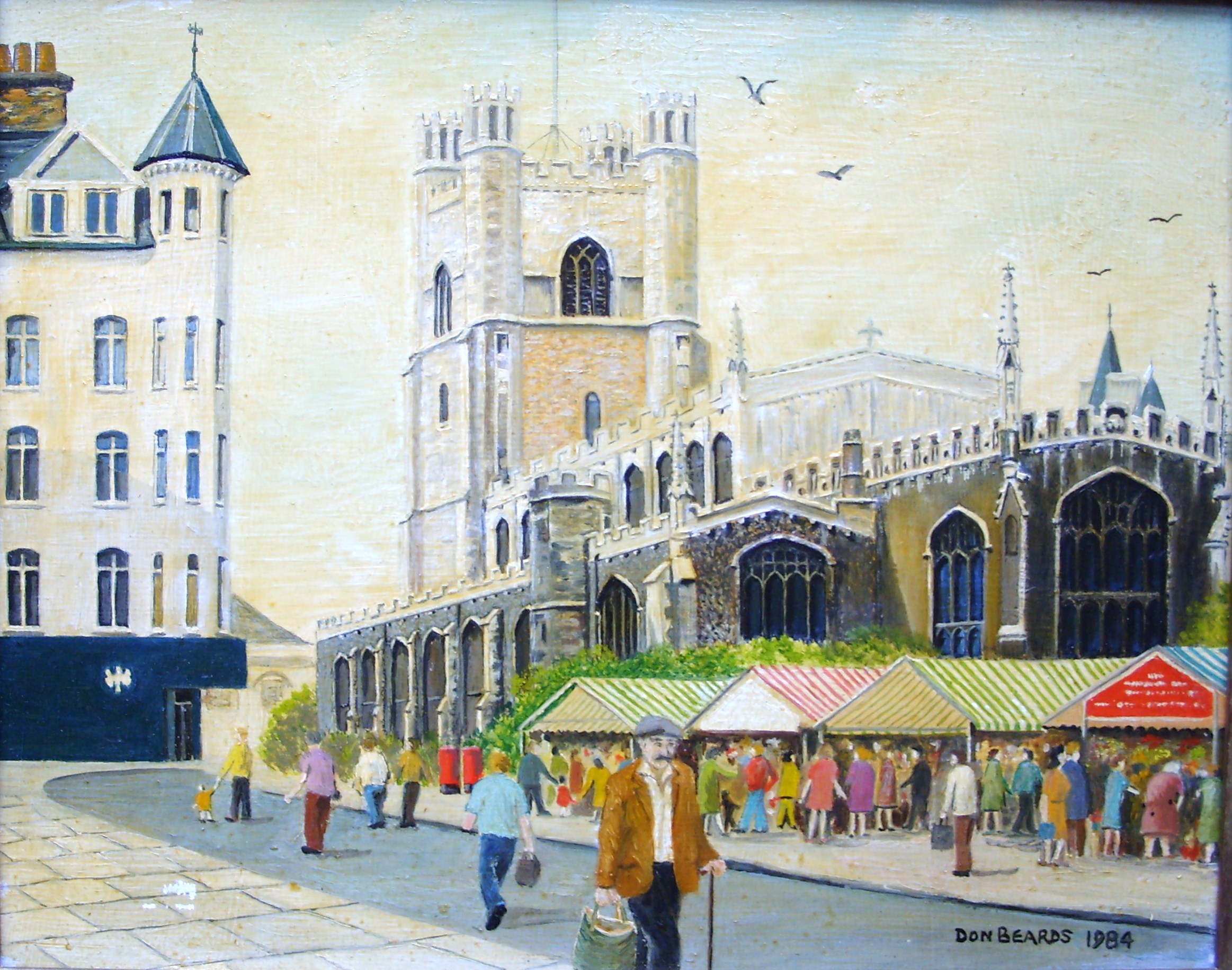
Cambridge Market with Great St Mary’s Church
Don Beards 1984

The first is an oil painting by local artist Don Beards.  It is a quaint image and shows the colour and life of the Cambridge Market. Great St. Mary’s stands in the background imposing herself upon the scene. She is the ‘Cambridge University Church’.  A focal point for many a year in down town Cambridge. The market place has existed from Saxon times and a daily outdoor market with stalls continues to operate there today.  From the market square, one can step quickly onto King’s Parade, Trinity Street, Sydney Street, and St Andrews Street.  A central hub from which life flows to and fro.  The heart of a great city filled with vibrancy, colour, youth and learning.

The Lodge, Queens’ College pen & ink drawing
H Toussaint @1880

The next is a pen and ink drawing of ‘The Lodge, Queen’s College’.  When I purchased this artwork, I took it for a nice print (since I forgot my jewellers monocle).  After getting it home and studying it up close, I found it to be an original  pen and ink drawing.  I have seen copies (etchings which  are signed C H Toussaint and dated Cambridge 1880) of this artwork on line and I have etchings in my own collection so am quite sure that this is an original drawing.  Toussaint lived from1849 to 1911. The signature(bottom left corner) on my drawing is unreadable by me and only reads Cambridge in the bottom right corner.   I wonder if this picture is the inspiration for C H Toussaint’s etching or is this just a very, very good hand drawn copy of his etching. I don’t know.  I will get my assumptions verified by a pro just to be sure.  It, of course, shows ‘The Lodge’ at Queens’ College and behind the lodge stands the Brandon Tower.  The tower shown was erected in 1848 and was replaced in 1911. This edition of the tower was considered to be too large and not suited to the height of the rest of the college.  To the right of the tower and the focus of the drawing is the ‘Essex Wing’ of the ‘President’s Lodge’.  The foreground is, I believe, Walnut Tree Court. A lovely drawing and a wonderful image from the life and history of Cambridge.

Posted in Drawings and Sketches, Oil Paintings | Tagged , , , , , , , , | Leave a comment

Art as Historical Perspective

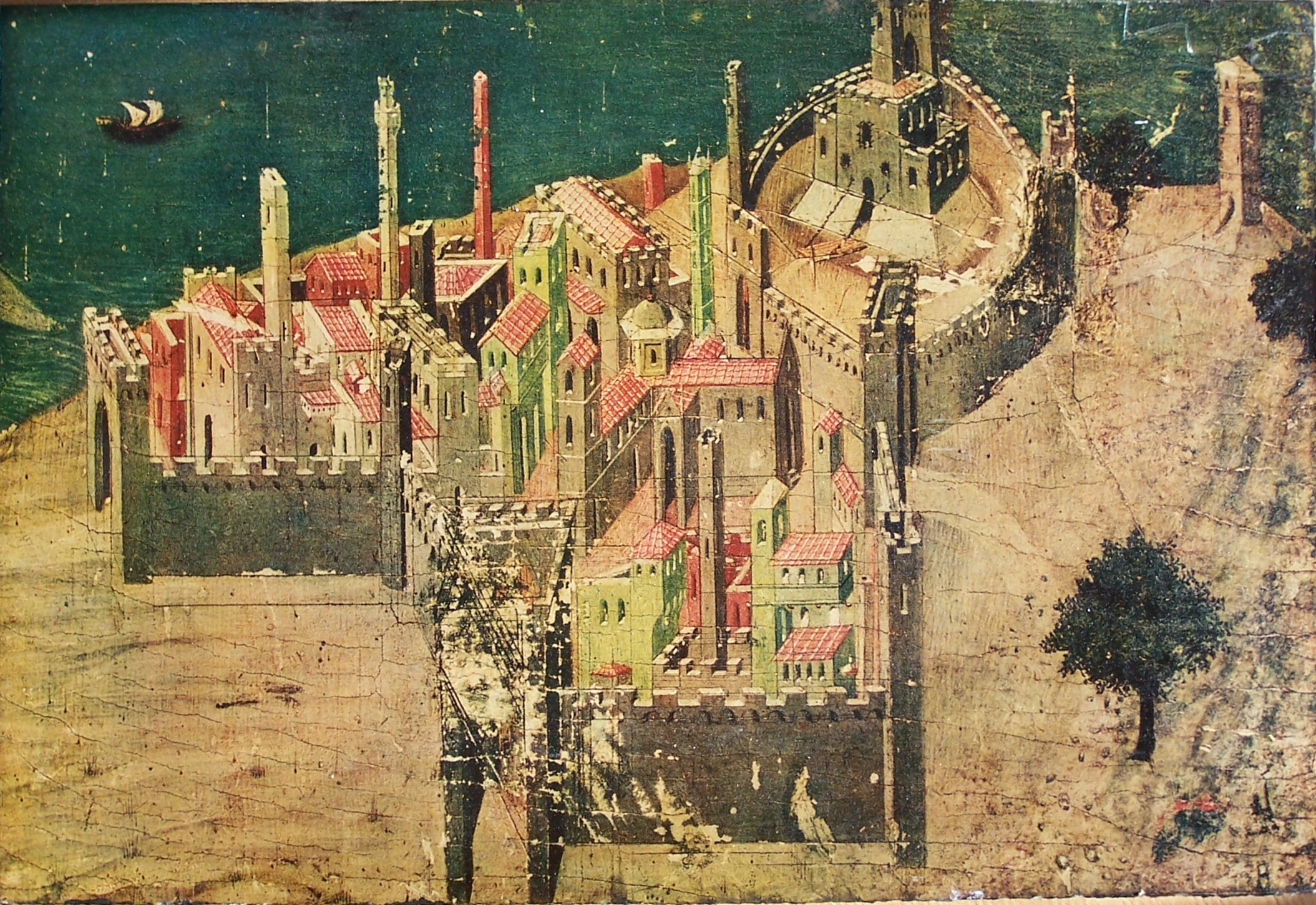
Here is a lithograph which I picked up recently. No signature, no date, no identifying marks at all. So, why talk about this picture. Well. It could be up to 200 years old since lithography was developed in 1796 or it could be 30 years old, as well, I find the view and perspective of this drawing very unique.  A town plan in 2D with 3D in aspects.  It reminds me of images which I might find on ancient maps.

Coastal Fortress – site unknown
no identifying marks

How do I go from this point?  How do I find out about this picture?  First I note specific points in regards to the content in the picture such as: the fortress’s exterior wall encloses a city through which one need pass to access the keep(donjon).  The keep sits on a mound(motte), is surrounded by a ditch, has a flat open area past the ditch(bailey) and entrance to the keep is granted by draw bridge.  The town itself appears to be European in style due to the architecture, the roof style, and the roof tiles so thus Italian, Spanish, Portuguese, Maltese, etc. The building in the centre of the picture with the dome roof has a cross on it so Christian.  It is on the coast  in a dry arid place and the trees could be olive trees.  The battlements are made for men and not canons. The ship has sails. and so on.

Now, it is time to surf the web using the noted specific points already listed. With so little information it is basically guess work as to what might lead me to identify the artwork.

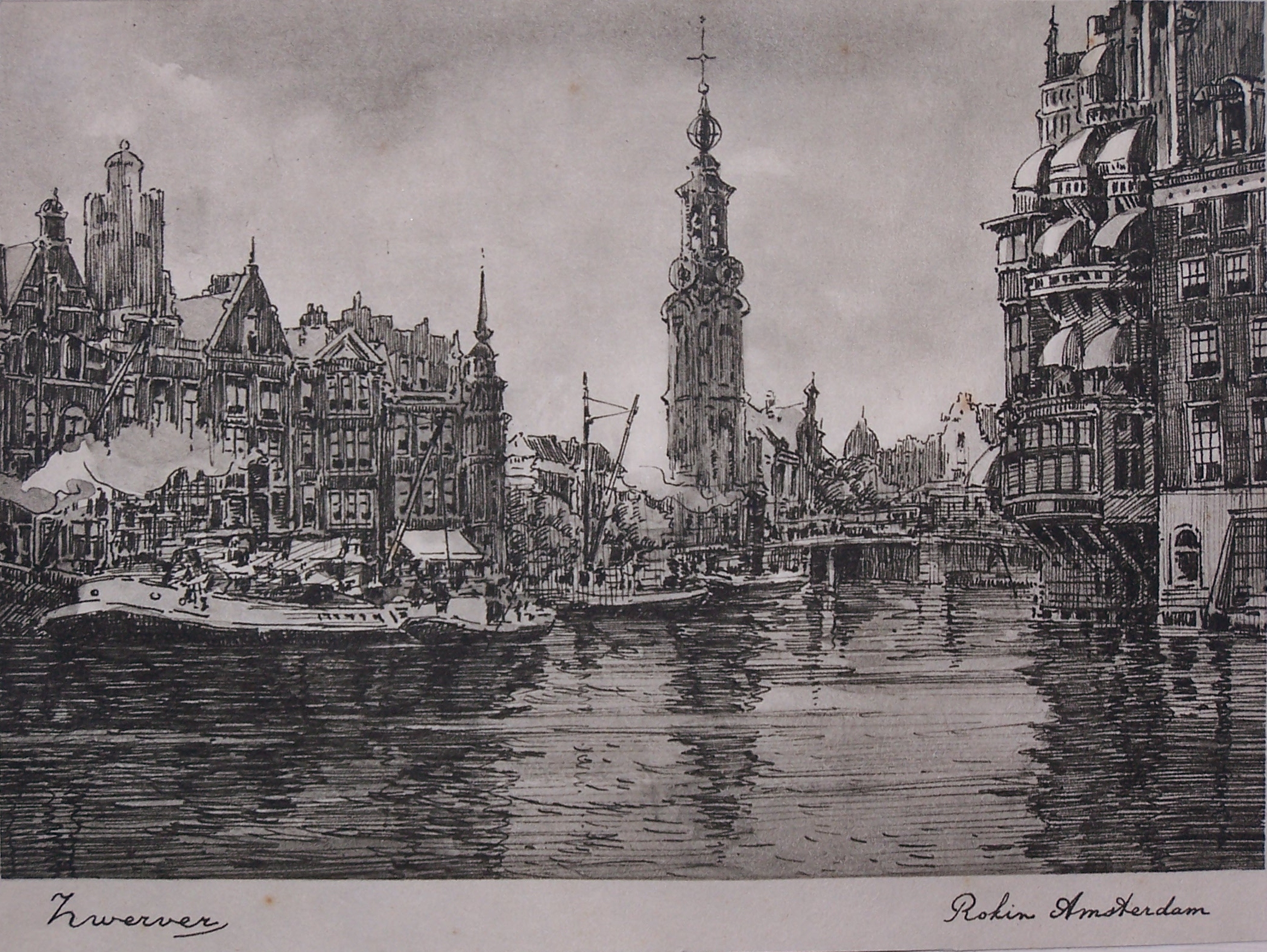
The next photogravure is not so mysterious. It is signed although I have yet to decipher it and it is titled.

Rokim, Amsterdam photogravure
signed – undated

It reads Rokim, Amsterdam.  So this is the Rokim Canal with the clock tower of the Mint (Munttoren) in the background.  I have looked at the web and have not yet decided as to when this print was done. The small pointed tower to the left of the Mint tower appears in early photographs that I’ve seen.  The rectangular shape of the bridge tells me the image is later than 1910  since images then have a bridge with curved arches.  The signature I continue to attempt to decipher.  Hopefully I will find the artist.

The quality of this image is wonderful.  A couple of small stains but not much else to detract from the beauty.

Posted in Lithographs, Modern prints | Tagged , , , , , , , , , , , , | Leave a comment

Art in Landscape

Recently, my wife and I visited Northern Ireland for a holiday.  We rented a small cottage on a farm where they stable horses, give riding lessons and teach show jumping.  The setting was I lovely.  Looking out of the French doors to the sea only a couple of miles away.  Driving the narrow and winding roads of the countryside and coastal roads, one understands the beauty of this place.  From the Giants causeway, to Torr Head, to the mighty Slemish mountain the ruggedness and antiquity of this isle breathes into ones imagination a vision of hardship and strife.  But Eire is know as a ‘green land ‘ and it is true that as one flies over this island that field after field is a varied shade of emerald, the Emerald Isle.

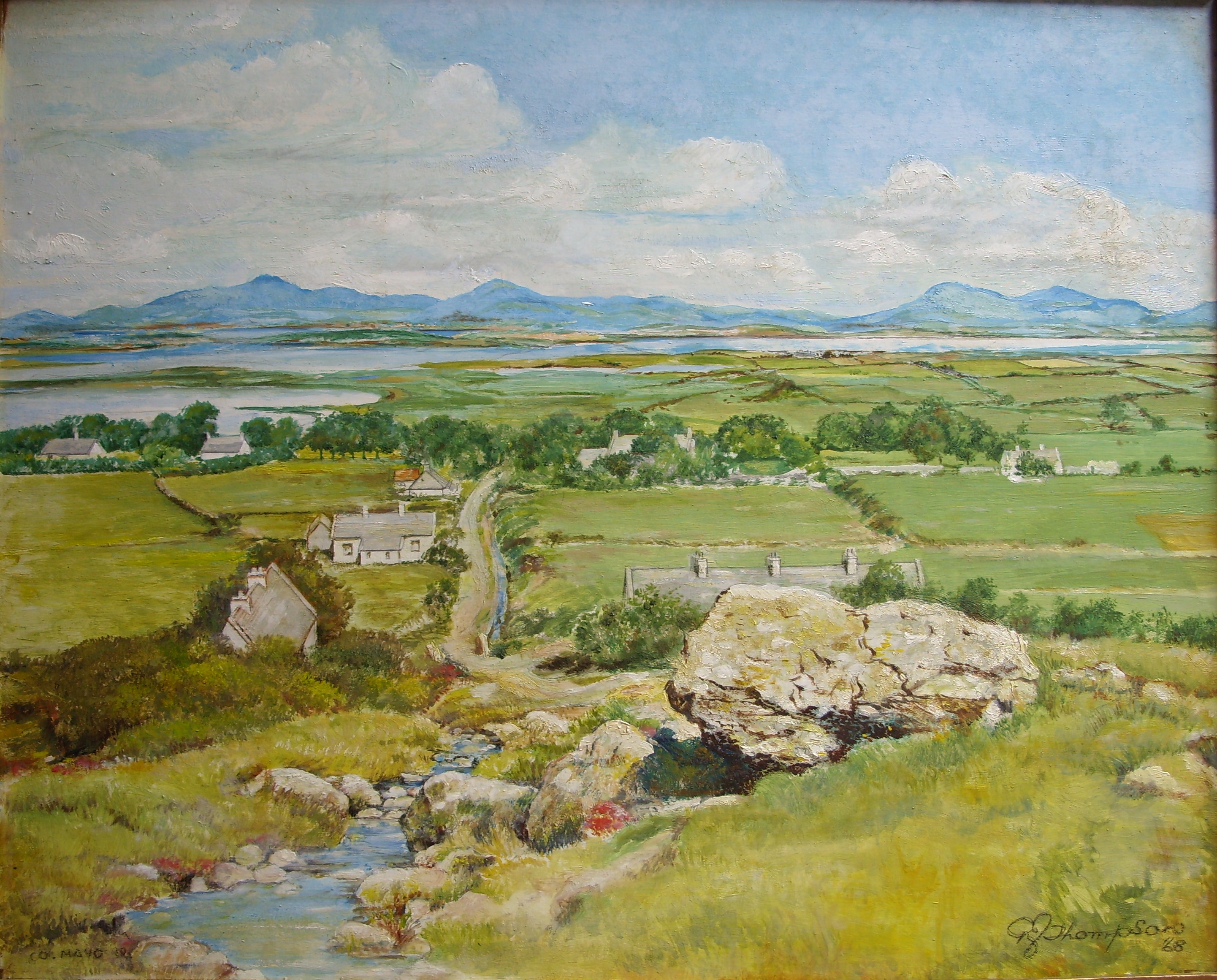
County Mayo, Ireland
oil painting by G S Thompson 1968

This green and pleasant land can be seen in this oil painting by G S Thompson. From rolling hill and gurgling stream, down to the sea on dusty road and beyond to the haze shrouded mountains, this place has been touched by God.  A serenity, a beauty, a ruggedness filled with life born of labour and strife.  This isles history tells of struggle and conflict, of victory and success, of feast and famine, of departing and returning.  It invites and entices and does not disappoint.  Come enjoy an Ulster fry, a Guiness, some soda bread,  a colcannon, a slice barmbrack followed by a Bushmills.  This is Ireland.

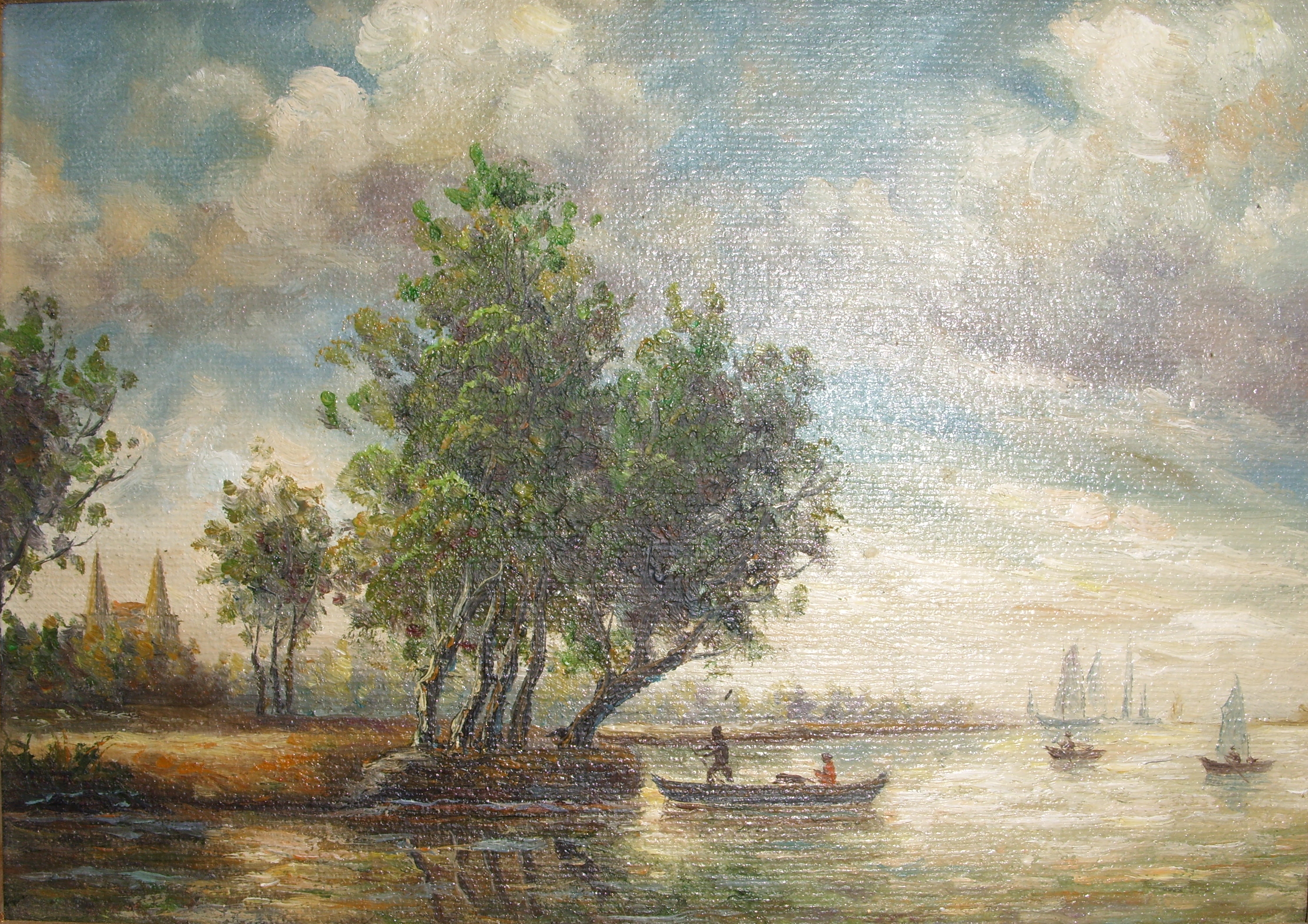
Coastal landscape
unknown artist oil painting

The above oil painting is something I thought you might just like to look at.  I know nothing about this painting for it is unsigned and undated.  It is painted on canvas which has been mounted on board. It is lovely to look at.  It is somewhat Constable-esque in its’ use of colour and the scene it portrays.  I hope you enjoy.  It differs from the first painting which measures a goodly 17″ by 21″ while the second is a meagre 5″ by 7″.  One done with what one might consider a regular size brush while the other done with a very fine brush indeed.  Enjoy.

Posted in Oil Paintings | Tagged , , , , , , , , , | Leave a comment

Art of Courtly Love

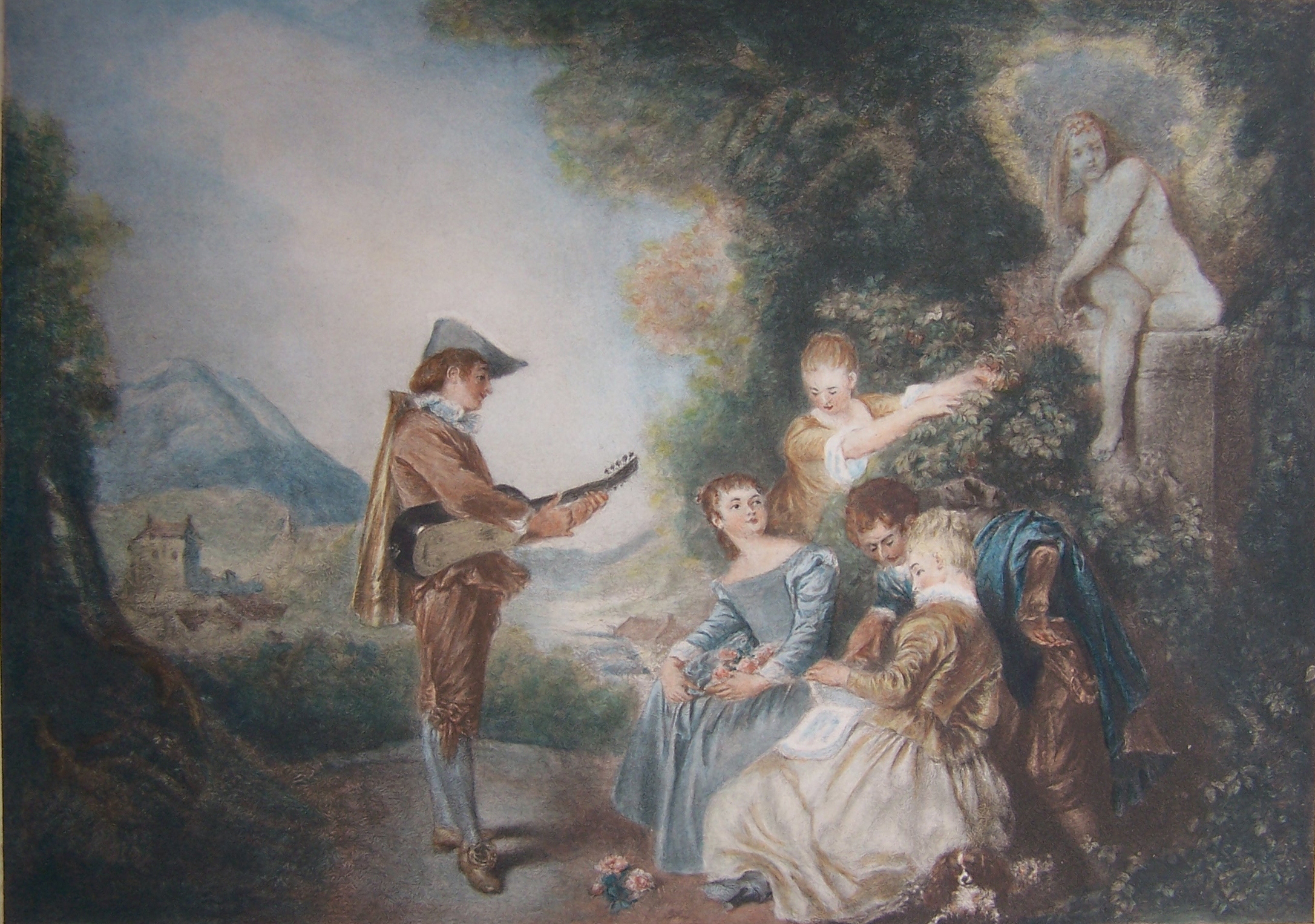
Lecon d’Amour by Jean-Antoine Watteau
hand-coloured lithograph published Franz Hanfstaengl, Munich

I purchased the previous chapters lithograph and the one on the left at the same time.  The quality of the work is what struck me first. For lithographs which are near or over 100 years old the colours are absolutely wonderful.  This lithograph was produced by Franz Hanfstaengl, Munich from an oil painting by Jean-Antoine Watteau (1684-1721).  These two lithographs have travelled many miles with the Lionel Ewart (previous chapter – Emma Hamilton) having been set in its frame by Braus Galleries of New York and this Watteau lithograph by the Beverly Picture Framing Studio in Beverly Hills, California.

Lithography is one of the oldest and finest printing techniques. As with this lithograph many were touched up or finished by the hand of very talented watercolour artists who put the finest details into them.

This scene is typical of Watteau, who loved to paint scenes which were charmingly bucolic and idyllic.  He frequently used subjects from the Italian comedic theatre and the ballet so some might say his paintings look a trifle staged.  He painted art about art, the world of art as seen through the eyes of an artist.

Watteaus paintings contain a note of sympathy, a wistfulness, a sadness at the fleeting nature or fickleness of love and other earthly delights.  Is love fickle or do we fall in and out of love too easily. Love is long-suffering, patient, kind. Love is as strong as death.  Maybe it is we who are fickle, changeable or just not prepared to offer what love demands.

His paintings are characterized by a huge palette of colors creating a dreamy and enchanted atmospheres illuminated by the use of a warm and diffuse light.  Certainly this lithograph of Lecon d’Amour is proof of his talent.  It is a sadness that his talent was not long for this world for he passed at the tender age of 37. The original Lecon d’Amour was painted in 1716.

Posted in Lithographs | Tagged , , , , , | Leave a comment

Art as Purveyor of Beauty

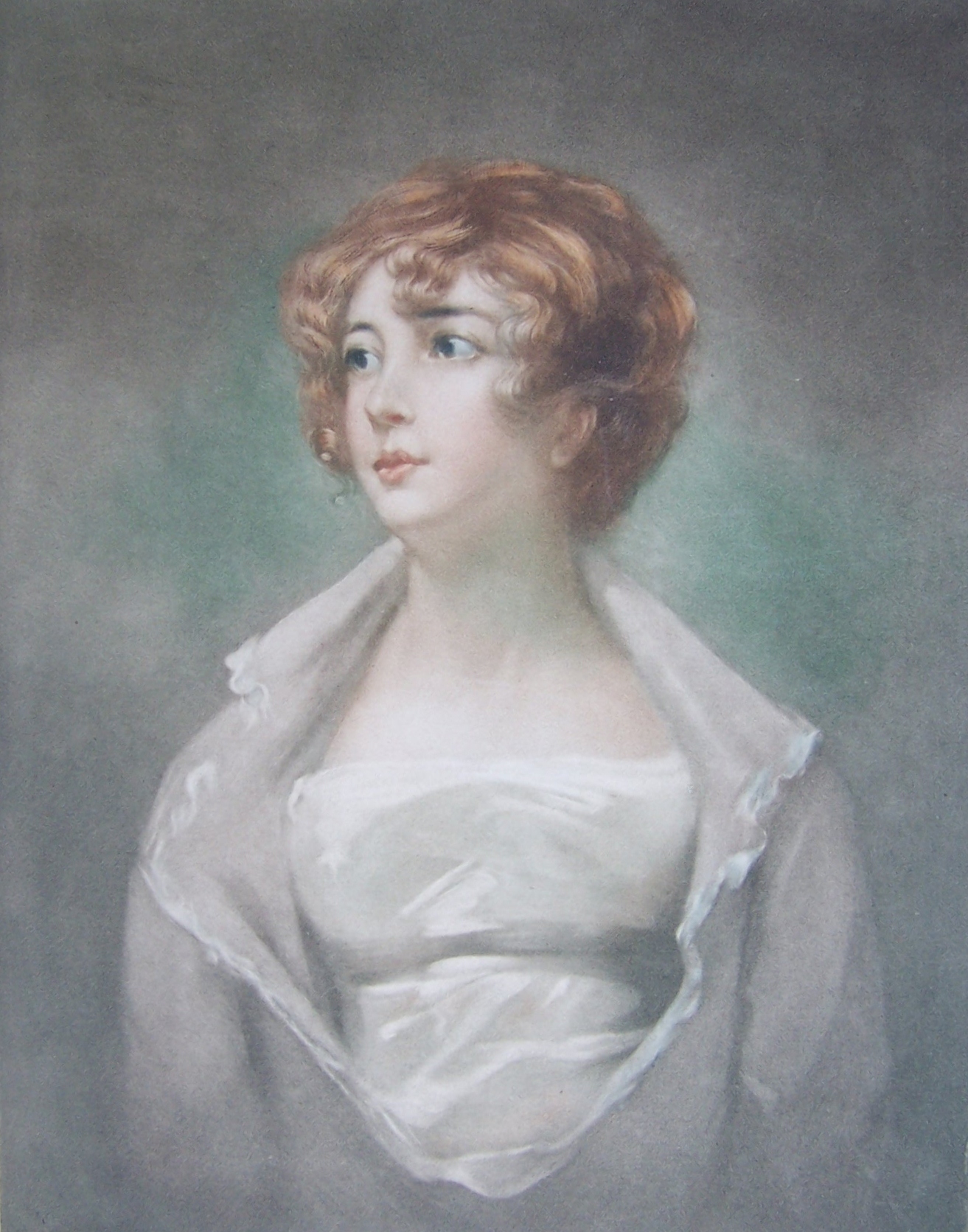
Lady Emma Hamilton
Lionel Ewart lithograph @ 1916

The lovely young woman on the left is (I believe) Emma Hamilton, who began life as Amy Lyon.  She was the daughter of a blacksmith but she had big dreams.  Dreams of wealth and prosperity.  Emma moved to London, centre of wealth in England and upward mobility.  She became a ladies maid to survive, then mistress to wealthy gentlemen.  One of these men introduced her to the painter George Romney. Romney became obsessed with Emma.  He painted Emma more than 50 times, portraying her as heroic historical figures like Joan d’Arc or Cassandra, Princess of Troy.  Her beauty was captivating.  Her love of life overwhelmed men.  They succumbed to her femininely whiles.  She eventually married Sir William Hamilton, her elder by some 34 years. Through her husband (He was ambassador to Naples.) she met Horatio Nelson and began a torrid affair with him.  Though they wanted to marry, divorce was not an acceptable route to take for it would have brought shame on Sir William as well as it might even effect Horatio’s naval career.  They waited, they lived together, and eventually Sir William died.  Now Nelson could divorce his wife and marry Emma, but Horatio returned to the sea to battle the Franco-Spanish fleet.  Nelson’s fleet won the seas but Horatio was fatally wounded and died before seeing Emma again.  Emma’s life went into a tail-spin and she died in poverty and sickness in France after fleeing her creditors.  From poverty to riches and back again.

The lithographic portrait of Lady Hamilton was done by Lionel Ewart. It is embossed ‘Limited Edition Proof’.  In very fine print across the top it reads ‘Copyright Published Feb 1916 by Landeker & Brown Ltd. London E. C.   A beautiful portrait for a woman of mesmerizing beauty.

Could her face launch a thousand ships as is said of Helen of Troy.  Surely Horatio Nelson thought so, but his dying request that his beloved be cared for by the state went unheeded.

I find the subtle colours used, the shades of green, the brown of her hair, the innocence portrayed, the vulnerability suggested, all lead one to say ‘yes’ Emma Hamilton was a beautiful woman. But I love this striking picture for its’ superb artistry. The technique is sublime. The eye of the artist true. And the finished product – well what more need I say.

Posted in Lithographs | Tagged , , , | 1 Comment

Art a Record of Change

Many of the pieces of art which I own are from the last century or even earlier. They inspire in me a desire to visit the places which they portray but I also realise that those places will have changed. That change is extreme at times and sites may hardly be recognisable.  My research into the history and what these places now look like does not lessen my desire to visit them.

Notre-Dame Cathedral, St. Lo
unreadable signature – dated 1852 – watercolour

This lovely pulpit is, I believe, the external pulpit of Notre-dame Cathedral, St. Lo.  Few cathedrals have an external pulpit.  The painting dated 1852 certainly shows a time of prosperity and peace.  The pulpit was saved from demolition by Victor Hugo in 1863.

St. Lo is named after Saint Laud, Bishop of Coutances.  Its history is complicated by conflict and destruction.  From the Vikings, to the English (twice), to the Huguenots and finally the Germans in WWII St. Lo has seen its’ share of war and devastation.

St. Lo was destroyed in the ‘Battle of Normandy’ and was named by Samuel Beckett as ‘The Capital of the Ruins’.  Estimates say that 95% of St. Lo was destroyed.  A devastation extreme.  Notre Dame church was among the few standing buildings after the bombings by the Allies in June and July 1944.  Its roof and facade were destroyed, as well as one of its two towers and the top of the second.  The church was partially restored after the war: the facade was rebuilt as a plain wall. A place in which history and modernity are juxtaposed with a view to remembering  the past while leaning toward future.

The next watercolour is once again not quite what you might expect to see if you went to the place portrayed. We see here Giudecca, Venice.  Giudeccas history is one of palaces and gardens.  Industry came to the island in the twentieth century with shipyards and factories and even a film studio.  It is now exclusively a residential area.  It is known for its docks and its churches.

Giudecca, Venice
initialled and dated 1895

Industry has not yet come to this place in 1895. It is a place of gondolas and calm seas. A place where one travels by water not land.  Where ones livelihood is connected to and centred on the water.

Whether this is a sunrise or sunset, I cannot tell but beauty lies here. A calm restfulness infuses this picture. I choose to believe this a sunset but you can decide for yourself .

It shows in the depiction of the sea a coming of the impressionists style.

With a few deft strokes a gondolier is created by this artist but for me its main beauty lies in the light.  How all is drawn toward the central brightness.  It pulls you in, taking you past the gondolas, past the harbour buildings to sail into, no, to float into the light.  Creating in you the desire to see what is in the light, what is beyond. the light.

Posted in Watercolour paintings | Tagged , , , , , , , | Leave a comment

Art of Advertising

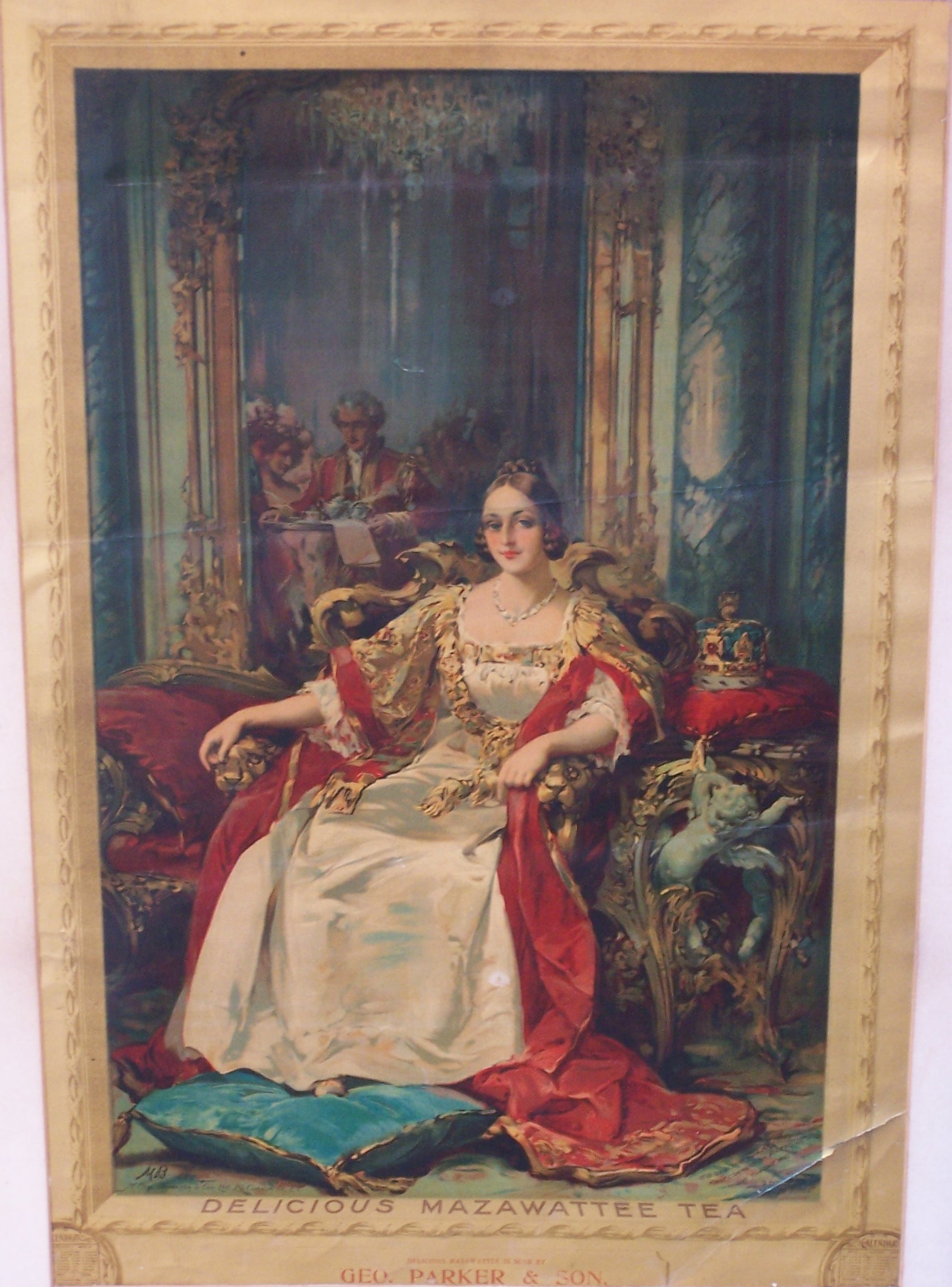
I did something today, which I do not often do.  As I was acquiring items for my work I stopped and did a quick shop for art works.  And I purchased something which, for me, is odd.  I have no others in my collection but may possibly add in the future.  I purchased a poster.  Big let down right.  Well perhaps not, for this poster is an antique.  It is an advert for Mazawattee Tea.  It portrays the newly crowned Queen Victoria (1819-1901) sitting on her throne and in the mirror behind her you see the image of a butler bringing to her her cup of tea.

Mazawattee Tea poster
McCaw, stevenson & Orr

In the bottom right corner of the poster it reads ‘ It is said that her majesty’s first command on ascending the throne was “Bring me a cup of Tea and The Times.”  A little bit cheeky but what a way to advertise your product.  Using the Queen – really!  The monarchs of England have at times allowed their likeness to be used in advertising but this is very in your face.  A royal seal of approval or recognition for any company would increase their overall worth tremendously.  I wonder if the Queen was paid for the sitting or did she just get tea.  Lots and lots of tea.

The Mazawattee Tea Company, founded by the Densham family, was one of the most important and most publicised tea firms in England during the late 19th century.  In the 18th century, tea had become an important drink in Britain.  The Densham family were leaders of the tea industry expansion.  They moved to London from Plymouth and managed to amass a fortune in quite a short time.  The poster which the company used for many a year consisted of a grandmother sitting with her grand-daughter having a cup of tea.  The slogan ‘Delicious Mazawattee Tea’ prominently placed for all to read.  At least the slogan is placed below the Queen in my poster and if you didn’t know it was there this poster would just be a lovely portrait of the Queen.

A few words to finish by poet William Cowper  to give reminder of perhaps the more leisurely days of tea drinking in the 18th century:

Now stir the fire, and close the shutters fast,
Let fall the curtains, wheel the sofa round,
And, while the bubbling and loud-hissing urn
Throws up a steamy column, and the cups
That cheer but not inebriate, wait on each,
So let us welcome peaceful ev’ning in.

Posted in Modern prints | Tagged , , , , , , , | 3 Comments

Art of J F Millet

I

Barbizon – Atelier J F Millet
artist ‘Le Gail’ – coloured etching

Jean-Francois Millet (October 4, 1814 – January 20, 1875) was a French painter and one of the founders of the Barbizon School in rural France. He painted mostly scenes of peasant farmers and country life. He was part of the “naturalism” movement , but could also as be considered a “realist”. The Barbizon School was a group of landscape artists working in the area of the French town of Barbizon, south of Paris. This group abandoned tradition and theory in an attempt at a truer representation of life in the countryside. Although coming from the same school these artists were considered to be individuals and approached their art in their own personal style. They had a great influence upon the impressionists which came after them.

Both of the coloured prints are from the ‘Atelier J F Millet’, titled ‘Barbizon’ and are signed ‘Le Garf’ – a known non de plume of Lucien Vader (1902-1978).  I would guess they would come from the mid 1900’s. They were set in their frames by the well known art dealers ‘Frost & Reed’ in 1964. Atelier means ‘workshop’. At an atelier a number of students, apprentices, or assistants worked under the tutelage of a master producing works that would go out under the masters name. I believe that the two story building on the left of the first picture was the home of J F Millet.

Barbizon – Atelier J F Millet – Titled ‘L’escalier’ (The Staircase)
artist ‘Le Gail’ – coloured etching

I have one other J F Millet in my collection. The last being a print of ‘A Shepherdess Knitting’. I do not know when it was printed but permission to do so originally was granted by a Mr F Keppel (d. 1912). Mr Keppel was an avid supporter of etchers and their work. His life-long love of art brought him in contact with many of the great artists of his day and he probably knew all the successful lithographers and etchers working. You can see from these prints that he loved the reality of his surroundings. He captured the little things that surrounded him with loving detail.

‘A Shepherdess Knitting’ by J F Millet
reads – by permission of Mr F Keppel

Posted in Etching, Lithographs | Tagged , , , , , , , , , , , , | 11 Comments

Art of Print

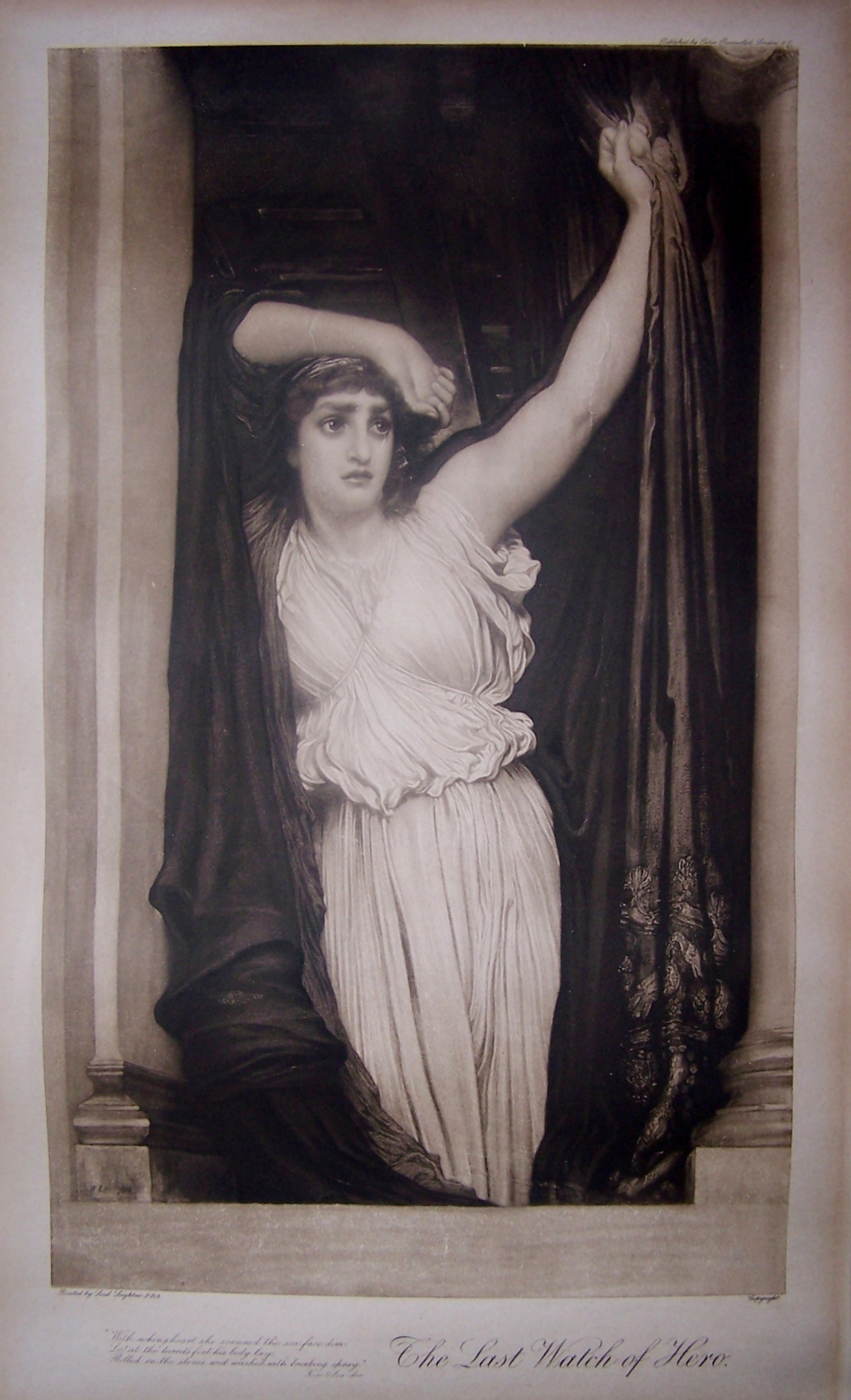
The Last Watch of Hero
printed by Lord Leighton


This week I have added two large antique prints to my collection. The first is titled ‘The Last Watch of Hero’. The original was painted by Lord Leighton(1830-1896) around 1887. Lord Leighton is renowned for his drapery or the way material hangs both on and off the human figure. The oil painting now resides in the Manchester Corporation Gallery. I’m not sure when my print was made. It is of one panel only, the oil painting is made up of two compartments; in the upper, and larger, Hero, clad in pink drapery, is seen drawing aside a curtain and gazing out over the sea. Below, in the smaller panel, is the body of dead Leander, on a rock washed by the waves. A quotation from Sir Edwin Arnold’s translation of Musæus was attached to its title:

“With aching heart she scanned the sea-face dim.

Lo! at the turret’s foot his body lay,

Rolled on the stones and washed with breaking spray.”
                                Hero & Leander
Hero and Leander lived in rival cities separated by a stretch of sea. The lovers conspired to meet every night. Braving the current, Leander swam across the water guided by a lamp which Hero lit. Tragedy eventually struck when winter winds blew out the lamp. Without his guide, Leander floundered and drowned. In the etching Hero’s draped robes convey her torment. We see her as she begins to fear that Leander has been lost to the sea. And when that has proven to be the case, Hero throws herself onto the same rocks and the lovers are joined in death.
The image size including title and poem measures 12″ by 22″ while sheet size is 19″ by 27″ and the print is set in a 23″ by 31″ frame.

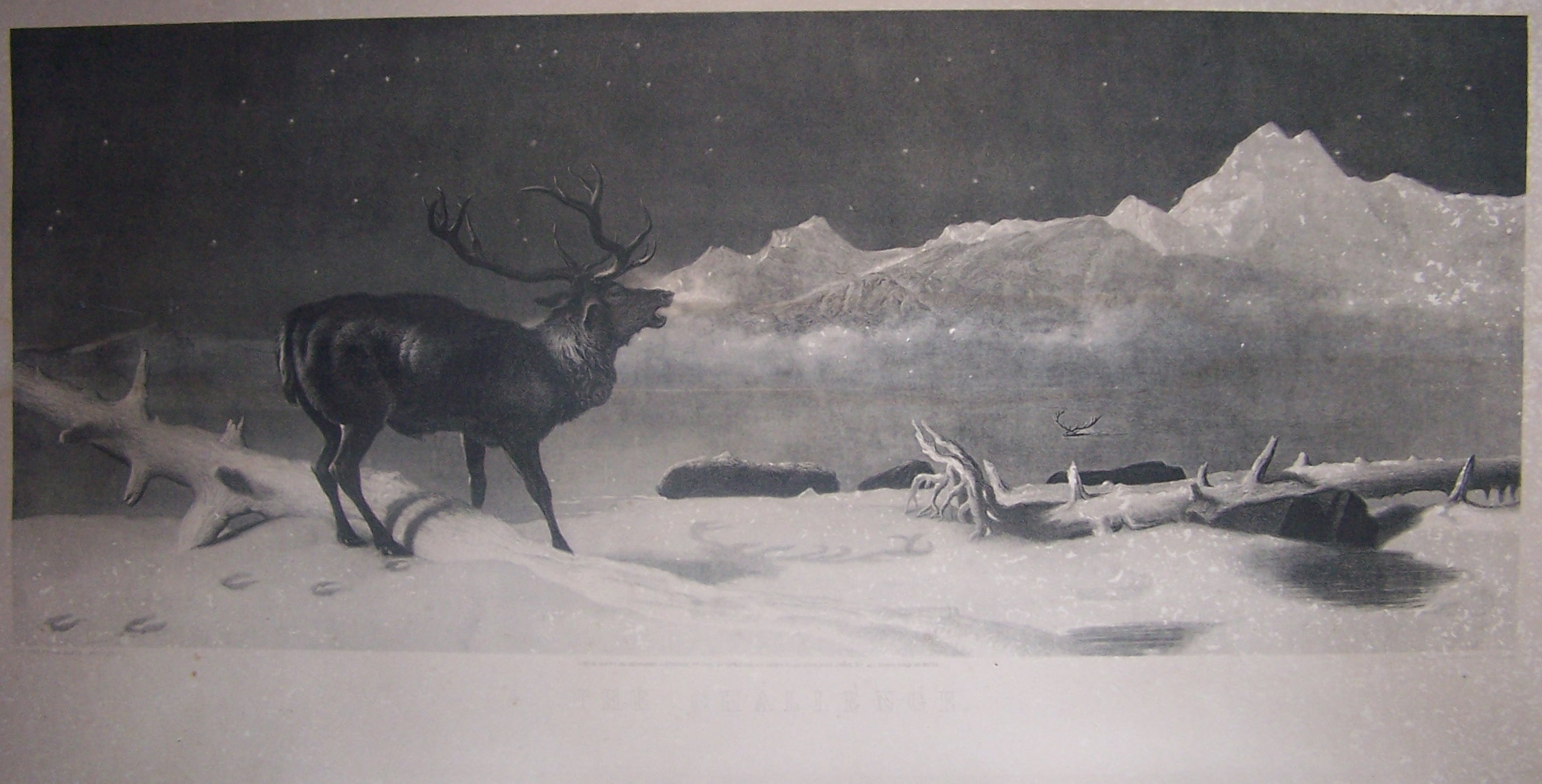
The Challenge
painted by E Landseer & engraved by C Mottram 1896

Here we have ‘The Challenge’ painted by Edwin Landseer and engraved by Charles Mottram. This print was published by The National Art Society on September 5th, 1896. The original painting was done in 1844. In the 1840’s, Edwin Landseer created a series of stag paintings based on his trips to the Highlands in Scotland. These paintings depict the animals fighting, challenging each other, reaching safety across a lake, being hunted or shot dead; their bodies are painted with superb accuracy as well as the landscapes which surrounds them … they bring to animal painting the epic and heroic qualities of high art such as the ‘The Last Watch of Hero’. The image size of this print is 12″ by 27 1/2″ while the sheet size is 20″ by 38″ and in it’s frame it is 23″ by 40″.

Posted in Etching | Tagged , , , , , | 2 Comments