Lontar

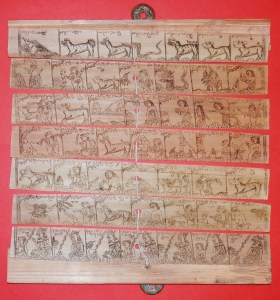
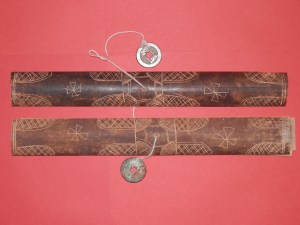
Unless you have been to Bali or Indonesia one most likely has not come across a #lontar.  A lontar is made of palm leaves which have been dried and smoked.  Due to dampness, insect activity, mould, and fragility lontars needed to be copied and replaced quite regularly.

Lontar Case with ancient Chinese coins

Lontar Case with ancient Chinese coins

Most lontars come with an outer case which is made of ornamentally carved bamboo.  A string runs through a central hole in the casing and the leaves.  The leaves after being prepared are etched with text and images.  The grooves are then filled with ink to make the text and images visible.  In the case of my lontar a coin is tied at each end of the string.  The coins are Sinkiang Qing dynasty Redcash Dao Guang Tong Bao Aksu which were minted between 1821 and 1850.

Lontar - ritual book from Lombok, Indonesia

Lontar – ritual book from Lombok, Indonesia

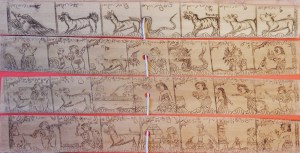
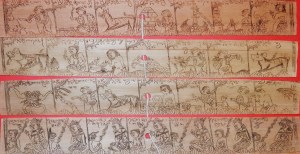
Firstly, I apologise if I have mistakenly turned the leaves so that the story is actually backwards.  The lontar which is pictured to the right is a #WektuTelu ritual book and originates with the #Sasak people of Lombok, Indonesia.  The Wektu Telu religion is a blending of Islam, Hinduism, and Buddhism as well as other ancient beliefs and traditions.  Lontar contained writings from religious rituals and law, astronomy and astrology, homoeopathy and healing, stories and epics, history and genealogy, performing arts, and illustrated stories.  There remain a few Hindus in Bali who can still read the old scripts found on lontars.  Although lontars have been copied for many centuries some are now unreadable due to the loss of the ability to read the language.  In the case with the Wektu Telu lontar pictured, no translation of the script or interpretation of the illustrations has been found.

Lontar 'Wektu Telu' ritual book from Lombok, Indonesia

Lontar ‘Wektu Telu’ ritual book from Lombok, Indonesia

Lontar 'Wektu Telu' ritual book from Lombok, Indonesia

Lontar ‘Wektu Telu’ ritual book from Lombok, Indonesia

Only in Bali will you find those who still practice the old skill of lontar writing – some for preservation sake and others for the tourism trade.  A lontar can take over a month to copy – not counting the time it takes to prepare the leaves.

Posted in Drawings and Sketches, Printing | Tagged , , , , , , | Leave a comment

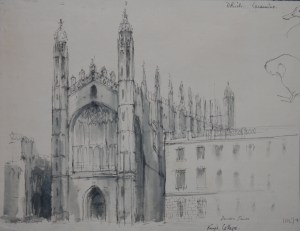
King’s College, Cambridge

Just down the road is one of the most prestigious colleges in the world.  King’s College, Cambridge has for centuries had a reputation for excellence.  It is, also, due to it’s architecture and chapel, a favourite with artists of all mediums.  Three ink and wash drawings of King’s are this chapters topic with a small twist too.

King's College Gatehouse by Night ink and wash drawing

King’s College Gatehouse by Night ink and wash drawing

An atmospheric drawing of the Gatehouse of #King’sCollege,Cambridge.  The signature of thee artist appears to be Jack ____ Kennedy but I’m not sure about this.  Done on a modern day sketchbook page the artist has achieved a stillness of place which could only be achieved in the wee hours of the morn before the tourists and students rise to their learning.  King’s Parade as one rarely gets to enjoy.

King's College pen and wash drawing by Deirdre James

King’s College pen and wash drawing by Deirdre James

To a view of #King’sCollegeChapel from the back.  This line and wash by Deirdre James is nicely accurate architecturally and yet loose enough to allow the wash to augment it’s depiction.  I am not sure of the age of this work – I will return to this idea later and I don’t know why the ducks appear but this was a work sheet to the artist.

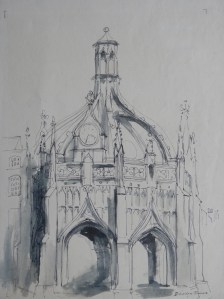
Chichester Market Cross pen and wash drawing by Deirdre James

Chichester Market Cross pen and wash drawing by Deirdre James

The second pen and wash by #DeirdreJames is one that I have yet to place.  I feel I know this place but I have yet to come up with the answer.  It is quite similar to the domed top of the Gatehouse of King’s College but it is different.  The present gatehouse was finished in 1828 from a design by William Wilkens.

I return now to the age of the two draws signed by Deirdre James.  The only artist by that name I have found worked for Foley Fine Bone China in Fenton.  I believe she worked for the company around 1950.

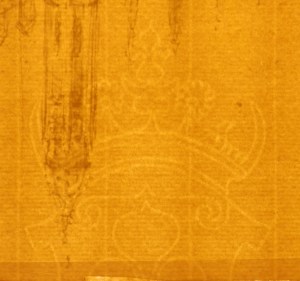
Strasbourg Lily watermark (partial)

Strasbourg Lily watermark (partial) – possibly C & I Honig @ 1770

The twist here is in the watermark found on the paper of the chapel drawing.  The paper itself is a laid paper.  We find we have the upper half of the watermark called #StrasburgLily.  The mark is a fleur-de-lis in a shield beneath a crown.  It was used by different makers in one form or another across Europe.  The mark appears on paper from the 17th to the 19th centuries.  Usually at the bottom of the watermark there would appear the initials of the individual paper maker.  Artists from Rembrandt to James Whistler have used Strasburg Lily watermarked paper. So if these are modern drawings – where did the artist come up with the paper?  Old or modern?  Mystery indeed.

Posted in Drawings and Sketches | Tagged , , , , , , , | Leave a comment

Byron Harmon Photographer

I came across two pieces of Canadiana this past week which hve travelled 7000 km (4400 mi), around 80 years, and is in part about a man with an almost impossible goal.  A man who had a huge effect on photography in western Canada.  His name #ByronHarmon.

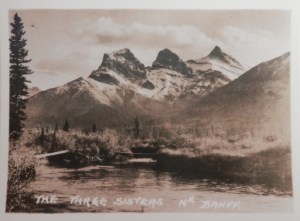
Three Sisters photograph by Byron Harmon

Three Sisters photograph by Byron Harmon

Byron Harmon’s desire was to photograph all the peaks in the Rockies.  A man with an adventurous spirit who in working on his dream was a charter member of the Alpine Club of Canada.  The ACC explored the remote regions of the Rockies and Selkirks.  They surveyed, performed glacial studies, and have a number of first ascents to their name.  A perfect situation for Harmon and his cameras.

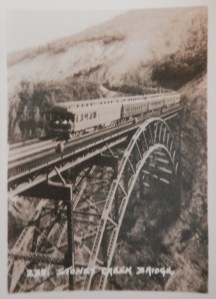
Stoney Creek Bridge photograph by Byron Harmon

Stoney Creek Bridge photograph by Byron Harmon

They travelled by foot, packtrain, dogteam, snowshoe carrying teepees or tents.  A man who captured not only a time and place but a spirit as well.

I came across Set I of ‘Selected Real Photographs’ – Canadian Pacific Rockies – 20 for 50c.  Small 3 3/4 x 2 3/4 – black and white images in their original packaging .  Published 1925-30?

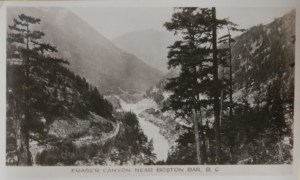
Fraser Canyon sceneograph by The Gowah Sutton Company

Fraser Canyon sceneograph by The Gowah Sutton Company

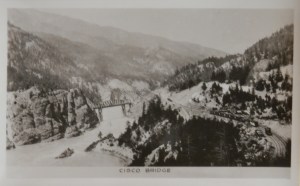
The second item comes from #TheGowenSuttonCo.Ltd. A package of 10 #SceneOgraph real photos of Fraser Canyon – 10 for 25c.  Photos uncredited but once again from around 1935-ish.  The Gowen Sutton Co. was established by Vancouver postcard photographer Frank Gowan (1878-1946).

Cisco Bridge sceneograph by Gowen Sutton Co.

Cisco Bridge sceneograph by Gowen Sutton Co.


Posted in Photographs | Tagged , , , , , , , | Leave a comment

Edith E. Strutton

I am always pleased when I find pieces which have been created by female artists for I know that in years past those artists might possibly not have received the deserved credit or accolades for their work.  So to slightly tip the scale, this weeks chapter is about #EdithEmmaStrutton.

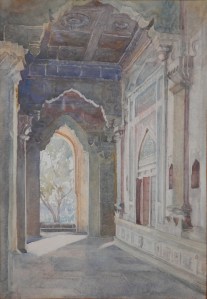
Ibrahim Rauza, Bijapur watercolour by Edith E. Strutton @ 1913

Ibrahim Rauza, Bijapur
watercolour by Edith E. Strutton @ 1913

Born #EdithEmmaMunnings in Christchurch, New Zealand, 1867, she studied at the Canterbury School of Art.  After graduating she taught at the school and was a successful teacher as well as artist.  In 1900 she married the Reverend H. Strutton and with him moved to India as missionaries.  They lived and worked in Baramati, Sholapur (Criminal Tribes Settlement), and Lonavala where Edith died  in April of 1939.

The image on the left is of the #IbrahimRauza.  It was erected in 1627  as a mausoleum and memorial for queen Taj Sultana wife of king Ibrahim II but the king also lies there.  It is proposed that this rauza was the inspiration for the wonderful Taj Mahal.  Arches, delicate carvings, geometric and calligraphic designs abound.

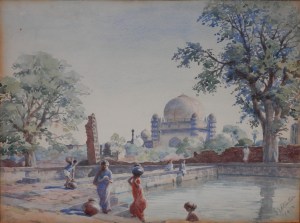
Gol Gumbaz, Bijapur watercolour by Edith E Strutton @ 1913

Gol Gumbaz, Bijapur watercolour by Edith E Strutton @ 1913

The #GolGumbaz is also in Bijapur and was built as the mausoleum for Mohammed Adil Shah, Sultan of Bijapur.  It was built to dwarf the Ibrahim Rauza which was erected by his father.  It was completed in 1656 and is of impressively simple design.  In the centre of the floor beneath the dome lies a cenotaph slab which marks the grave below it.  This is the only instance of this practice to be found in the architecture of the Adhil Shahi dynasty.  Like other great domed buildings, the Gol Gumbaz has a “whispering gallery”.  The pantheon in Rome has an area covered without supports of 15, 833 sq ft while the Gol Gumbaz has an area 18, 109 sq ft.  Simple – yes.  Impressive – very.

Two beautiful paintings by Edith Strutton which display the great talent which she was blessed with.

Posted in Watercolour paintings | Tagged , , , , , , | 1 Comment

Claus Hoie

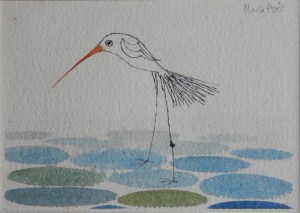
#ClausHoie (1911-2007) was born in Stavanger, Norway and emigrated to the United States with his family when he was 12 years old.  Coming from a family of seafarers, the sea was also in Claus’s blood and he went to sea for two years with the Merchant Marine.  This love and respect of the sea influenced and inspired an enduring theme in his work: the picturesque adventure of seafaring.

Wading Bird ink and watercolour by Claus Hoie @ 1980

Wading Bird
ink and watercolour by Claus Hoie @ 1980

Settling in Brooklyn, New York, Claus spent four years in the army after which he continued his studies in Paris.  His imaginative and intricate renderings of plants, insects, fish, birds, still-life , and landscape draw the viewer in with charm and a welcoming warmth.  Hoie is possibly best known for his depiction of the whaling world in his illustrated book ‘The Log of the Whaler Helena’ in 1994.  Both words and images are Hoie’s creation – filled with the haunted tracings of seamen’s lives, and of the whales they hunted. Here word and image combine to show us much more.  Light and shadow, sibilance, visage’s gaunt and dogged, the utter strength and power of it all strive together.  In the end, ‘The Log of the Whaler Helena’ is a work of forthright truth and muscular beauty.

Images powerful and awesome, charming and familiar were his milieu.  Art displaying life, the love of it and the adventures in it – both simple and intense.

Posted in Drawings and Sketches, Watercolour paintings | Tagged , , | Leave a comment

John Ewbank and Edward Badham

The artists #JohnWilsonEwbank (1799-1847) and #EdwardLeslieBadham (1873-1944) are this weeks artists.  I acquired graphite drawings created by both of these artists, recently.

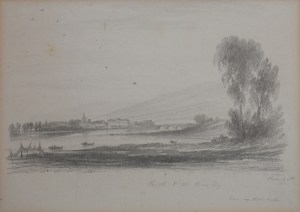
Perth and the River Tay pencil sketch by John Wilson Ewbank @ 1825

Perth and the River Tay
pencil sketch by John Wilson Ewbank @ 1825

This serene view by John Wilson Ewbank is of the city of Perth and the River Tay in 1825.  Ewbank was the son of an poor innkeeper.  He was adopted by a wealthy uncle who lived in Wycliffe on the banks of the River Tees.  It was intended that John enter the priesthood and was educated to that end but he rebelled and ran away.  He apprenticed with Thomas Coulson as an ornamental painter in Newcastle and then Edinburgh.  He also studied under Alexander Nasmyth.  He was a successful painter and teacher.  His sketches from nature were admired greatly as well as were his coastal and marine scenes.  Late in his life he altered his style and painted great events coming from history such as ‘The Visit of George IV to Edinburgh’ and ‘Hannibal Crossing the Alps’.

Edward Leslie Badham studied at the Clapham School of Art and The Slade. He lived and worked in London for a number of years before moving down to St. Leonards on Sea and eventually to Hastings.

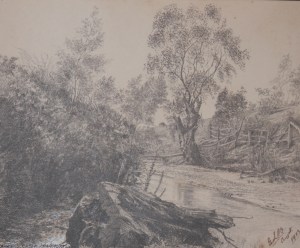
Barkers Creek, Harcourt pencil sketch by Edward Leslie Badham @ 1903

Barkers Creek, Harcourt pencil sketch by Edward Leslie Badham @ 1903

Badham exhibited often and was well respected.  This picturesque scene drawn in 1903 and done only in graphite displays superb finesse and an eye for accuracy.  Drawn in the month of August, one can feel the turn of the year veering into fall.  I love the ancient tree on the far bank – broken yet still striving upward – and the old rail fence.

Two fine drawings from an art that is undervalued these days – the art of the pencil.

Posted in Drawings and Sketches | Tagged , , , , , | Leave a comment

Wilhelm Hass Mapmaker

#WilhelmHass (1698-1764) was a map-maker from Nuremberg.  He furthered the work of #AugustGottliebPreuschen (1734-1803) who developed the printing method called typometry.  #Typometry is a relief printing method using movable type.  The technique was inflexible and the maps looked quite schematic in style.  Everything—text, borders, and topographic features—are set by hand using a variety of text fonts as well as a specially designed cartographic font.  Due to these limitations the technique did not catch on.

 Until the later 18th century, maps were printed in one of two ways: either from a relief block (typically a woodcut where all non-printing areas cut away from the block’s top surface); or from an intaglio plate (typically an engraving, with the map’s lines cut into the surface of a copper plate).
Rempublicam Basileensem typometric map by Wilhelm Haas @ 1776

Rempublicam Basileensem typometric map by Wilhelm Haas @ 1776

In the early 1770s, August Gottlieb Preuschen of Karlsruhe, Germany, invented an alternative to the printing of maps : a 21-character cartographic type font. Preuschen’s idea was realized through the technical skill of Wilhelm Haas, a typefounder in Basel, Switzerland, who perfected and cast the cartographic font and, in 1776, published the first map composed entirely from movable types. Over the next two decades, Haas continued to refine and expand his cartographic font until it contained at least 139 different characters, or “sorts.” These were special symbols, not letters, including 24 designed for depicting streams and rivers, 17 for borders, 14 for roads, 31 for charting military movements, 15 for human habitations, 6 for mountains and forests, and 32 for coastlines. All told, Haas employed his proprietary font to publish approximately two dozen typographic maps.

In setting these maps, Haas’s compositors worked from manuscript maps drawn on gridded paper. By breaking the complex cartographic image into small units, the compositors were better able to translate the image into small blocks of type metal. In doing so they faced two principal problems. First, the twists and turns of rivers and roads could be approximated but not rendered exactly, as could be done through engraving. Second, great care was needed to “lock up” these disparate assemblages of movable types so that they would not shift during printing.
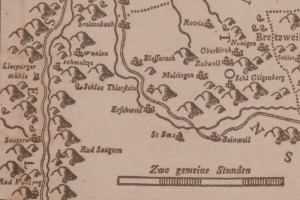
Rempublicam Basileensem typometric map by Wilhelm Haas @ 1776

Rempublicam Basileensem typometric map by Wilhelm Haas @ 1776

Type fonts are designed so that each sort has the same height, or “body size.” As long as each horizontal row of movable type contains sorts of the same height, a page consisting of several thousand small rectangles of metal type will “lock up” easily. Because Haas’s cartographic font contained sorts with a range of body sizes, which could not be arranged into uniform rows, it was necessary to painstakingly add filler material to the irregular gaps between types. In essence, the process was more like assembling a mosaic than setting type.

Haas’s cartographic font could claim several advantages over copperplate engraving: maps could be prepared more quickly, revision was easier, and unlimited impressions could be taken. But decided disadvantages remained for the prospective map publisher: only a limited level of accuracy could be achieved, and a large initial investment would be necessary to purchase the requisite types. Soon, however, the invention of lithography (and later, wax engraving) gave cartographers a far easier method for reproducing maps accurately, and Haas’s font was never adopted by other map publishers.
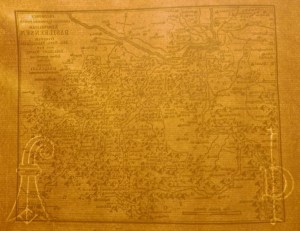
Rempublicam Basileensem typometric map by Wilhelm Hass @ 1776

Rempublicam Basileensem typometric map by Wilhelm Hass @ 1776

The map that I acquired has two other marks which should be mentioned.  A close inspection of the paper reveals that it is a ‘laid’ paper upon which there are two watermarks.  These marks are created by weaving or sewing a wire into the paper mould in the appropriate shape.  Watermarks are still used today to identify paper-makers.  On the left we see a #Bishop’sCrozier – the watermark for the Swiss canton paper-makers of Basel (Basle).  On the right is the watermark of the #Gallizianis family of paper-makers from Basel.  A fine map with an interesting heritage and rare if my research is correct.
 

Posted in Printing | Tagged , , , , , , | Leave a comment

La Madonna Della Sedia

#LaMadonnaDellaSedia (La Madonna Della Seggiola) was painted by Italian renaissance painter Raphael in 1514.  It is housed in the Palazzo Pitti collection in Florence. It depicts Mary embracing the child Christ, while a young John the Baptist watches on adoringly.

La Madonna della Sedia etcher unknown after Raphael

La Madonna della Sedia etcher unknown after Raphael

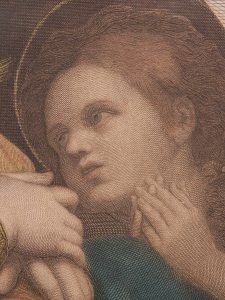
I acquired this drypoint etching recently.  It has been trimmed slightly so no credit is given to the artist who created this artwork.  It is an amazing piece of work.  Containing drypoint, line engraving , cross hatching, and stipple work this artist has produced a work of astounding beauty. This etching has also been coloured by hand.  It emulates the warm colours that Raphael used in the original.

The sheet size is 365mm (14 3/8″) x 437mm (17 1/4″).  The circular print is 317mm (12 1/2″).  So, this is no small endeavour by the artist.

La Madonna Della Sedia etcher unknown

La Madonna Della Sedia etcher unknown

So that you might appreciate the wonderful technique of this artist, I include a couple of close-ups of segments of the work.  I love the superb fine line engraving giving way to stipple work which contrasts with the soft richness of the drypoint etching.  There is such life in the faces and Mary’s eyes appear to be looking right at you.  The adoration in the face of the child John as he looks upon the Christ child and his mother is palpable.  If you increase the size of the pictures you can appreciate the finesse involved in this work.  I hope you enjoy the supreme artistry involved in this work as much as I do.

La Madonna Della Sedia etcher unknown

La Madonna Della Sedia etcher unknown

Posted in Etching | Tagged , , , , , | Leave a comment

John Coney Etcher

This weeks focus is English etcher, #JohnConey (1786-1833).  He was born in London and like many an artist his talent was noticed at an early age.

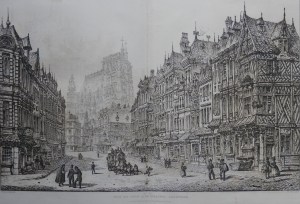
Rue de Puit a la Chaine, Abbeville etched by John Coney @ 1843

Rue de Puit a la Chaine, Abbeville etched by John Coney @ 1843

He was apprenticed to an architect to begin with where he honed his art and although this profession was quite a safe route to take Coney did not follow it.  He began to make drawings of the interior of Westminster Abbey and other Gothic buildings which he sold to dealers and private customers at somewhat inadequate prices.

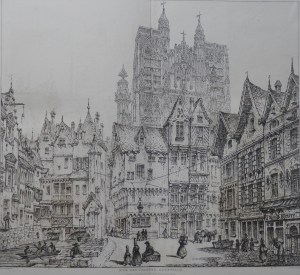
Rue des Changes, Abbeville etched by John Coney @ 1843

Rue des Changes, Abbeville etched by John Coney @ 1843

In 1815, Coney published his first works – 8 views of Warwick castle – interior and exterior.  These were noticed by publishers for their excellence and he was soon employed to draw and engrave cathedrals and abbey churches of England.  These works were for William Dugdale’s ‘Monasticon’ and consumed the next fourteen years of Coney’s life.  Coney then set out on a project engraving ancient cathedrals and public buildings in France, Holland, Germany and Italy.  This project was only partially successful and so in 1831 he started a similar project ‘Architectural Beauties of Continental Europe.

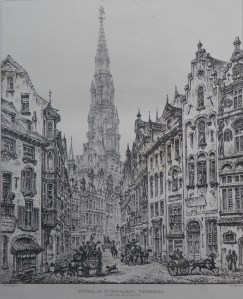
Tower of St Michael's, Brussells etched by John Coney @ 1843

Tower of St Michael’s, Brussells etched by John Coney @ 1843

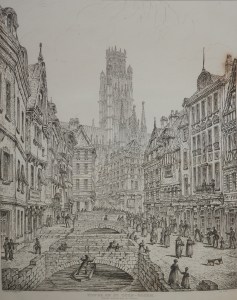
This project consisted of 28 large plates of wonderful edifices in France, the Low Countries, Germany, and Italy along with 56 vignettes.  The five images in this chapter come from the my copy of #BeautiesofContinentalArchitecture published by M. A. Nattali in 1843.

Tower of St Ouen, Rouen etched by John Coney @ 1843

Tower of St Ouen, Rouen etched by John Coney @ 1843

These five plates as well as the others in the publication display Coney’s expert architectural skills and the ease of his imbuing his works with richness and depth.  Finesse and intricate richness are the expressions which give these etchings a beauty to behold and admire.

Cathedral Church, Antwerp etched by John Coney @ 1843

Cathedral Church, Antwerp etched by John Coney @ 1843

Posted in Etching | Tagged , , , , , , , , , | Leave a comment

From a Poet Priest to an Adulteress Muse

Two people who in different ways either created or caused to be created beautiful art.  We visit with #GeorgeHerbert and with #JaneBurdenMorris.

George Herbert was born into an artistic and wealthy Welsh family.  Herbert received a fine education culminating at Cambridge.

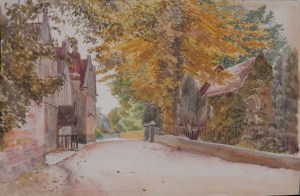
St Andrews, Bemerton, Wiltshire church and rectory of George Herbert by William Botham @ 1830?

St Andrews, Bemerton, Wiltshire church and rectory of George Herbert by William Botham @ 1830?

He had intended to go into the priesthood but was persuaded to enter politics for a while before taking holy orders.  Herbert wrote religious poetry throught out his life but his time at Bemerton was his most prolific.   Herbert’s poems have endured in various ilks such as popular hymns, including “King of Glory, King of Peace”, “Let All the World in Every Corner Sing” and “Teach me, my God and King”.  His biographer wrote that he composed “such hymns and anthems as he and the angels now sing in heaven”.  Herbert suffered ill-health all his life and he died at the early age of 39 from consumption (tuberculosis).  The quaint  watercolour on the left shows the ivied walls of St. Andrew’s Church, Bemerton on the right and the rectory on the left.

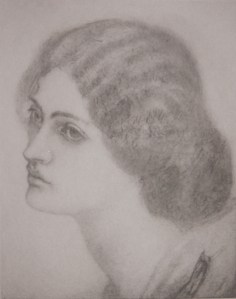
On the other side of the economic divide, we meet Jane Burden.  Born in Oxford to a stableman and  a laundress, her early life was one of poverty and privation.  Jane was a beautiful young woman and at 18 she was discovered by #DanteGabrielRossetti and #EdwardBurne-Jones.  She sat regularly and often for Rossetti and Jones and through them she was introduced to #WilliamMorris.

Jane Burden Morris drawn by William Morris etched by Emery Walker @ 1858

Jane Burden Morris
drawn by William Morris etched by Emery Walker @ 1858

William and Jane married in 1859.  Being little educated in youth, Jane set about to her learning as was befitting the wife of a rich gentleman’s wife.  Jane had a keen intelligence and loved to read.  She became proficient in French and Italian as well as becoming an accomplished pianist. Her manners and speech became refined.  Jane may have been the model for the heroine in the 1884 novel Miss Brown by Vernon Lee.  The heroine upon which was based the character of Eliza Doolittle in Bernard Shaw’s play Pygmalion and the later film ‘My Fair Lady’.  She also became a skilled needlewoman who would be later renowned for her embroideries.  Her affair with Rossetti began several years after her marriage to Morris and lasted in some form or other for 17 years.  She also had an affair with Wilfrid Scawen Blunt.  A beautiful woman who was the model for ‘Queen Guinevere’ by Rossetti  and Morris’s ‘La belle Iseult’.  A woman who inspired those around her to great feats of beauty.

The image above is taken from William Morris’s drawing which now resides in the British Museum.  The drawing was folded in two – so is creased badly across the face and has a stain on the face a well.  #EmeryWalker was asked to etch the image and has done a very fine job in doing so.

Posted in Etching, Watercolour paintings | Tagged , , , , , , , , , | Leave a comment