When we think of modern day artists, certainly, #SalvadorDali (1904 – 1989) is a name that comes to mind. Dali was born in Figueres, Catalonia, SpaIn. A talented draftsman, Dali is best known for his imaginatively striking and even bizarre images. He was one of the leading figures in the ‘Surrealist’ genre. 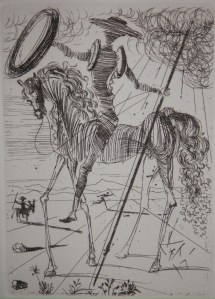
Greatly influenced by the Renaissance masters, he did not restrict himself in the medias in which he worked. A painter, an engraver, a sculptor, a photographer, a film maker – Dali dabbled in many artistic media. He not only dabbled but was efficient and even proficient in whatever media he chose to work in. He worked along side many great artists involved in those various fields.
Dali’s success came early. His works were exhibited in his home in the beginning. Studying first in ‘drawing school’ in Figueres and later in Madrid. His work in the area of ‘Cubism’ brought him notice while at school but his supreme painting skills were evidenced by his realistic work ‘The Basket of Bread‘. His studies finished, Dali visited Paris, where he met Picasso and Miro and many other Surrealist artists who had a great effect upon his work.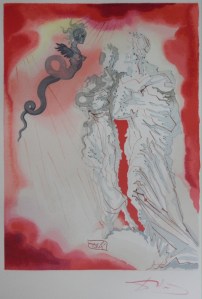
Dali created more than 1,500 paintings and numerous drawings, lithographs, etchings, films, books, and sculptures. Dali often used images and symbols which included melting clocks, elephants,eggs, ants, snails, and locusts in his works. Dali was highly imaginative, flamboyant, extravagant, and eccentric not only in his art but also in his person.
The two pieces in my collection are an etching of ‘Don Quixote – El Cid- Cervantes’ and a woodcut ‘The Black Devil – Canto 21 – Hell – The Inferno – The Divine Comedy – Dante’ . Both reveal his uniquely creative and imaginative style.

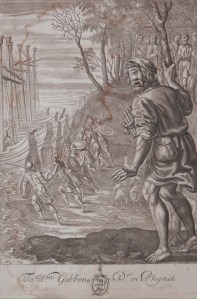 The etching comes from Hollar’s work illustrating Virgil’s Aeneid. It was translated by John Ogilby and to finance the epic undertaking wealthy patrons were approached for support. In return they would receive an etching with text removed and a commendation to the patron. One hundred and three full-page illustrations were commissioned from a number of the best known artists of the time. They include Francis Cleyn, Wenceslaus (Vacaville) Hollar, Pierre Lombard, Ludwig Richer, and William Faithorne.
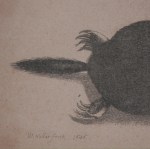
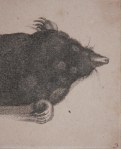
 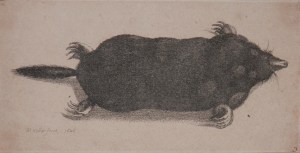 From a folio size etching to a much smaller one (2 3/4 x 5 1/2″ – cut on plate mark). Hollar was in Antwerp, in 1646, where he produced many of his most renowned works. Dutch cityscapes, seascapes, depictions of nature, still-life’s, and his ‘muffs’ and ‘shells’ series. My version (#3) of the run (full number unknown) has the two mishap scratch lines which occurred late in the etching process. A line coming from the top of the mole’s snout (toward top right)and a line coming out of the lower foot can be seen. It is signed by Hollar in the plate as well as the year of creation and there is a small number three in the bottom right corner.
  .
. 





 ronsartblog