Art with Dogs

Dogs appear in art both as subject or background.  As with the human form, the depiction of animals is not easy.  The misalignment of a single line can make very very fine rendition into an abstract view. We, not just artists, like to humanise our animals giving them human qualities which endear them to us or alienate them from us.  Certainly it is said regarding dogs that they look like their owners.
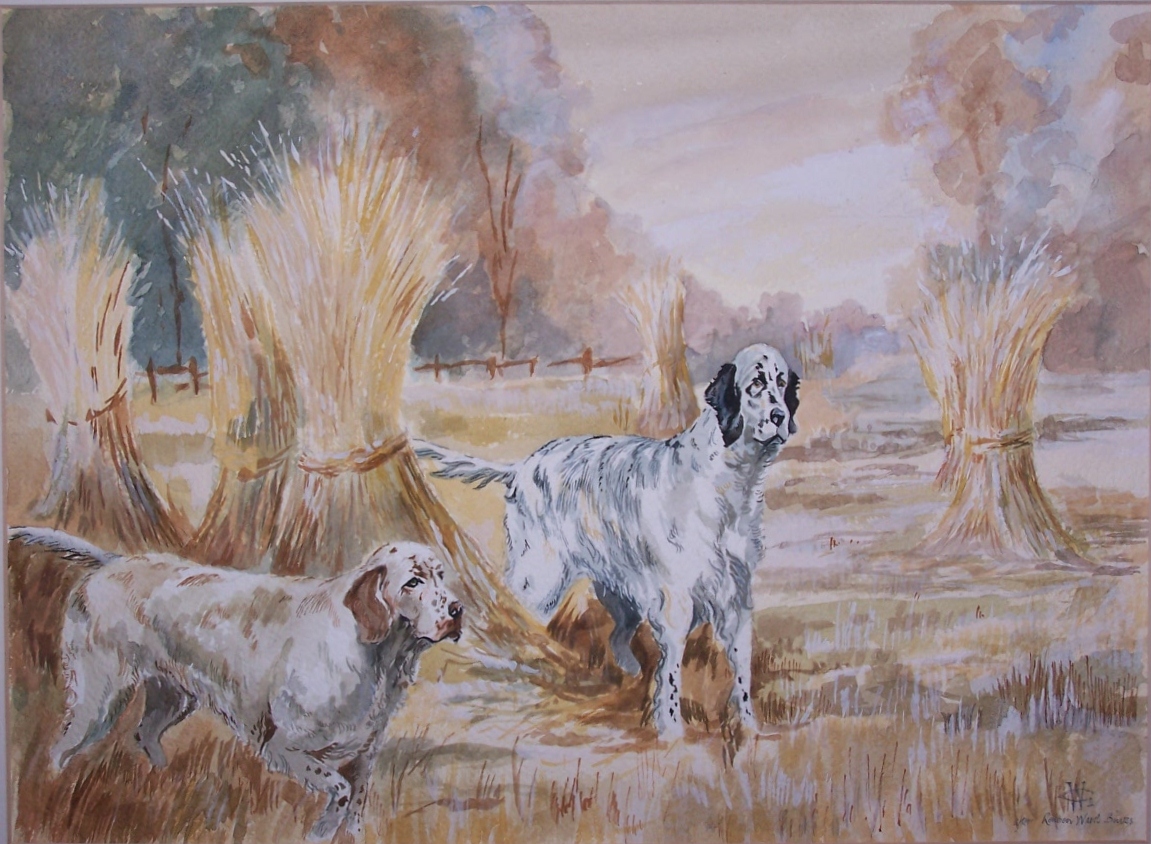
On the Hunt after Reuben Ward Binks signed GW

On the Hunt
after Reuben Ward Binks
signed GW

‘Man’s best friend’ has worked in coordination  for centuries.  Hunting, herding, befriending, guarding are all jobs which dogs lovingly provide to their masters.  The pair of setters to the left are performing something they would do naturally but they do it in conjunction with their master.  This watercolour in it’s warm autumnal colours and lovely depiction of a pair of hunting dog is ‘after #ReubenWardBinks’.  Mr. Ward Binks was one of the foremost illustrators of pure bred dogs.  He travelled the world to perform commissions for dog owners and worked for some of the most influential people in the world.
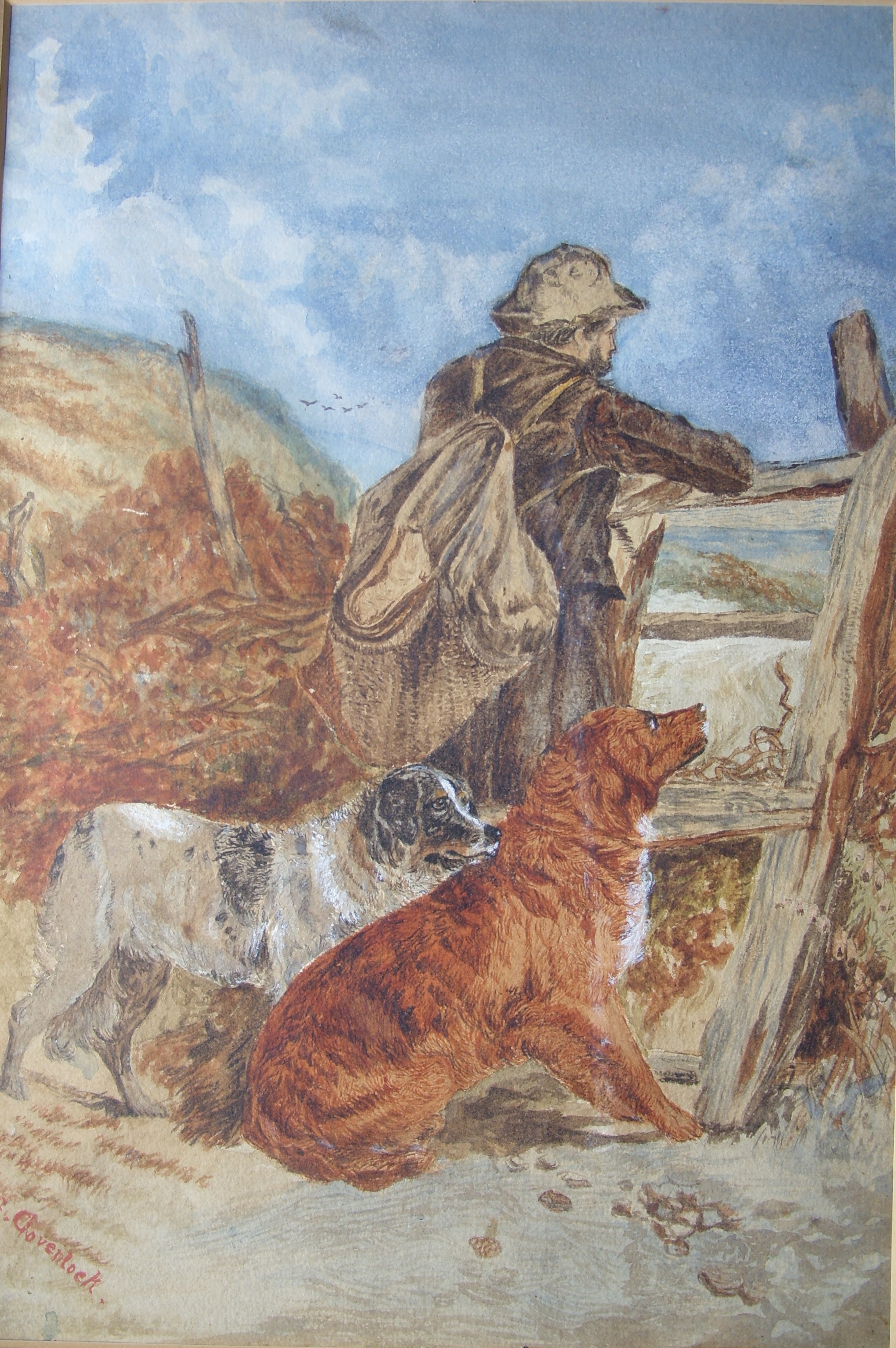
Travelling with Friends by S Govenlock

Travelling with Friends
by S Govenlock

The dedication to their master can be seen here in a painting by #SGovenlock.  Is he a traveller?  Does he have a home?  The dogs do not care . Their devotion is to the man not to their comfort.  Happy wherever the man is – they follow.  I believe this painting to be from the 1920’s or 30’s.  I picked it up in Canada recently.  Is this an image of William Govenlock overlooking the land in Saskatchewan that he would homestead in 1910.  Later a town(1913) formed and was named ‘Govenlock’ after its’ founder.  The town prospered during the years of prohibition due to its’ nearness to the border and bootlegging.  Its’ decline began when prohibition ceased and with the  provincial control of spirit sales.  Today, Govenlock, is no more, a ghost town with only cement foundations and a few wooden walkways remaining.

These beautiful and devoted animals are lovingly portrayed here doing what they love to do – please their masters.  Whether as companion or fellow worker they live not for themselves but for another.  Maybe that’s why I love dogs.
Posted in Watercolour paintings | Tagged , , , , , , , , , , , | Leave a comment

Art of the Ungava

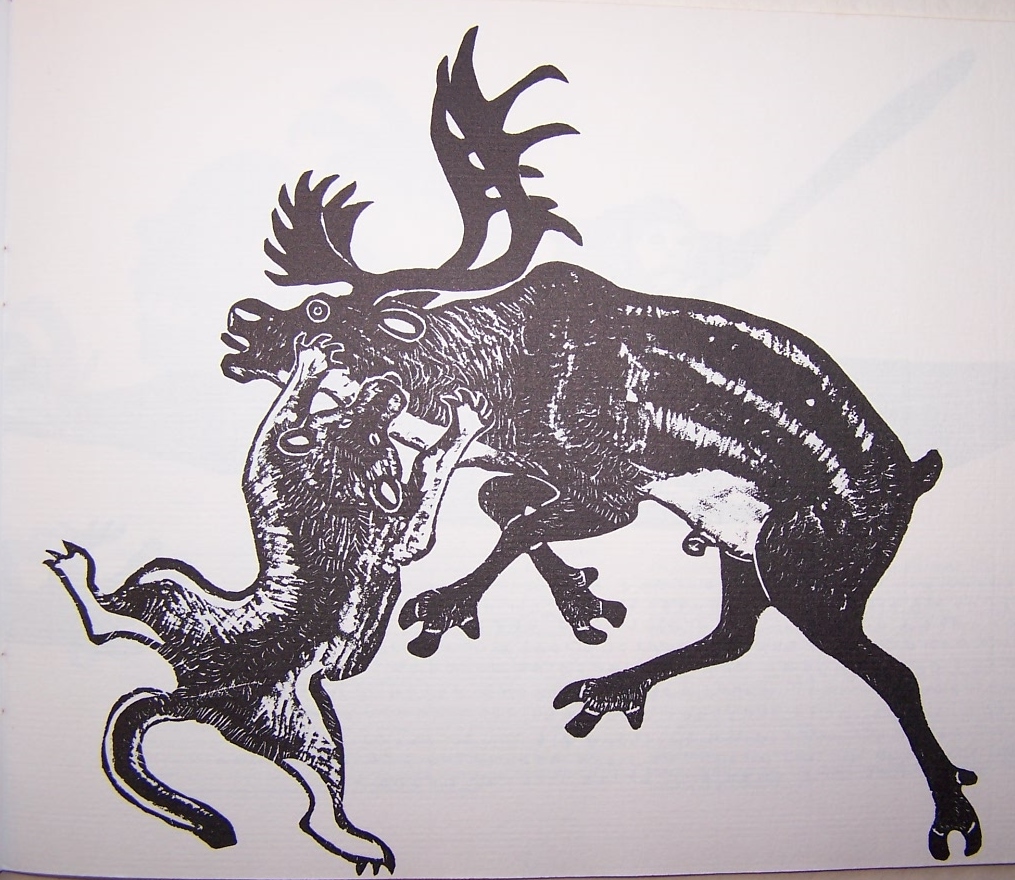
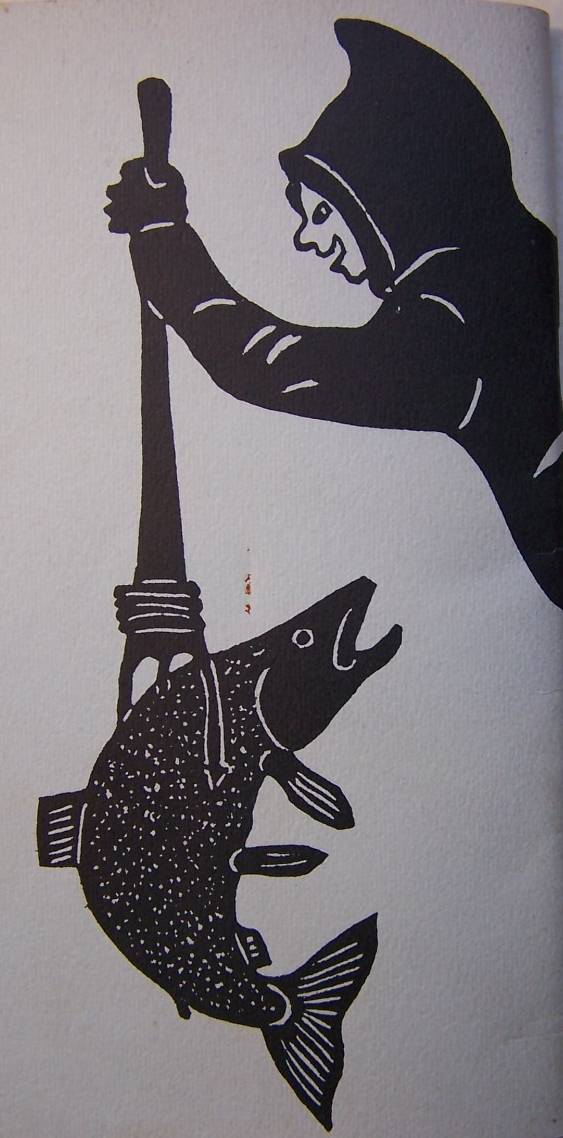
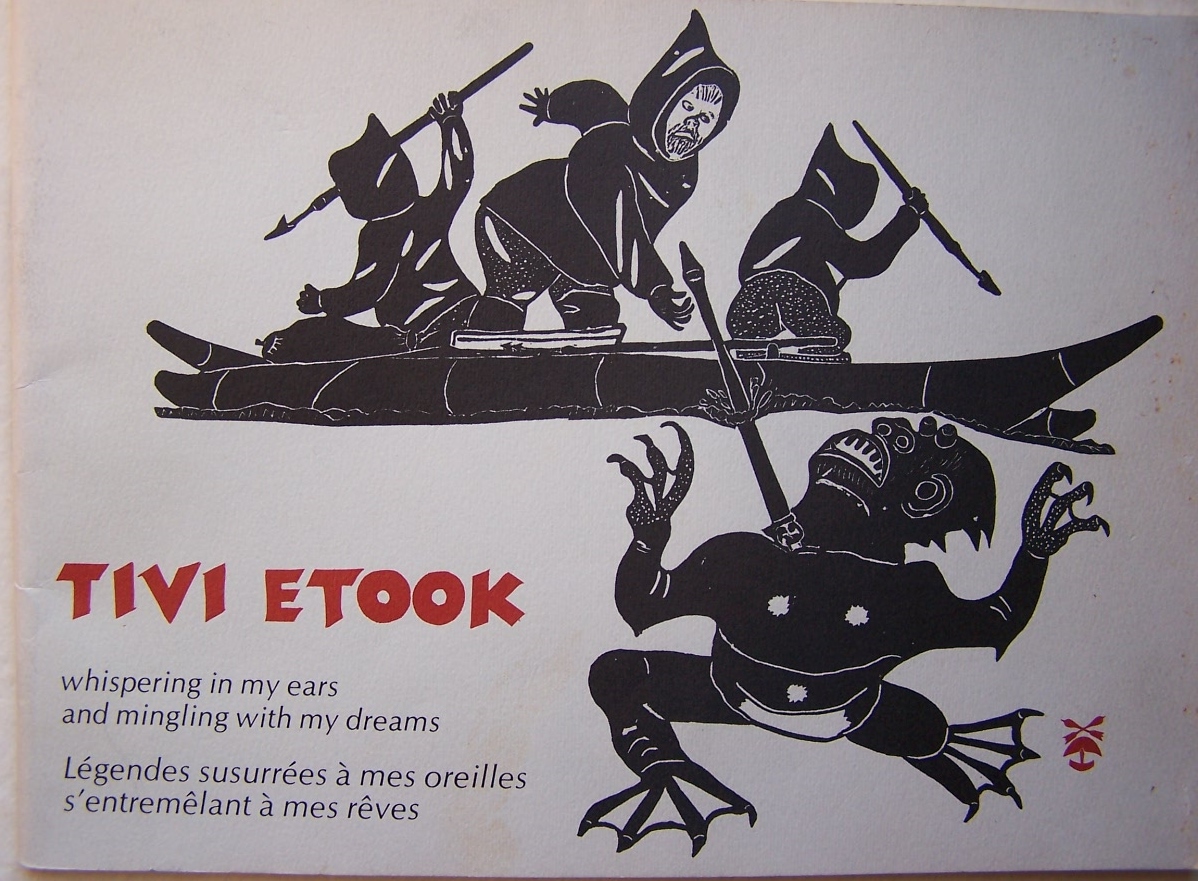
One might consider that with a name like ‘the Ungava’ that this chapter might be about a place in Africa but ‘Ungava’ is actually found in northern Canada.  I came across a booklet  or catalogue in my travels.  It’s focus is the artwork of #TiviEtook.  He cuts into stone the images portrayed here and then inks and prints.  These stone cuts burst with vibrancy, for they show us not the ordinary caribou and men, but the great sharp-horned spirits-torngat that guard the swollen rivers and the tundra plain.

Ekeagualukby Tivi Etook

Ekeagualuk
by Tivi Etook

Tivi Etook is a hunter, a tracker, a butcher, and an anatomist who understands the rhythm of the animals, the very twitching of the fish.   His sharp edged knife probes the ancient surfaces of stone in search of images and dreams, in search of life.  He gives us a first hand account of a world of privation and survival.  A world where demons such as the powerful Ekeagualuk are once more becoming stronger and increasing in numbers.

Tivi Etook was the first Inuk printmaker to have a collection of his own prints released in 1975.  He is now an Inuk Elder.

Wolf with Caribou IIIby Tivi Etook

Wolf with Caribou III
by Tivi Etook

“When I make my prints I recall the things which happened in my childhood – the hunger, the search for food, the days of walking and the stories I heard from the old people.  When I make a print i make it reveal the truth of our life as my ancestors lived it and as I did to a lesser extent in my own youth”

“Though we went hungry many times, though during our walking we crossed swollen rivers which often swept us off our feet, though we spent months alone on the land, we did not fear anything except hunger.  Now we do not find hunger but we find fear. In the past we were never lost.  Now we know not where we are going.”

Hunting the Salmonby Tivi Etook

Hunting the Salmon
by Tivi Etook

What awesome images of a life that few will ever know.  A past not far gone by.  A history that needs to be remembered and retold to our children and their children.  A memory which should not be forgotten either in story or image.  A leading light of #Inuit artists.  A talent supreme who once could not see the value of drawings for his society had no use for them.  Thankfully he changed his mind for for now we have images like these not just for pleasure but history.

Posted in Modern prints | Tagged , , , , , , , | Leave a comment

Art Mediums

The great variety of mediums which artists can use and do use expands the realm of what we call art.  The items in my collection do not reflect the multitude of artistic mediums which exist but every once in a while I acquire a medium not yet in my small collection.

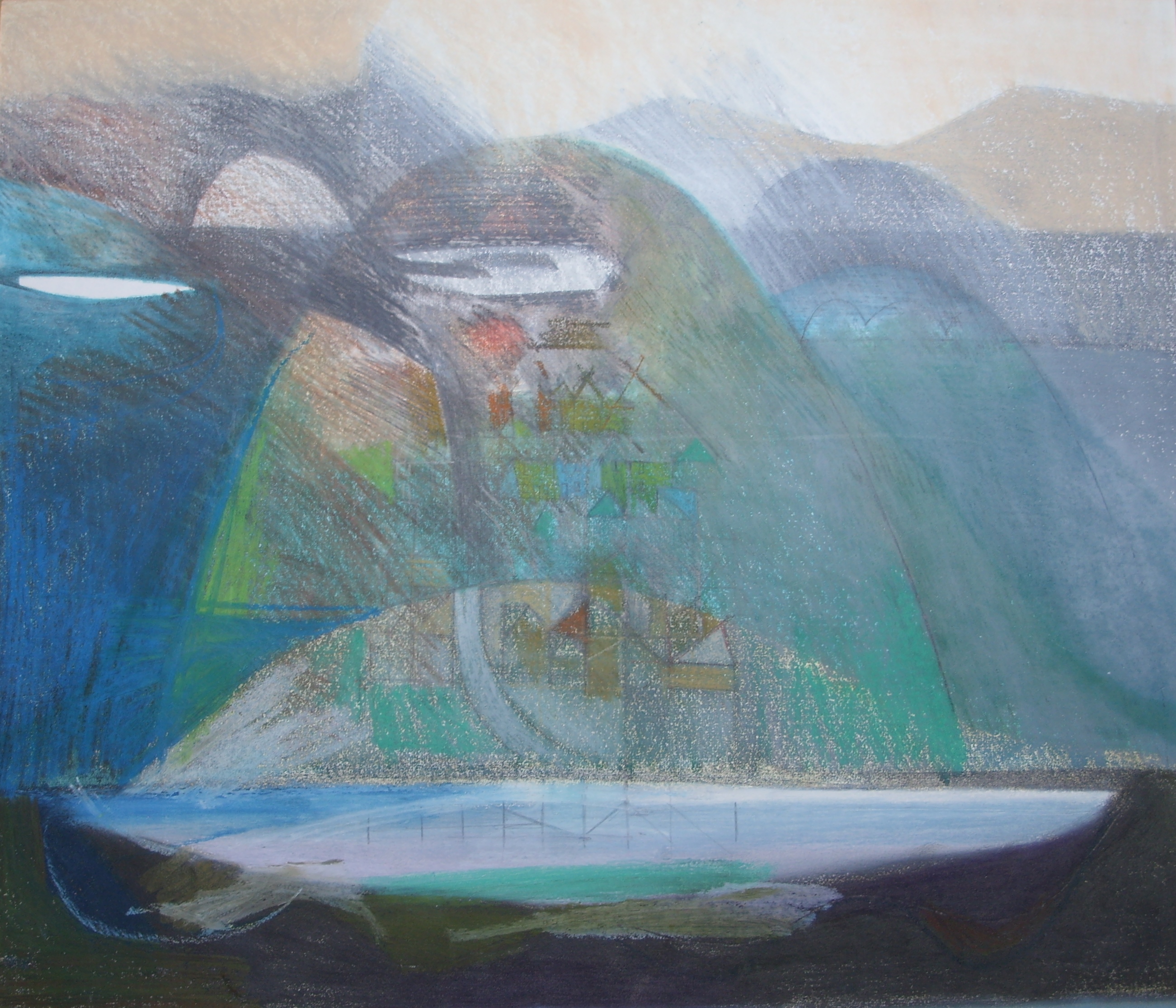
In the Welsh Valleypencil, wax & oil crayonby Alec Pearson

In the Welsh Valley
pencil, wax & oil crayon
by Alec Pearson

This unique and beautiful image of the welsh valleys, is a creation by artist #AlecPearson.  Mr. Pearson was a teacher for most of his working life but in 1974 he left the  field of education to become a full time artist.  His use of various artistic mediums eventually settled in the direction of tapestry weaving.  The image to the right and it’s wonderful colouring could possibly have been an artist’s study for a weaving (12′ x 12′).  It is easy to imagine this picture hung on an expanse of bare wall.  The mist shrouded hillside holds the village in opacity.  The lakes high and low speak of a fertility and lusciousness to life but the purple draped hillsides tell a different story. A tale of toil and struggle against the elements that surround us at all times.

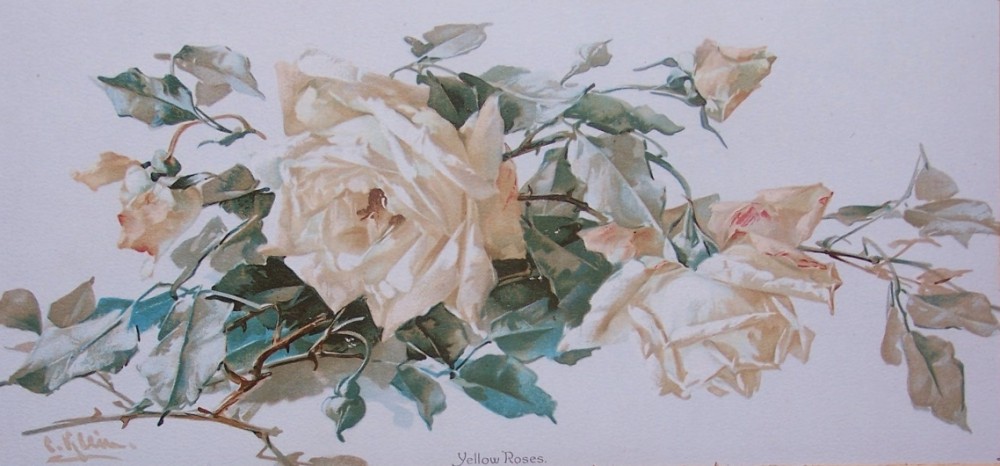
What comes next comes from an artist whose prolific output did not diminish the quality of her work.  Today, #CatharinaKlein is mostly remembered as an artist who painted still-life images produced mainly for the greeting card and postcard industry.

Yellow Roseschromolithographby Catharina Klein

Yellow Roses
chromolithograph
by Catharina Klein

Catharina Klein (1861 -1926) produced some 2000 different still life images which today exist only on postcards, calendars, and advertisements   She painted from real life examples so that inadvertently she documented varieties of fruits and flowers which are now considered to be rare.  The lithograph pictured is roughly 6″ by 12″ in image size and is a wonderful study.

Two lovely images from very different artists with greatly varied skills.  Both display an artistic eye with a view of portraying reality with an individualistic twist.

Posted in Drawings and Sketches, Lithographs | Tagged , , , , , , , , , | Leave a comment

Art of Architecture

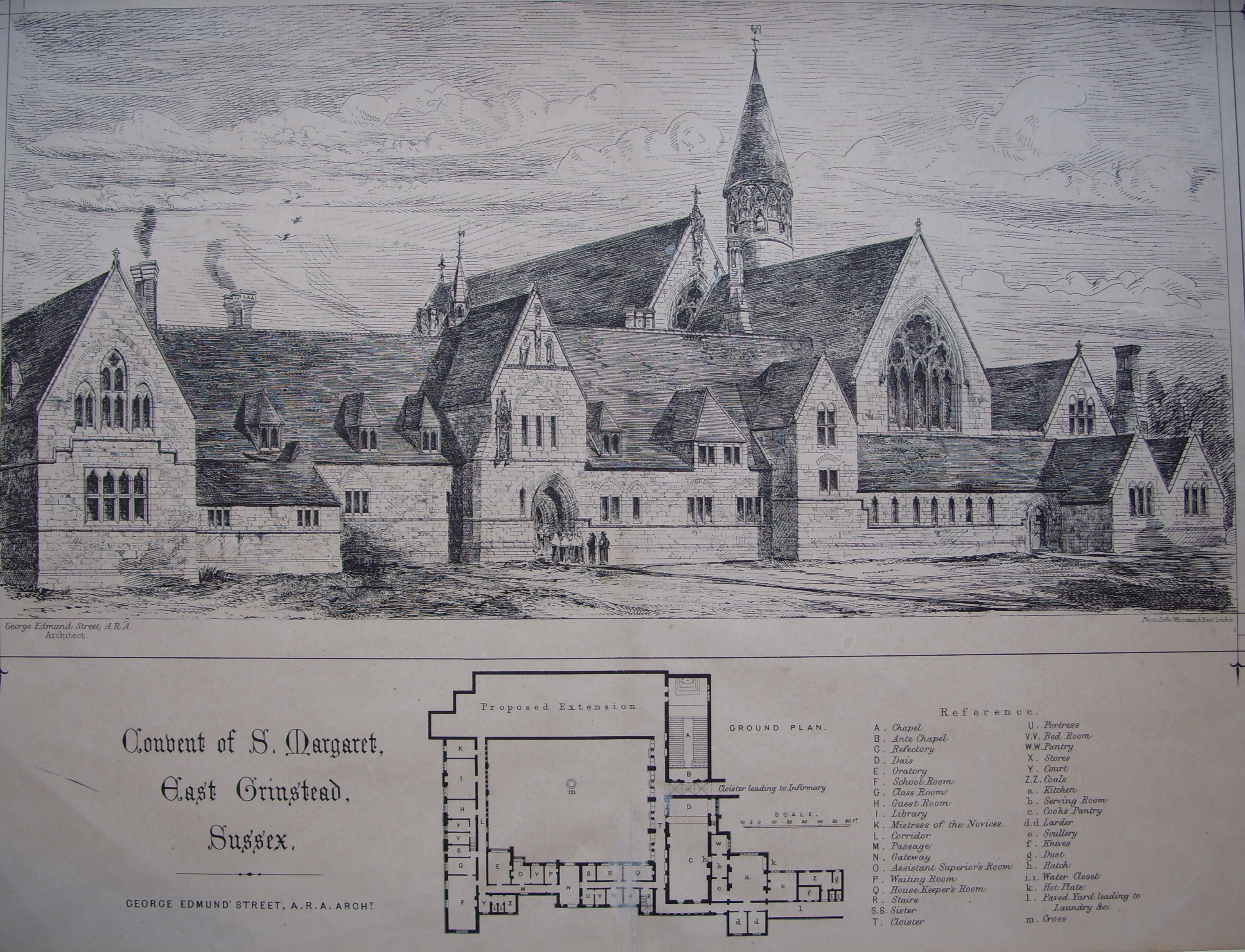
Convent of St MargaretEast Grinstead, Sussexby George Edmund Street1868

Convent of St Margaret
East Grinstead, Sussex
by George Edmund Street
Nov. 27, 1868

This week, I added an antique print to my collection.  It comes from a publication called ‘The Building News’.  It was printed and published on November 27th, 1868.

One does not usually think of architectural drawings as art now-a-days, but then today so many are done by computer and not by hand.  In years gone by drawings were done by hand and rule, compass and protractor, or even by eye.  This lovely print was drawn by the well known architect #GeorgeEdmundStreet.  He lived from 1824 to 1881. George Street was a leading figure of the Victorian Gothic revival in architecture.  He was mainly an ecclesiastical architect but is perhaps best known as the designer of the Royal Courts of Justice, in the Strand in London ( It has been suggested that there were 3,000 drawings for the Law Courts ready when Street died).

After his studies, he had placements in Winchester and London to learn his craft. He set up his own business in 1849 working mostly in church restorations.  He was appointed architect to the dioceses of Oxford, Ripon, Winchester, and York, as well as York Minster, Salisbury and Carlisle cathedrals at different points in his life.  Well known in the history of architects, Street’s students include some very renowned architects like Philip Webb, Canadian architect Frank Darling, and the renowned William Morris.  His large works include the nave of Bristol Cathedral and the restoration of Christ Church Cathedral, Dublin.  Chief amongst his complete works include #StMargaret’sConvent, East Grinstead, and the theological college at Cuddesdon.

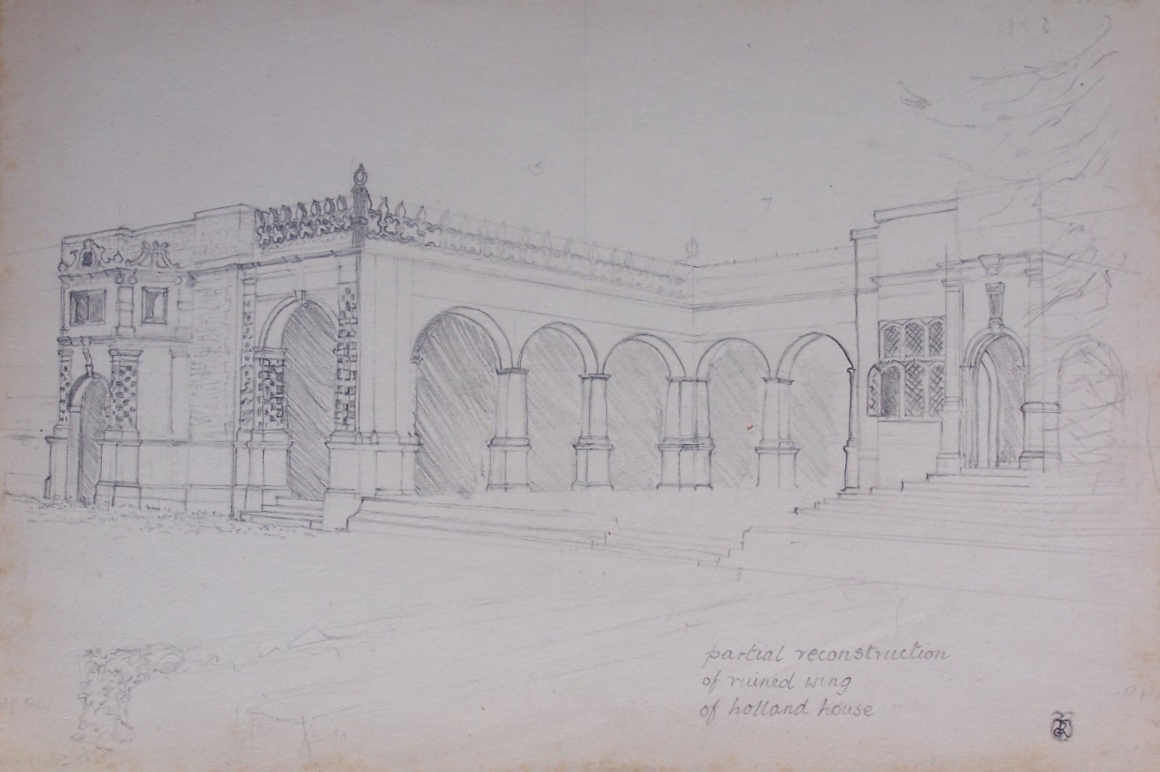
Ruined Wing, Holland House, Londonby AJM de Routon

Ruined Wing, Holland House, London
by AJM de Routon

From the very detailed drawing of St Margaret’s by Street to a simpler but still accurately detailed drawing by AJM de Routons.  This is #HollandHouse in London.  Built in 1605 and originally called Cope Castle for its’ owner Sir Walter Cope.  It transferred through several families and then on Sept. 27th, 1940, the  house was largely destroyed by German firebombing during the Blitz, and today only the east wing and some ruins of the ground floor still remain.
Today, the remains of Holland House form a backdrop for the open air Holland Park Theatre, the “London Holland Park” youth hostel is now located in the house. The Orangery is now an exhibition/function space, with the adjoining Summer Ballroom, The Belvedere, now a restaurant. The former ice house is now a gallery space while the grounds provide sporting facilities.

Two images which show the art of architectural drawing.  Detailed, accurate and still artistic.  Items that could very easily hang on a wall.

Posted in Drawings and Sketches, Modern prints | Tagged , , , , , , , , | Leave a comment

Art Inspired

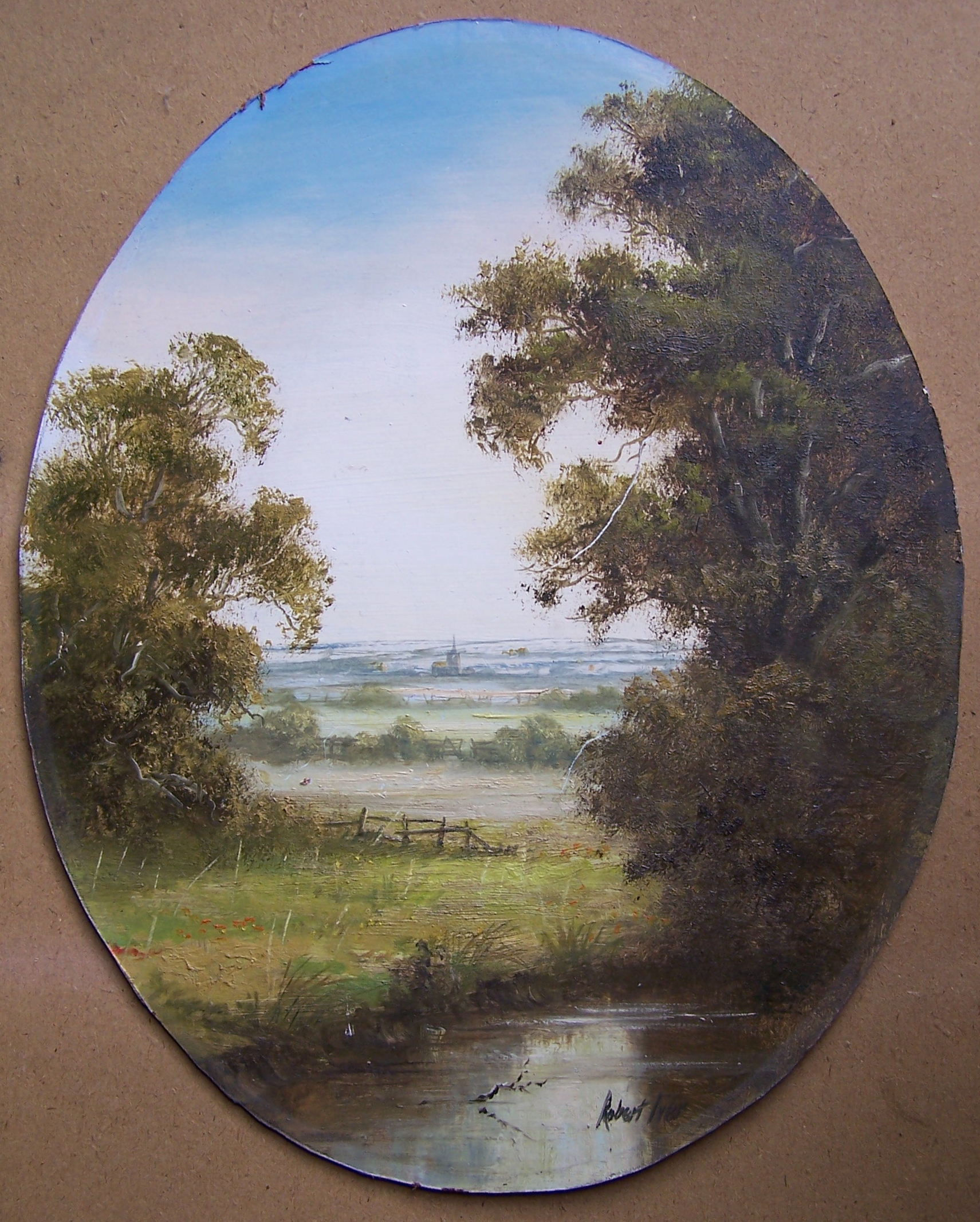
One does not now what truly inspires an artist to memorialise a scene but we, the viewers, should be moved or enticed into joining with the artist in seeing his motivation.  Being individuals we will each see from our own perspective and thus find our own foci in whatever artwork we might be looking at.

Pastoral Sceneby Robert Iver

Pastoral Scene
by Robert Iver

#RobertIver presents to us a tranquil setting.  A river or pond in the foreground and fields enclosed by hedge rows drawing us towards the small chapel in the distance.  Is this scene real or imaginary.  Whichever, it matters not for as we look at this painting each one will be drawn to their own solace and respite.  We might just wish to dip our toes in the cool water, or picnic in the field, or cross to the chapel – each will find ones own place .

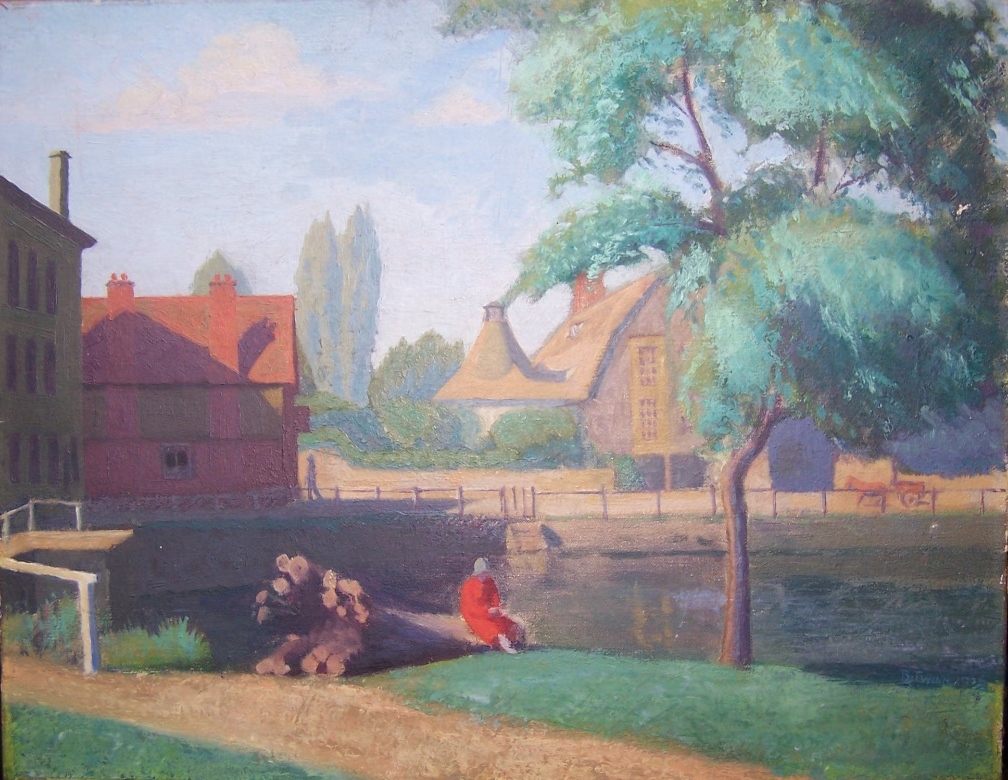
The next painting by #BTWinn continues our tranquil mood.  We are on the path along the river at the lock and happen upon a woman sitting on a fallen tree.

By the Riverby B T Winn 1923

By the River
by B T Winn 1923

Is she remembering her love who was lost in the conflict.  Do her memories stir her into immobility.  Does she weep?Remember?  Are we intruding into her grief or do we share in her grief and loss – ‘we will remember them’.

These of course are just my ‘wonderings’ and they are mine – yours will lead you to other places, other lands and other realities which you will find in and for yourselves.  Stand, look and wonder at the art which surrounds you.  Let it take you to places beyond the present – into the future of your dreams or the imagination of history past.  That is what art can do for you.

Posted in Oil Paintings, Uncategorized | Tagged , , , , , , , | Leave a comment

Art of Towers

As I travel visiting the beautiful sites of this country, one is always drawn to the great historical and religious buildings which one finds all across this nation.  #York is one of those beautiful cities.  Filled with history both sacred and secular. a city which has had great effect upon the direction which this country has travelled.

Holy Trinity, Micklegate, Yorkby Joseph Pike @ 1910

Holy Trinity, Micklegate, York
by Joseph Pike @ 1910

It is said that #JosephPike was a very happy person -happy in his work, happy in his home, happiest in his Church.  An artist with little aptitude for business, he never made much money.  He shunned publicity and abhorred advertisement, so much so that outside of a few close friends and family none knew of his passing without nearly a month having passed.  Such was his humility.

After his schooling , Joseph Pike worked for John Hardman Studios(renowned Victorian stained glass makers) in Birmingham until WWI.  After the war he became an a freelance artist illustrating a number of books.  Then followed a style which Joseph Pike preferred and practised to perfection.  The art of pencil studies or drawing.

This drawing shows the corner of Micklegate and Priory Streets with the tower of Holy Trinity Church rising above in the background.  I find it interesting that Mr Pike has misspelled the street name in the title of his work (seen lower left).  A realistic image of this place since in the York Museum an oil painting hangs by J H Bakes (1931) showing almost the exact same perspective with some small architectural changes.

Lincoln Cathedralunknown artist

Lincoln Cathedral
unknown artist

From Steep Hill Street in Lincoln, we look upwards to the twin towers of #LincolnCathedral.   A watercolour by an unknown artist gives an interesting perspective on the west end of the cathedral.  Drawn at the intersection of Michaelgate, Bailgate, and Steep Hill streets, it displays quite a contemporary image.  A nice rendering , I think, of the west end towers of the cathedral.

"Ely

And finally an image(please click rectangle to view) of #ElyCathedral by F B Strevens, an Ely resident for a number of years.  It is quite a naive depiction but still has something about it which says look at me.  And I do enjoy looking at it. I hope you do to.

Posted in Drawings and Sketches, Watercolour paintings | Tagged , , , , , , , , , , | Leave a comment

Art of Burma

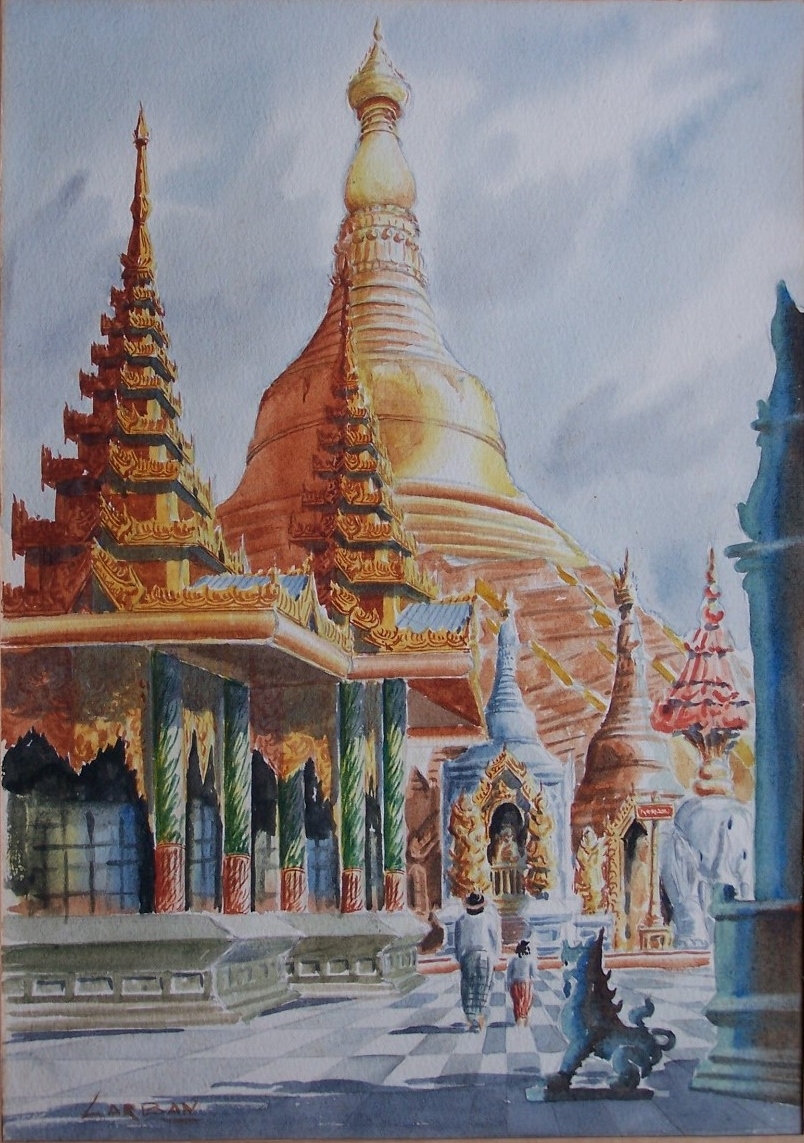
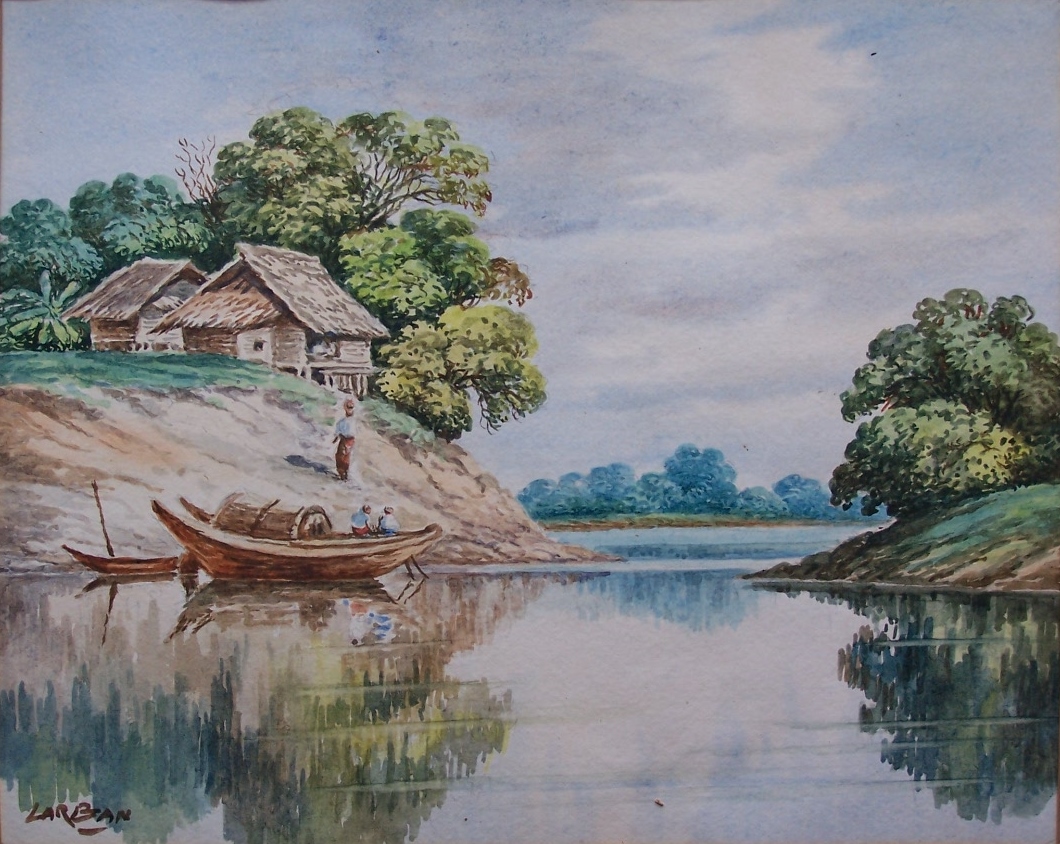
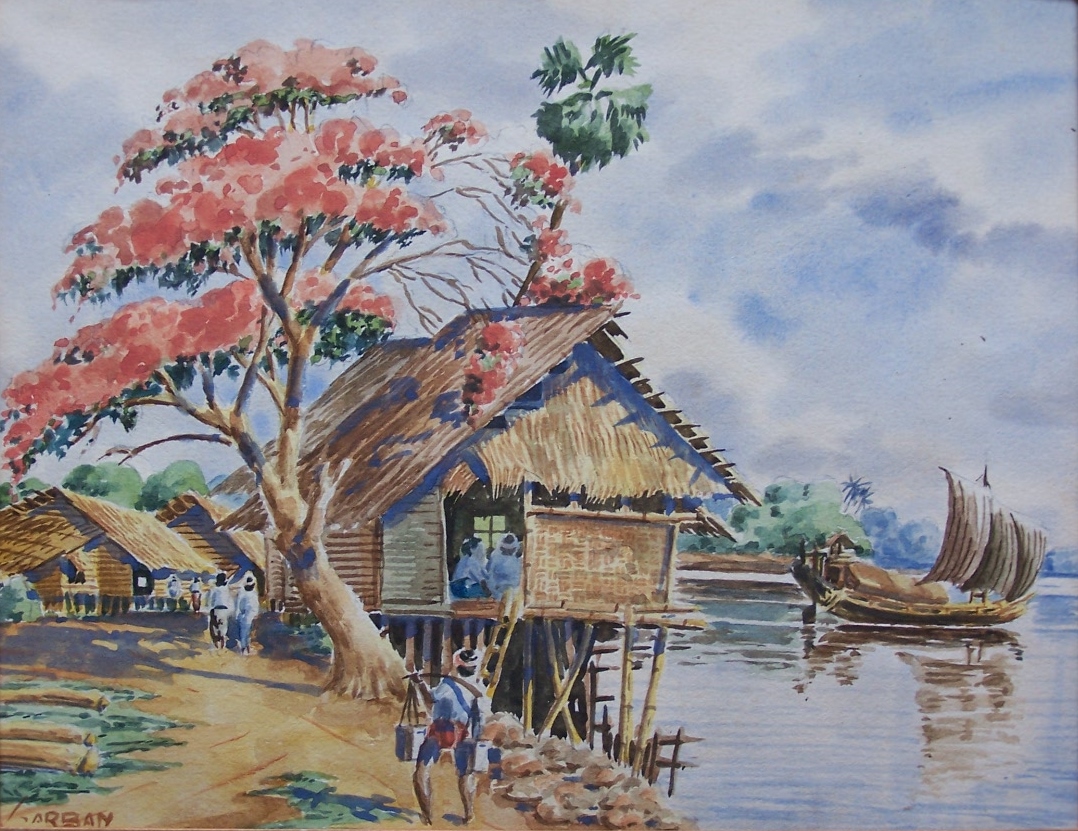
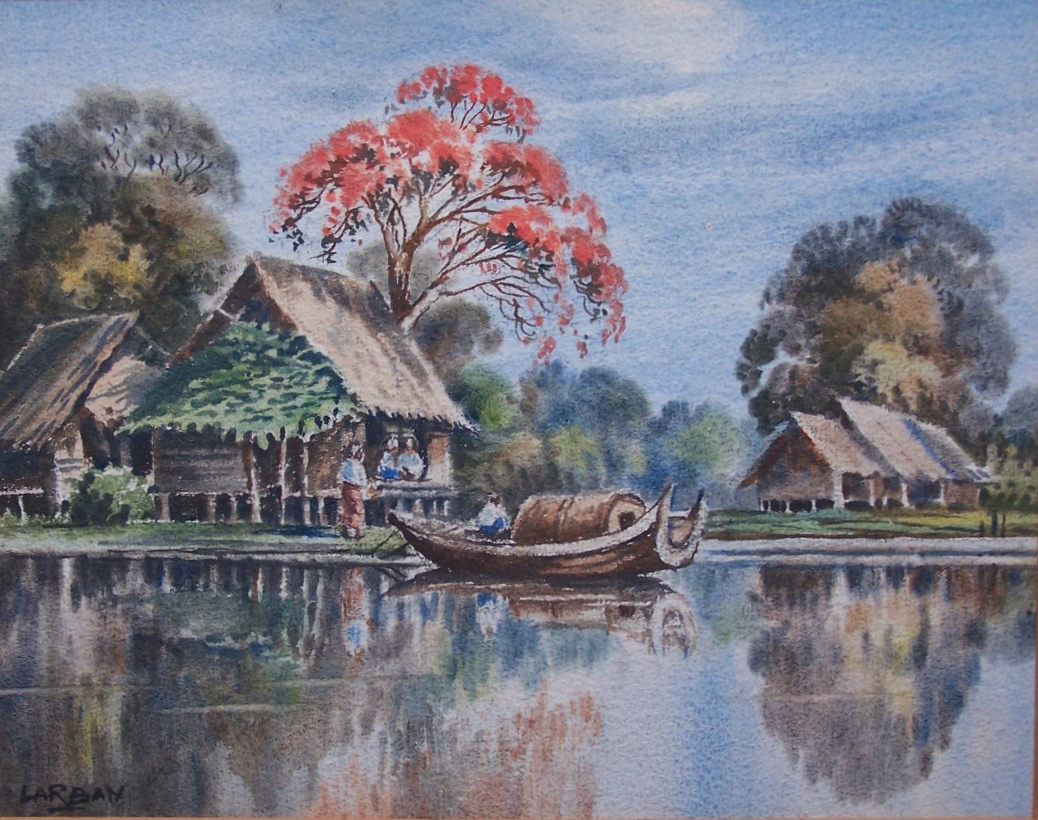
As I procure works for my collection, it rarely occurs that I find a set or series of pieces by the same artist.  Today, I found a set of four works by the same artist.  The artist, #MuangLarBan, was from Burma or Myanmar and these works come from around 1936.

Shwedagon Pagodaby Maung Lar Ban @ 1936

Shwedagon Pagoda
by Maung Lar Ban @ 1936

Burma, also known as Myanmar, is a sovereign state in Southeast Asia bordered by China, Thailand, India, Laos and Bangladesh.

The first image is probably the best known site in Burma, the marvellous #ShwedagonPagoda in Rangoon.  Sitting high atop the sacred shrine of Singuttara Hill, the pagoda houses the  relics of The Buddha and three Buddhas that preceded him.  Encased in gold and jewels, the beauty of it’s architecture and design will amaze you, as will the sparkling of it’s jewels. This wondrous holy place is filled with spirituality, history and legend.

The following three images portray, I believe, waterside village scenes on Inle Lake.  Local fishermen are known for practising a distinctive rowing style which involves standing at the stern on one leg and wrapping the other leg around an oar. This unique style evolved for the reason that the lake is covered by reeds and floating plants making it difficult to see above them while sitting. Standing provides the rower with a view beyond the reeds. However, this leg rowing style is the practice of the men only. Women row in the customary style, using the oar with their hands, sitting cross legged at the stern.

Inle Lake Iby Muang Lar Ban @ 1936

Inle Lake I
by Muang Lar Ban @ 1936

Inle Lake IIby Muang Lar Ban @ 1936

Inle Lake II
by Muang Lar Ban @ 1936

Inle Lake IIIby Muang Lar Ban @ 1936

Inle Lake III
by Muang Lar Ban @ 1936

I love the colours in these pictures and love the image of villager life which they portray. I hope you enjoy them too.

Posted in Watercolour paintings | Tagged , , , , , , | 7 Comments

Art In Variety

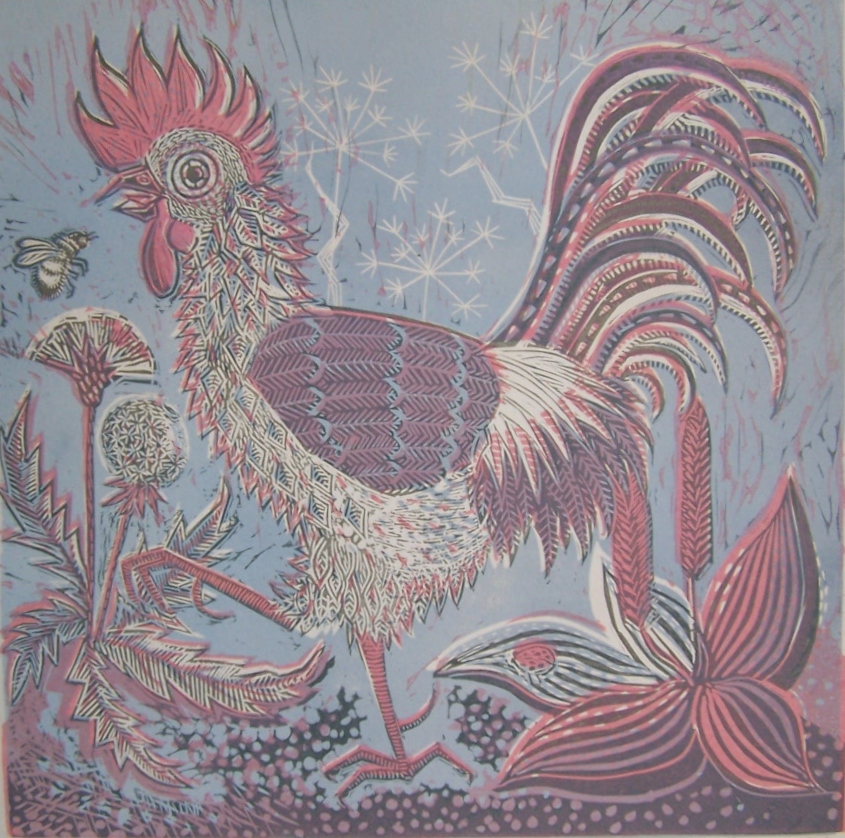
Three different types of art today, a linocut, an aquatint, and a pen and ink drawing, all from modern artists.  Very different techniques and yet they produce beauty in their own ways.

The Cockerelby James Kerr

The Cockerel
by James Kerr c.c.c. 58/20

A linocut by James Kerr entitled ‘The Cockerel’.  I love the colours but to achieve this multi-colour effect one must cut a plate for each individual colour used and then press the paper again and again transferring each colour.  Since the linocut images may vary somewhat from each other, the effect can give a slightly offset or misaligned appearance.  One must cut the image which you are creating into the lino using either a knife, or a V or U shaped chisel.  One must be able to imagine your final image and then dare to cut away the unwanted portions of the lino.  I love the design of the feathers and the dandelion heads. A very nice example of the art of the linocut.

The Canal at Orsman Roadby M Brand 1976

The Canal at Orsman Road
by M Brand 1976

We follow on with an aquatint/engraving displaying  part of down-town London.   We stand along the canal at Orsman Road  looking towards the mighty St. Paul’s Cathedral.  The image is not in proportion since St. Paul’s should  appear more distant.  An atmospheric image of London under an imposing dark sky.  Dated November 1976, I wonder if it is raining or snowing or possibly the feel of the city to this artist is somewhat grey.

Hawaiian Geeseby Norman Arlott

Hawaiian Geese
by Norman Arlott

And to finish, a pen and ink drawing with white high-lighting by Norman Arlott   I say Norman Arlott because a small label on the back of the picture states it.  The image itself is not signed, titled, or dated.  Mr. Arlott lives in Norfolk in England and is a renowned bird illustrator.  Norman Arlott’s illustrations are modern, detailed, and very accurate.  He has created tens of thousands of watercolour paintings of birds for more than 150 books in Britain and beyond in the last 37 years.

Three unique artworks which display their makers’ skills and techniques.

Posted in Drawings and Sketches, Etching, Lino/woodcuts | Tagged , , , , , , , , , , , , | 1 Comment

Art of Italy

For much of Europe’s history, Italy has been a centre for the arts and artists of all persuasions.  Many of the great cities of Italy are renowned for their galleries ,museums, and churches which hold some of the worlds great art.  Today’s artworks portray three different cities and are an etching, an aquatint, and a watercolour.

MilanRouargue del et sculp
@ 1835

Milan
Rouargue del et sculp
@ 1835

Please click on rectangle to see image. Do not know why it will not show like all the others.

Odd but we begin with a French artist Emile (1796 – 1865) or Adolphe Rouargue (1810 – 1870). I list two artists since my engraving is only signed #Rouargue del et sc. and could be either artist.  During his life, he travelled extensively and many of the sties he encountered are displayed in his artworks.  The great churches from across France and Italy and sites in the Holy Land are to be found in his work. Presented is his engraving of the ‘Piazza Duomo di Milano’. It has been hand-coloured and is a very nice example of the art of engraving.

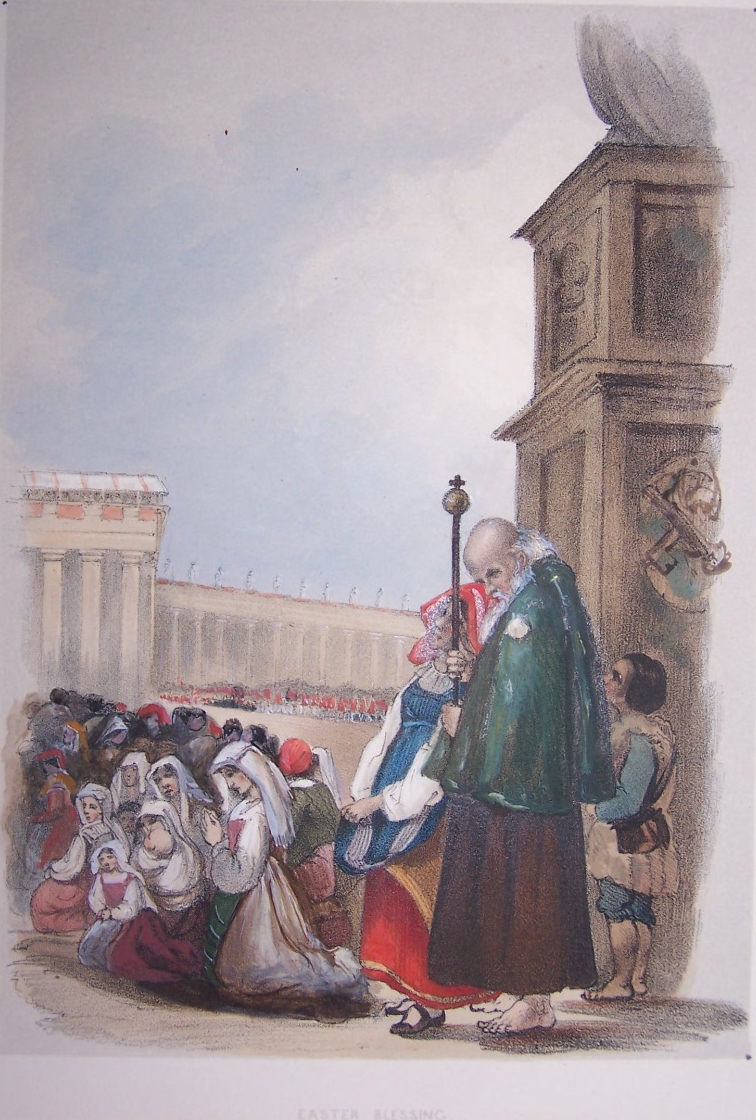
Easter Blessinghand-coloured aquatint

Easter Blessing
hand-coloured aquatint

We continue southwards to the city of Rome to the Vatican into St. Peters Square where the next #aquatint is taken from.  I have no knowledge of the artist but once again the etching has been hand-coloured and I think the etching comes from the 1800’s and might be a page from a large book.  It is titled ‘Easter Blessing’ fitting since we are now in the church season of Lent.  I do not know who the old priest is but he holds some resemblance to Cardinal Pietro Bembo.

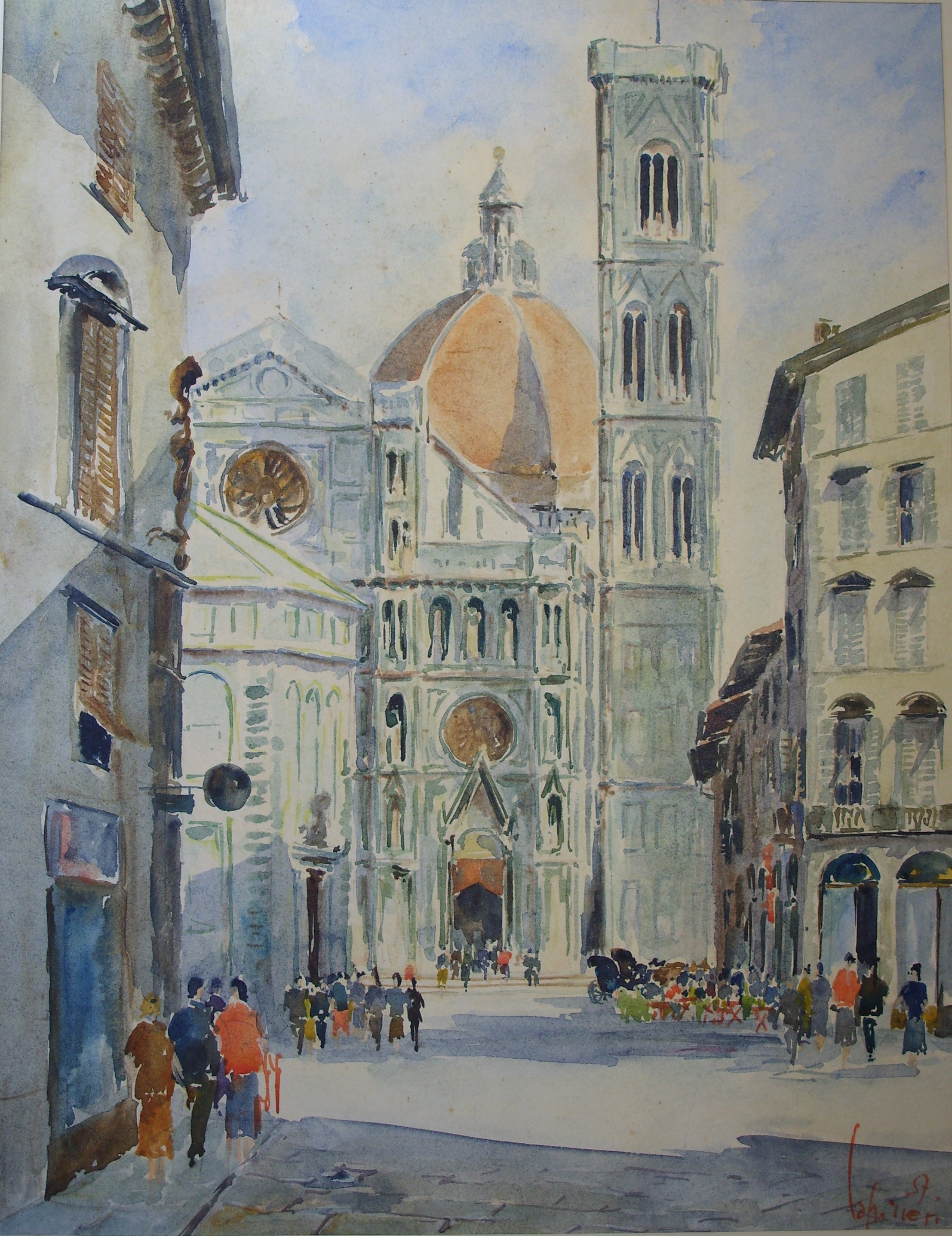
Santa Maria del Fiorewatercolour - signed & titled

Santa Maria del Fiore
watercolour – signed & titled

And now back to the north of Italy to the beautiful city of Florence.  We stand in the ‘Il Campanile da via de Pecori’ looking at the ‘ Church of Sante Maria del Fiore’.  The church is particularly notable for its 44 stained glass windows.  They are the work of the greatest Florentine artists of their times.  The basilica is one of Italy’s largest churches, and until development of new structural materials in the modern era, the dome was the largest in the world. It remains the largest brick dome ever constructed.  The historic centre of Florence which includes the Basilica is an UNESCO World Heritage Site – a major attraction to tourists visiting the region of Tuscany.

Posted in Etching, Watercolour paintings | Tagged , , , , , , , , , , , | Leave a comment

Art of Gustave Dore

In my journeys in the search for art I have acquired some things which might not be considered art but they are works which contain artworks.  I have in my collection a set of ‘The Graphic Illustrated Paper’ from September to December 1870 but they are for another day.  Today, I wish to talk about two publications which are illustrated by the same artist.  One of the great etchers and engravers of all time.  Gustave Dore by name.  And the two books from my collection in to-days  blog are DON QUIXOTE (2 volume set published Cassell 1906) and ‘THE NATIONAL FAMILY BIBLE ( published by Pike & Brothers @ 1880).

Don Quixoteby Gustave Dore

Don Quixote
by Gustave Dore

The wonderful artist Gustave Dore (1832-1883) was a French engraver, illustrator, and sculptor.  Doré worked primarily in wood and steel engraving.  He illustrated a number of books and in the 1860’s he illustrated a French edition of Cervantes’s Don Quixote, and his depictions of the knight and his squire, Sancho Panza, have become so famous that they have influenced subsequent readers, artists, and stage and film directors’ ideas of the physical “look” of the two characters.  Dore’s illustrations for the English Bible were also very successful.  Amazingly, Dore was known for his painting while he was alive and although fine paintings they are his woodcuts and engravings are where he excelled as an artist.

The first two images come from the Don Quixote and the third comes from the Family Bible.  The first image is the frontispiece of Volume 1 and is titled ‘A world of disorderly notions, picked from out of his books, crowded into his imagination’ and if you look closely you will find images from throughout the whole two volumes.

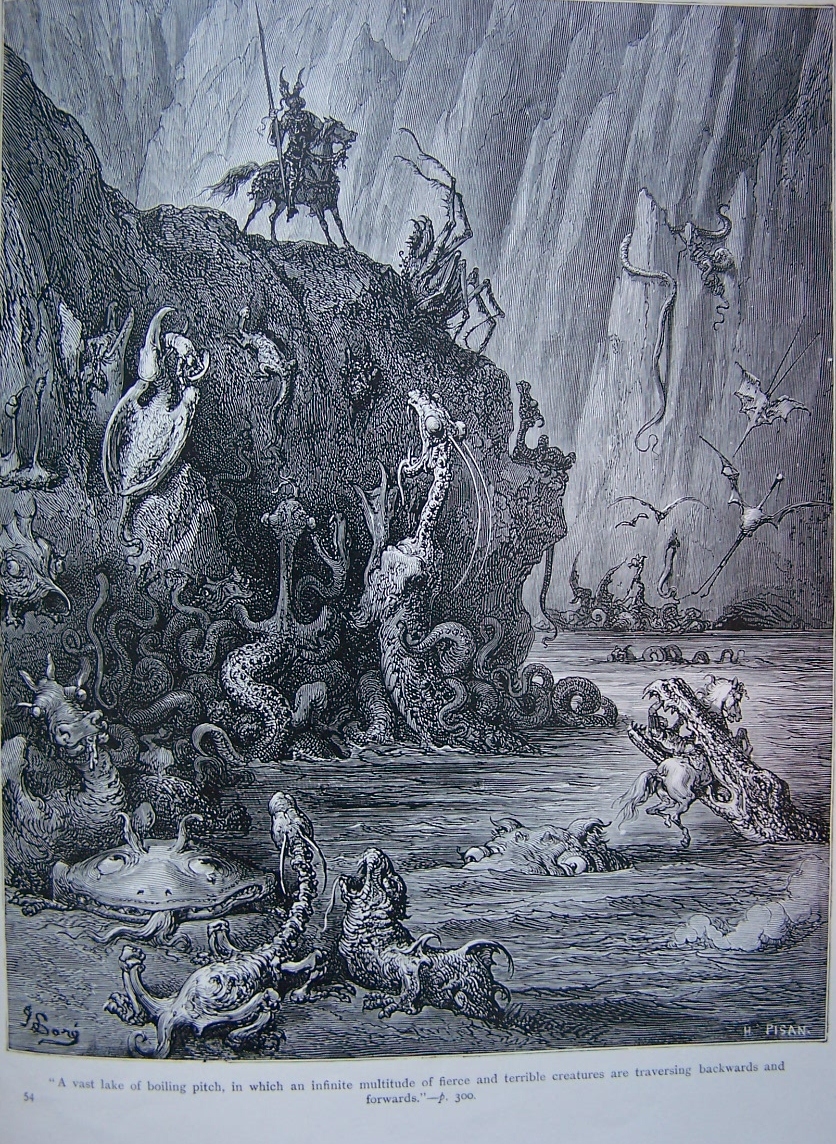
Lake of Boiling Pitchby Gustave Dore

Lake of Boiling Pitch
by Gustave Dore

‘A vast lake of boiling pitch, in which an infinite multitude of fierce and terrible creatures are traversing backwards and forwards’ is our second image and our trusty hero,  Don Quixote,  without reflection or considering dangers cast himself into the midst thereof, only commending himself to heaven and to his lady.

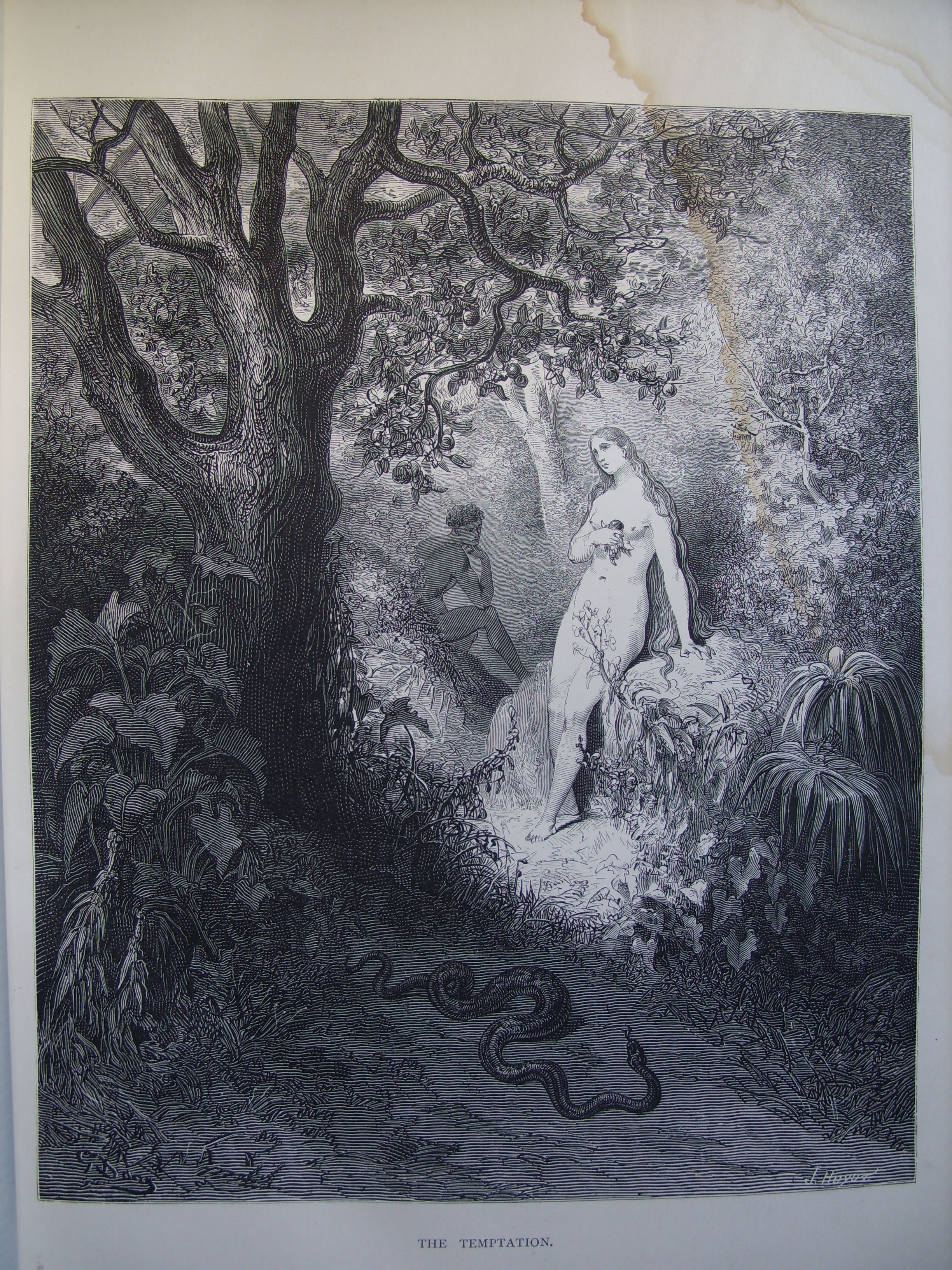
And finally, ‘The Temptation’ from the national Family Bible.

One can easily see from these few images that Dore was a truly gifted artist and well deserves his renown.

The Temptation of Eveby Gustave Dore @ 1880

The Temptation
by Gustave Dore @ 1880

Posted in Etching, Modern prints | Tagged , , , , , , , , , , , , | 4 Comments