We consider an artist who broke with family tradition and followed his own road. #GeorgeOwenWynneApperley was born into a wealthy aristocratic Welsh military family in 1884. Family tradition destined him for military service. He was educated at Eagle House, Sandhurst and Uppingham School but George forwent his military education to study art at the Herkomer Academy (1903).
He first exhibited at the Royal Academy in 1904 and had his first solo show by 1906. Apperley was elected into the Royal Institute of Watercolour Artists in 1913 but ill health saw him move to Madrid, Spain and then Grenada (until 1933). He fled Spain at the beginning of the Spanish Civil War and settled in Tangier, Morocco. Even with his absence, Spain awarded him a number of honours.
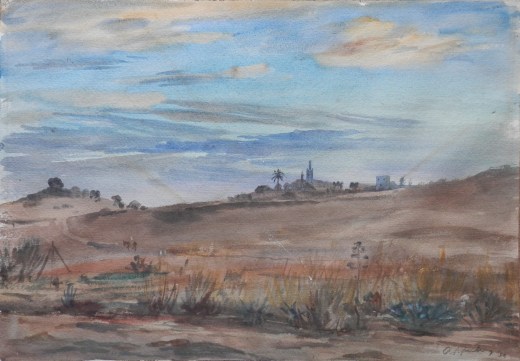 The watercolour, in my collection, is titled ‘Paissaje Tangerino‘ and shows a landscape near Tangier where Apperley lived from 1933 till his death in 1960. Whether it was a study for an oil painting or done ‘en plain air’ as a painting on it’s own, I do not know. It does show a nice use of colour and a deftness of brush stroke. I especially like the sky with it’s clouds. It is signed and date lower right on the face and again on the verso.
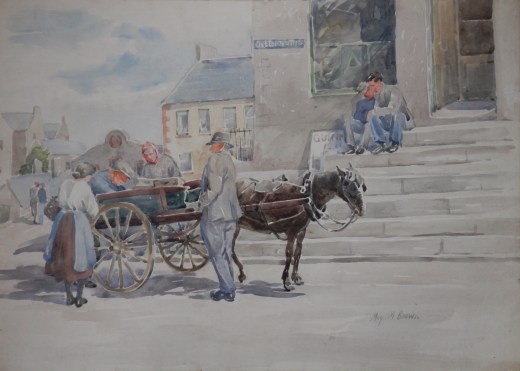
 As with many engravers of his time, he took advice from master printer Frederick Goulding. His series of etchings of Oxford (1909) and Cambridge (1910) are some of his best known works. Howard has exhibited at the Royal Society of Painters, Etchers and Engravers until 1923 and showed with a number of galleries as well as the Royal Academy. Howarth’s work was extremely popular and most of his works up to 1912 sold to collectors and were only obtainable if they came up for resale at auction. During his artistic career , Howarth worked with several printers/publishers. They would purchase the finished plate from him and produce a limited set of prints – after which the plate would be destroyed. Howarth died in 1936 at the young age of 64.

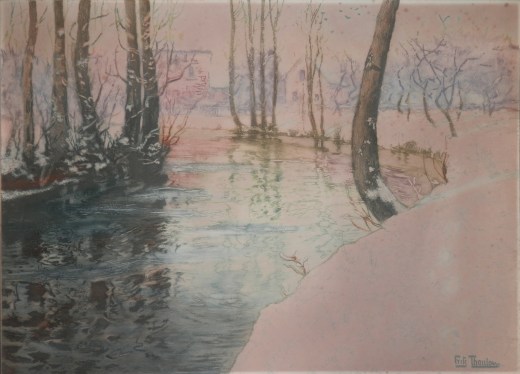 At first Thaulow focused on becoming an artist of seascapes and marine vistas but over time became more interested in landscapes especially those with small bodies of water. His masterful portrayal of water and how it reacts and reflects is sublime. Thaulow traveled between Norway and France for several years and finally settled in Paris for the last 14 years of his life. Thaulow is credited with bringing Impressionism to Norway. Thurlow did not marry, thus after his death, officials sold his studio.The aquatint presented here is titled ‘The River, Snowy Day’ or ‘Wintry Landscape’. It is known that Thaulow painted this scene several times (1 oil and 5 pastel drawings) Each with slight variations in the buildings. Mr. Vidar Poulsson, an expert on this artist, has stated that this present work was probably made during his stay at Petit-Appeville, a small village near Dieppe by the river Scie. Probably painted around 1895.
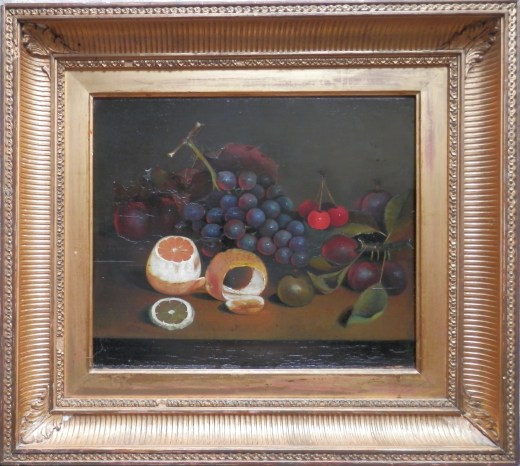 I picked up this painting a couple of weeks back. I took me some time to read the inscription which I display.
  I will admit that the information I have found on Robert Kell calls him a journeyman painter and decorator and a house painter. He did paint artistic works but the two I have seen make him a mediocre artist. The citation here (which took a while to decipher) is painted over top of the original paint and has partially disappeared. As well I have never seen any artist sign his work ‘Painted by’. If my reading is correct, the inscription reads ‘Painted By Robert Kell 1859. The date would mean this painting was created in 1859 – some 21 years before his earliest known exhibiting. The frame – although fine – is not the original in which this piece was mounted. The quality of this still life says to me that there was no reason Kell should not not have been very well known and a professional in his own right and not a house painter.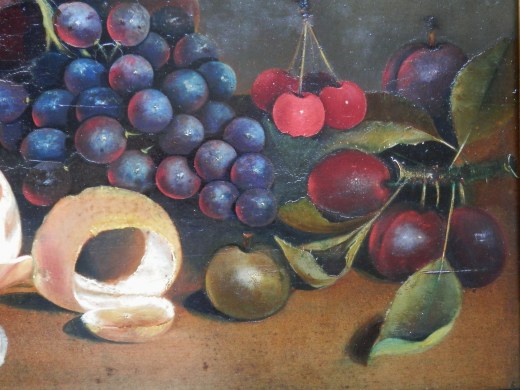
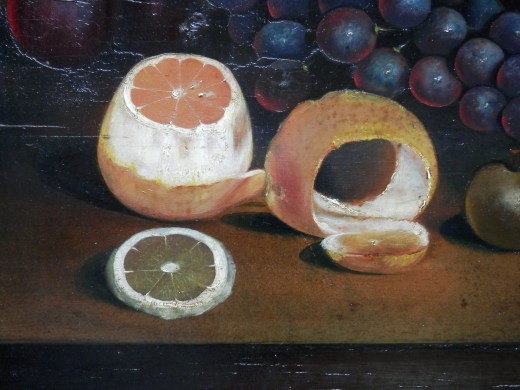 I have recently been to The Ashmolean in Oxford and visited their still life gallery. To be truthful, the quality of this piece ranks it among pieces by Old Dutch masters like Kalf, de Heem, Claesz, Hullegarden, van Son, Heda and Davidsz. I believe it to be that good. Even so, I hope you enjoy looking at this artwork which might have been painted in 1859 or it might actually have been painted around a hundred years earlier.
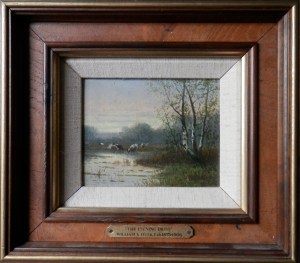 William lived in Shere near Guildford from 1882 onward and the surrounding Surrey countryside was an ever present inspiration for his paintings. He specialised in rural scenes usually including cattle and water with the effects of light and shadow on it.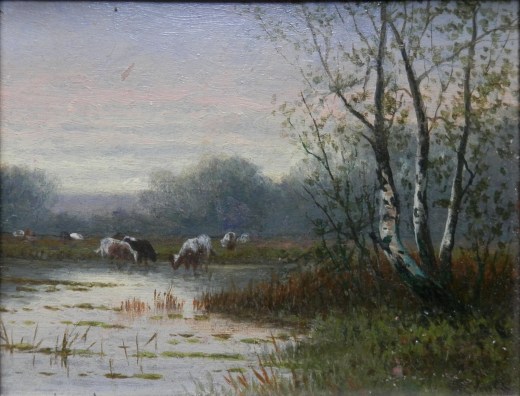
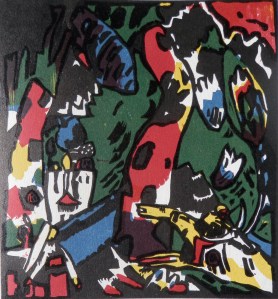 Here he taught and painted at the Bauhaus School of Art till 1933 when it was closed. Kandinsky then moved to live in Paris. He remained in France, even becoming a citizen, till his death in 1944.
  The magazine in called #Siecle XXe and I acquired numbers 3 and 4. The magazine was the brain-child of Gualtieri di San Lazaro. It was an art magazine dedicated to the promotion of modern art and artists. Artists were asked to supply works which would be used in the magazine (limited early on to 1200 copies).
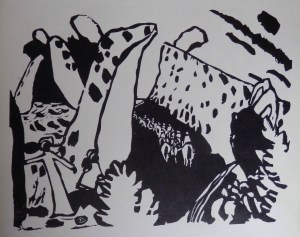
 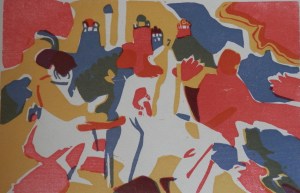 For the third volume, Kandinsky provided six #woodcuts to be reproduced – 3 in colour and 3 in black and white. Thankfully all six are to be found in the volume which I acquired. They are (as they appear in the chapter)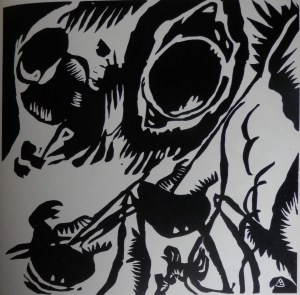

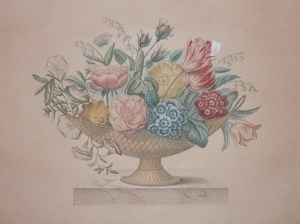 I have very few of this type of print in my collection and the best one is this still-life.
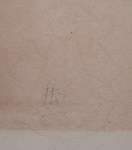 I have yet to find the watermark in any records. Nor have I deciphered the monogram.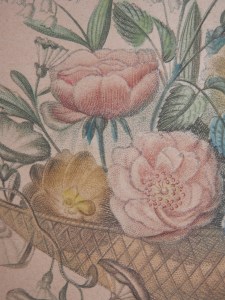
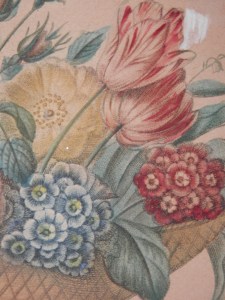 Usually only five or six colours or less were used. Here, we have red, blue, green, yellow, black and brown used in this print. One can also see the hand-finishing in the application of further colour to enhance the printed image. This type of print was made popular by #JohanTeyler (1648-1709). Téyler, himself, was not an artist but a mathematician. He did own the patent for the multi-colour printing technique he used and most likely set up a publishing house which employed engravers to produce the plates and prints.
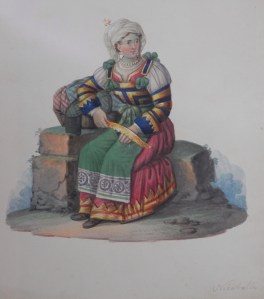 Little is known in regards to this female painter. She was born in Abruzzi, Italy and was known to have worked and resided in Naples when she became a known and respected painter. She may have been the daughter or possibly sister of Camillo de Vito another well known painter of gouache scenes of real life.
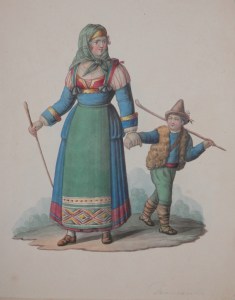 Michela worked in the early part of the 19th century. This is corroborated by the watermark found on one of the pieces I have. The watermark reads ‘ J Whatman Turkey Mill 1837‘. As an artist she was described as “A refined painter, very skilled when it came to drawings, she had the characteristic to make her subject more gentle, compared to her male collegues”.
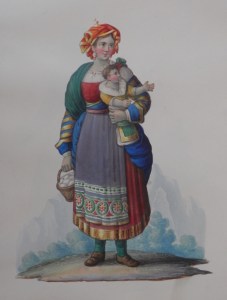 Three love pieces. Very typical of her work and historically important in regards to the history of local folk costume of the time.
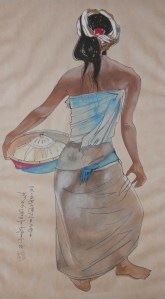 Lee moved to Jakarta to become an art editor for a newspaper but left after six years to establish his own advertising agency. Although, he owned his own company, Lee never gave up his own artistic pursuits. Lee became a full time artist in 1941. He was imprisoned for a time during the Japanese occupation. While imprisoned he befriended Sukarno (later to become Indonesia’s first president). After the occupation, Lee traveled to Holland to work and study.
 ronsartblog