I bought a picture at a charity shop in town this week past. Nothing new there. It was old, stained, and mediocrely framed. Due to its’ condition most people would pass it by but that is just not me. So, for only a few pounds, it was mine.And now the fun begins. The shop likely did as I in looking for information on the picture. I entered the name at the bottom of the picture into the web but nothing comes up in regards to this name. It is now time to study the picture and gain clues. The first thing I discover is that what I took in the shop to be a lithographic print was actually a drawing done in charcoal with added body colour (white) and other light touches of colour. 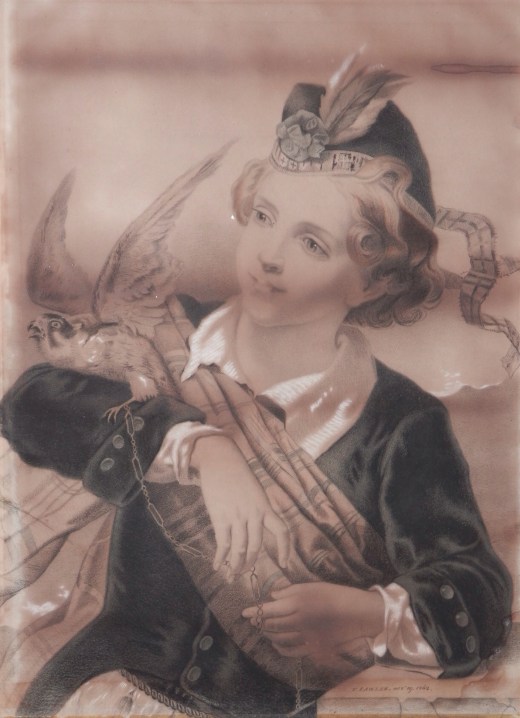
So, discovery number one. It is an artist rendering. Next, the boy has a falcon. Falconry was an aristocratic sport when this picture was done, 1862. We might deduce from that that the young man is an aristocrat. The young man is wearing Scottish garb. Thusly either Scottish or British royalty. The tam which adorns his head is a #Balmoral ribboned and the tartan we wears could be a royal tartan although without colours I am not sure. Now, if we do suggest that the young man is a royal and possibly at Balmoral, who might he be. In 1862 that royal would have to be Albert Edward, Prince of Wales. Later to be #KingEdwardVII. He is grandfather to our present queen. I have looked at images of Albert Edward and am convinced I am correct in naming the young man pictured as #AlbertEdward,PrinceofWales. There is also a clue in the picture which may mean nothing but I think it a cheeky clue to insert. The chain which is tethering the falcon is an ‘albert’ chain.
I hope you enjoy this image and I wish I could tell you more in regards to the artist for it is a fine likeness even though stained. It has live and will continue to live a well loved life.
 Paper is an amazing concept. We fold it, mould it, pierce it, print on it, paint on it, etc. The pieces which I display in this post show a number of combinations to which paper has been put to use. The first is a keepsake card/bookmark with moulded and pierced edges surrounding a printed etching. The second is another with moulded edges (far more extensive) enclosing a printed image.
 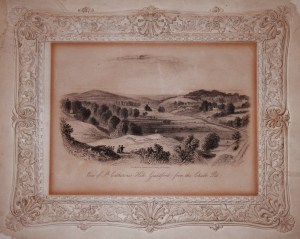 The final piece is one which has been embossed, impressed, pierced, cut, coloured, layered, and printed. The creation of something unique and personal.
  Paper an invention which changed the world and continues to influence the world of art. An amazing and versatile creation.
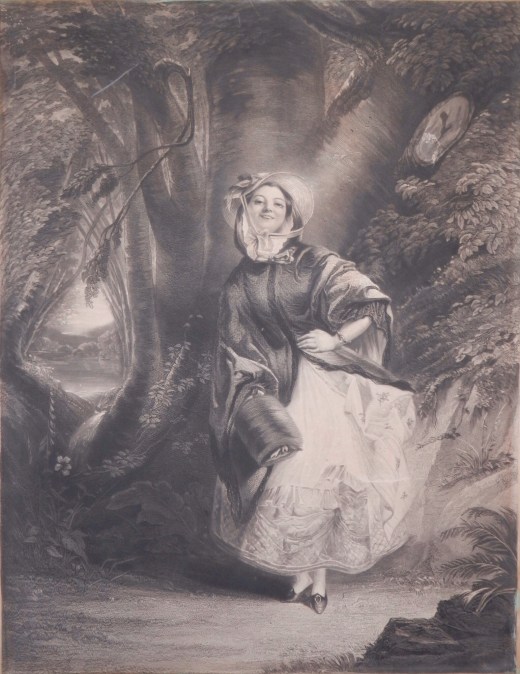 Dolly Varden is a young lady in Dickens’ Barnaby Rudge. #BarnabyRudge was produced by Dickens during 1840-41 in serial form. It was intended to be Dickens’ first publication in book format but due to publication problems it was actually his fifth published book. If it had been published first, he might have struggled with other books because it is considered to be his weakest effort. Barnaby Rudge is largely set during the Gordon Riots of 1780. The Gordon Riots began as an anti-Catholic protest in London against the Papist Act of 1878. The protests devolved into rioting and looting. The riots also occurred at the height of the American War of Independence and rumours ran that they were influenced by France and Spain in an attempt to weaken Britain.
 Welcome to ‘Christina’s World’. The original of this study hangs in the MoMA in New York as part of it’s permanent collection. It is roughly 32″ by 47″. It was created in 1948 by Andrew Wyeth. The study which is shown here is 10″ by 13″. The fine brushwork used is superb and painstakingly precise, although some of the fine work on the original has been lost due to the reduction in size. There are also a number of minor variations in the rendering, evenso, this is a finely painted study by RC Maddison.

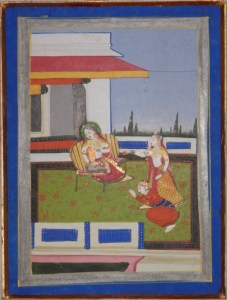
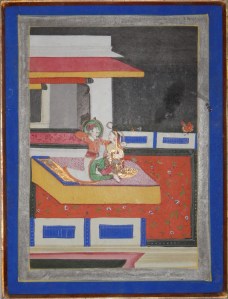
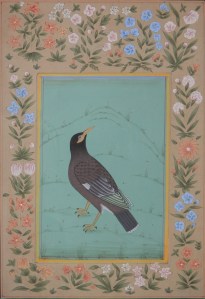
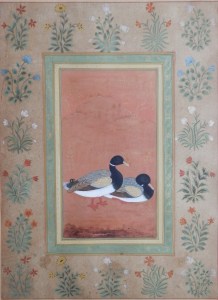
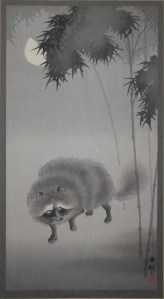
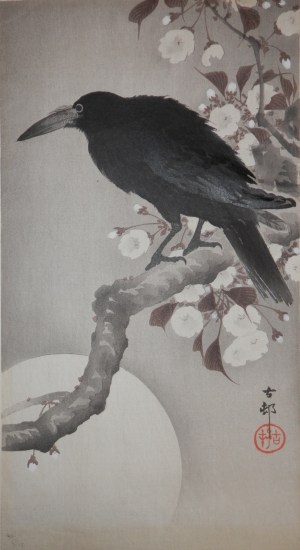 In Tokyo, Koson worked with a number of publishers. He concentrated on works which portrayed birds and flowers although he did produce works – triptychs- illustrating scenes from the Russo-Japanese war.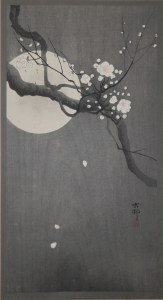

 ronsartblog