Art from Nepal and Bali

While I continue to grow my art collection I often come across artworks which I am unfamiliar with.  Certainly with the following pieces my naivety is abundant and so I research to increase my knowledge and appreciation of the artworks themselves.
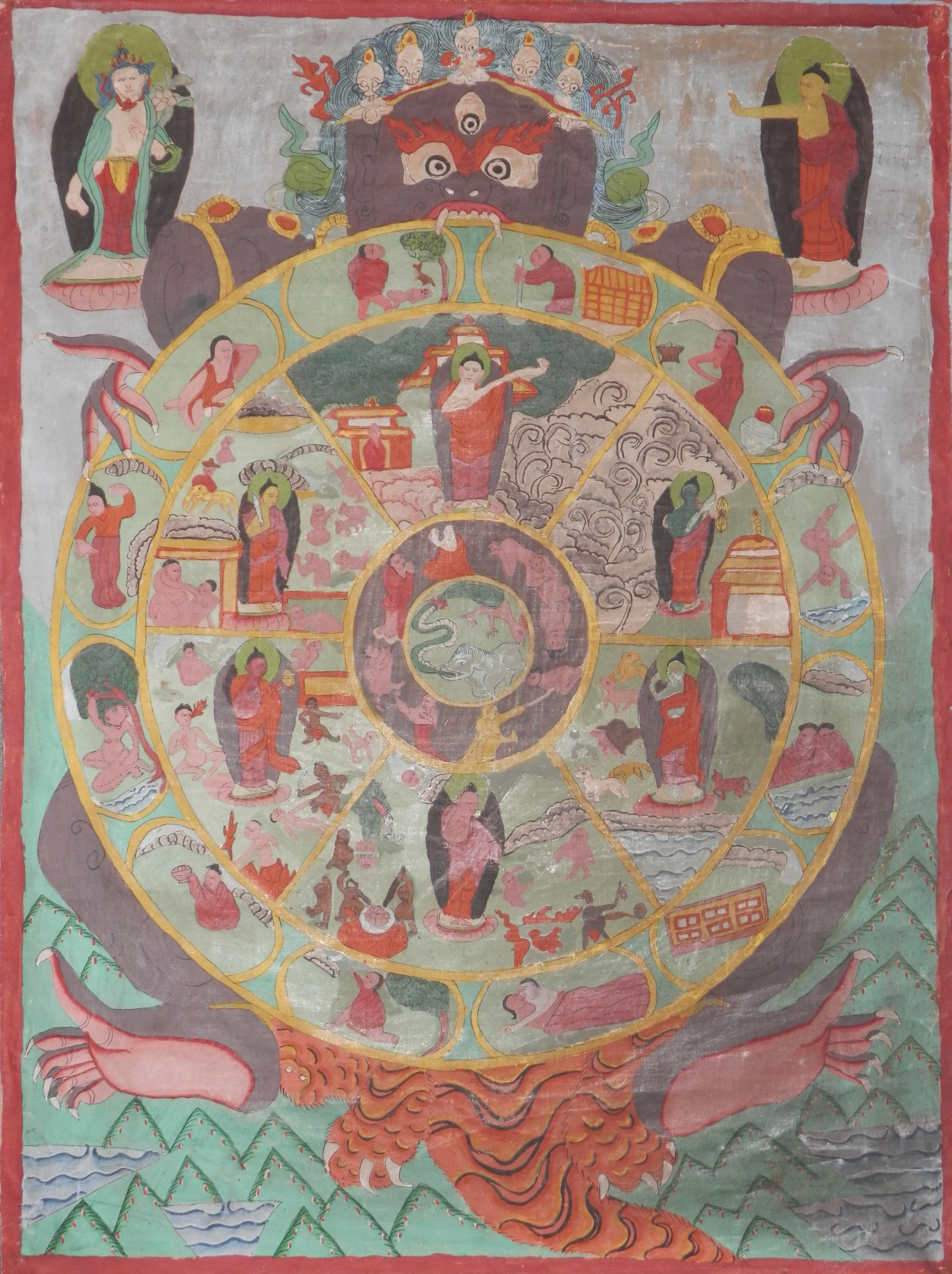
Wheel of Life Thangka

Wheel of Life Thangka

A thangka is a religious painting.  #Thangka painting evolved as early as the ninth or tenth century and has remained popular to this day.  Early  Thangkas are simple in design and composition. The main deity, a large figure, occupies the central position while surrounded by smaller figures of lesser divinities.  Tibetans do not sell Thangkas on a large scale as the selling of religious artifacts such as thangkas and idols is frowned upon in the Tibetan community and thus non-Tibetan groups have been able to monopolize on its (thangka’s) popularity among Buddhist and art enthusiasts from the west.

The #WheelofLife to the left is crude and naive.  It lacks the finesse and intricacy of many thangkas which are seen today as well as in the second of my thangkas. OLYMPUS DIGITAL CAMERA
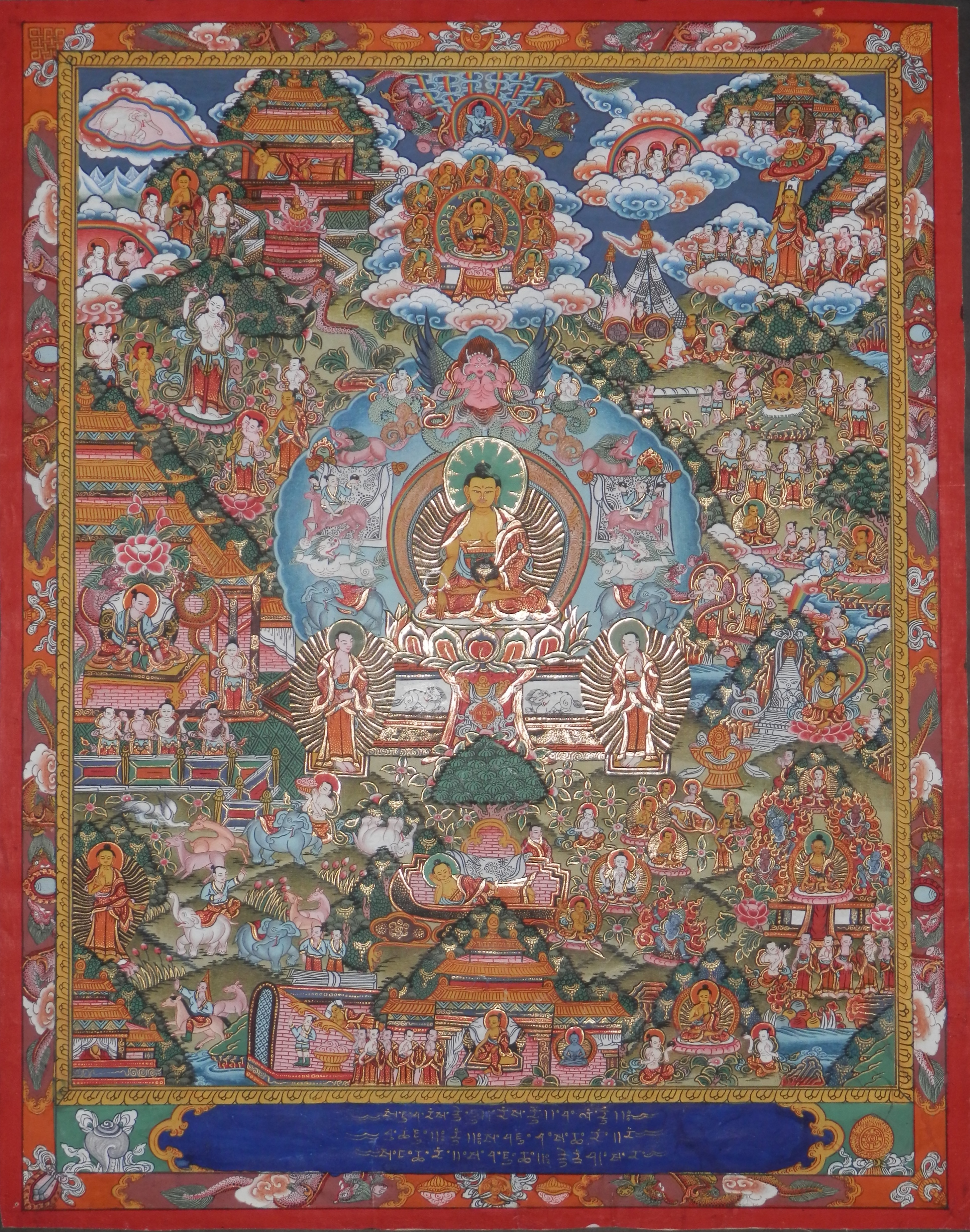
The #LifeofBuddha is a much finer example of what a thangka can be.  As a religious image it can be used as an icon but it is also meant to be a religious experience for the artist while rendering the image.  Thangkas are painted on cotton or silk and are highly geometric. All elements of the painting are all laid out on a systematic grid of angles and intersecting lines. A finely rendered thangka can take over two months to paint. A skilled thangka artist will generally select from a variety of predesigned items to include in the composition, ranging from alms bowls and animals, to the shape, size, and angle of a figure’s eyes, nose, and lips. The process seems very methodical, but often requires deep understanding of the symbolism involved to capture the spirit of it.

Sayan-Baung by Nyoman Tapa Ubud, Bali

Sayan-Baung
by Nyoman Tapa
Ubud, Bali

#NyomanTapa (1958-) is a Balinese artist with a very fine touch.  He paints wonderfully colourful and intricate religious celebrations and festivals as well as Balinese life images.
Posted in Oil Paintings | Tagged , , , , , , , , , | Leave a comment

Art Inspired

I am always amazed at what people give away. Do we lack taste or appreciation of art? Maybe because it is old we think it unworthy of our modern world? I think in some respect we do lack an appreciation for old things unless we are told it is worth while by someone else.  Granted the eyes with which I look at art have not changed but they have been refined – tutored even – in the appreciation of the talent, of the creativity, of the genius even of some artists.

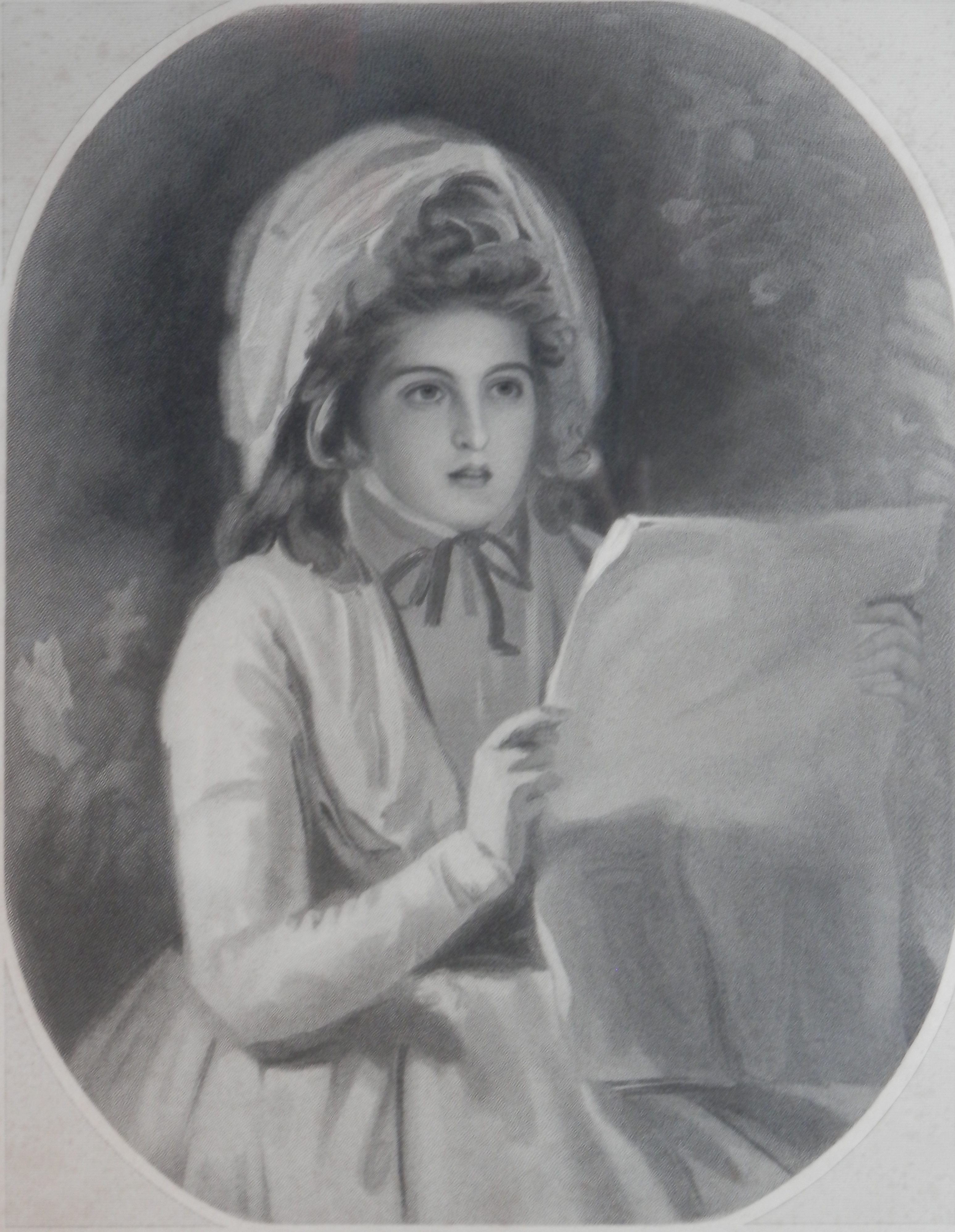
Lady Hamilton as 'Serena' stipple engraving by Francis Holl

Lady Hamilton as ‘Serena’ stipple engraving
by Francis Holl

Firstly, a superb  stipple engraving by #FrancisHoll (1815-1884) of Lady Hamilton as ‘Serena’ reading a newspaper of Lord Horatio Nelsons naval accomplishments. From an earlier chapter you might remember that Lady Hamilton was considered to be one of the great beauties of her time.

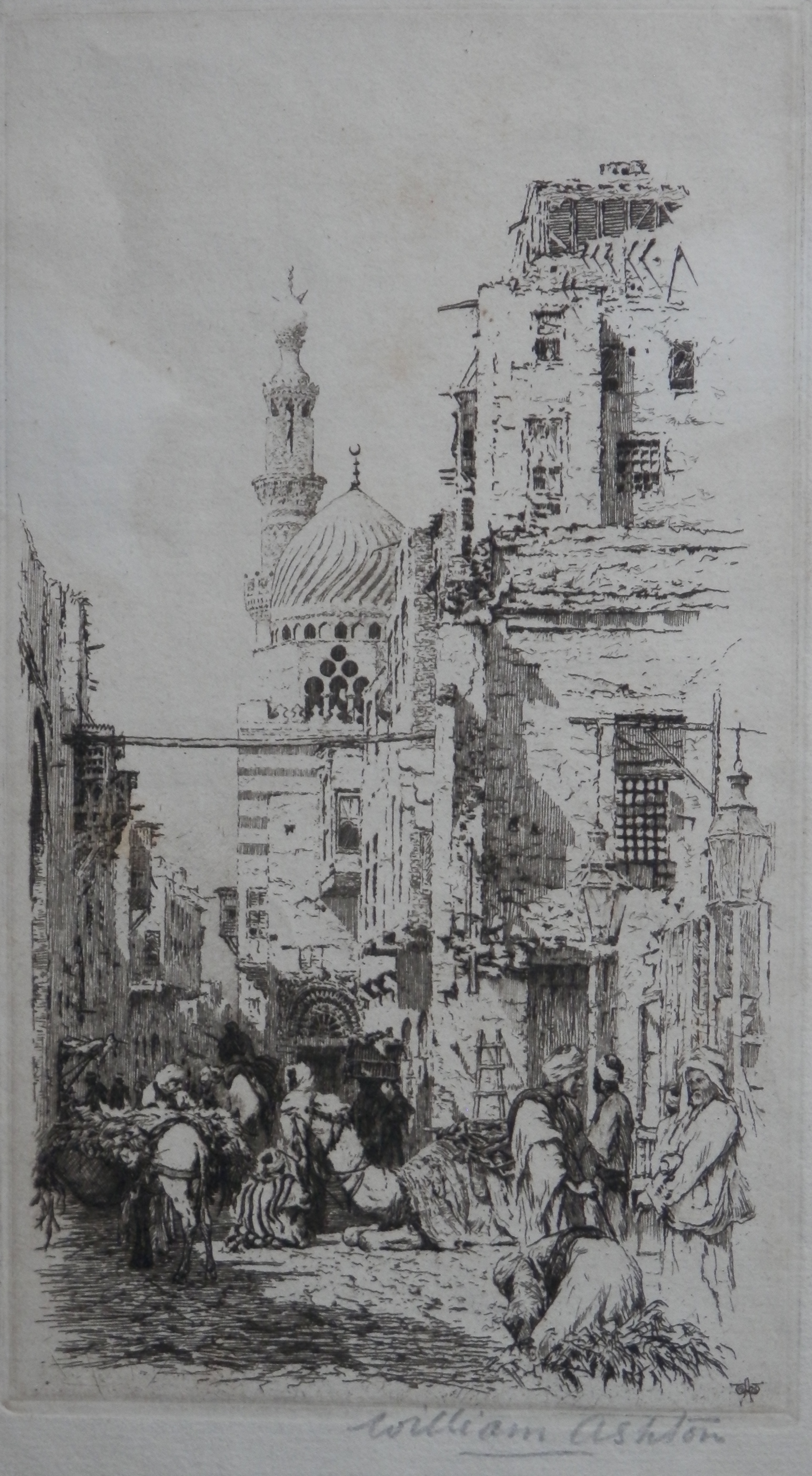
Mosque near the Citadel, Cairo @ 1926  by William Ashton

Mosque near the Citadel, Cairo @ 1926
by William Ashton

#WilliamAshton (1881-1963) was not an etcher for very long in his artistic life.  He made around 25 etchings in total. This one from 1926, displays a street in Cairo.  I believe the tower in the back ground stands over the Bab el Zuela.  A very fine etching and I wonder what great heights he might have reached in the field if he had continued.

Girl's Portrait unknown artist aquatint/etching

Girl’s Portrait
unknown artist
aquatint/etching

And now to what I think is exceptional talent. An exquisite aquatint by an unknown artist. The subtleness of the portrayal just adds to the beauty of the girl. making this just lovely to behold.

Posted in Etching | Tagged , , , , , , , , , , | Leave a comment

Art To Be Thankful For

Today an artistic and a medical advance which helped develop their concerned fields.

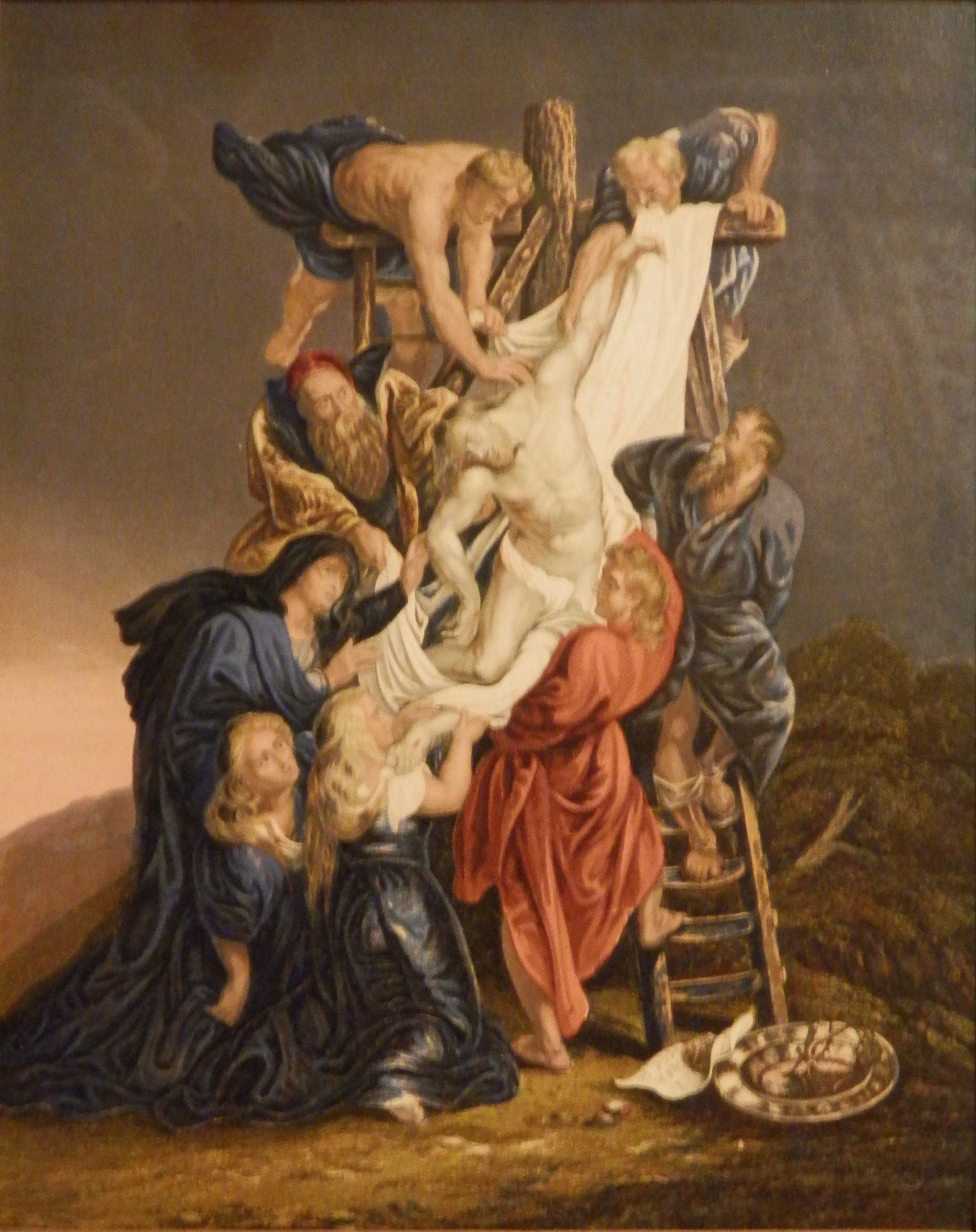
Descent from the Cross 1855 by George Baxter after Rubens

Descent from the Cross 1855
by George Baxter
after Rubens

We begin with #DescentfromtheCross.  A colour print by #GeorgeBaxter.  Most of us would not recognise his name but we possibly should. George Baxter developed/advanced the art of coloured printing.  Baxter prepared a main or ‘key’ plate, usually steel, using any combination of engraving, stipple, etching and aquatint.  The key plate provided the main lines of the image and much of the tone, light and shade.  It was usually printed in a neutral tone, such as light grey or terracotta.  Often Baxter used more than one colour to ink the key plate – for example, to gradate the image from blue in the sky, to buff in the middle distance and to a darker colour in the foreground.

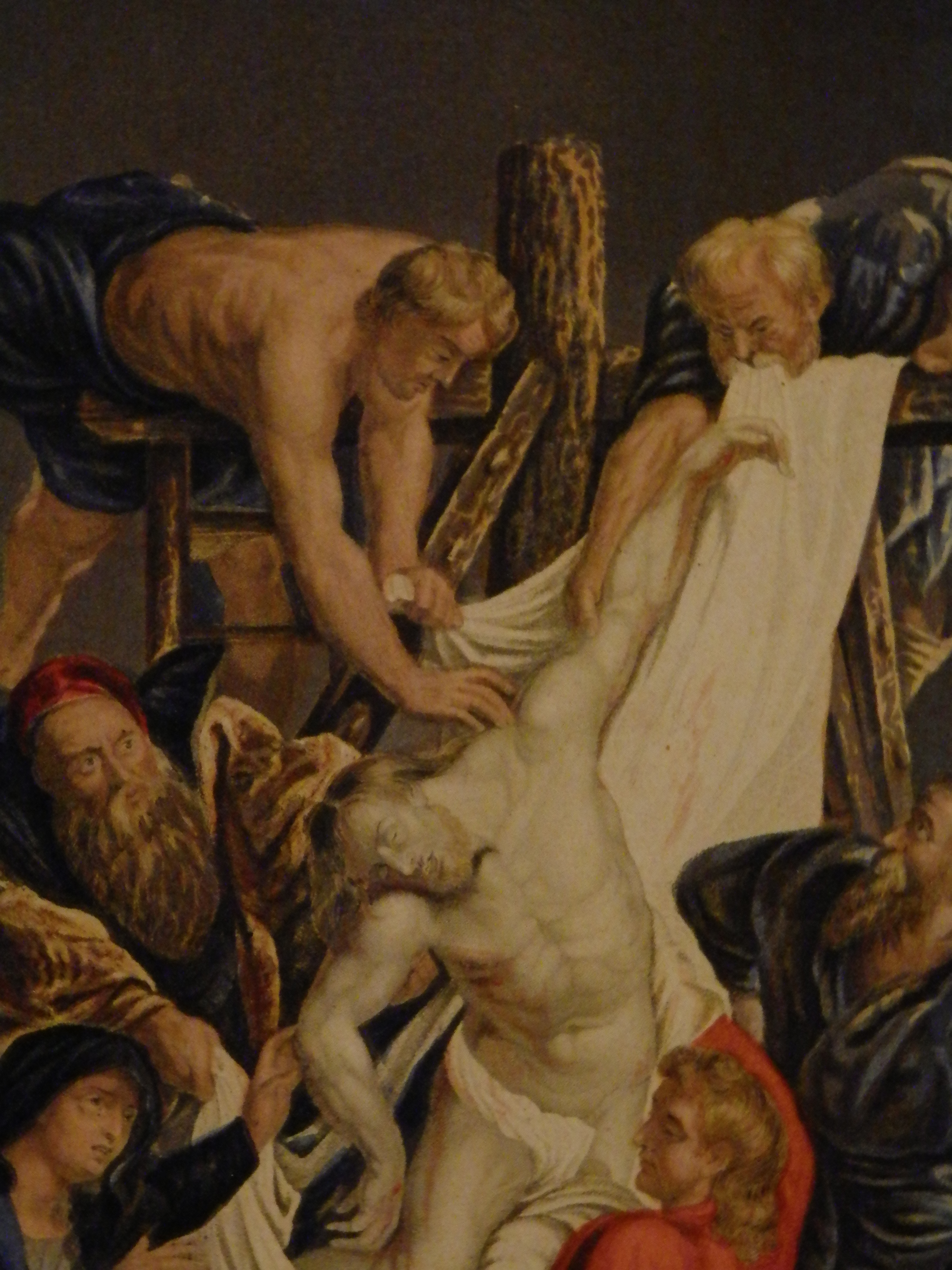
Descent from the Cross detail A 1855

Descent from the Cross detail A
1855

Following the printing of the key plate, relief blocks were prepared, usually from wood, zinc or copper, using impressions of the key plate to create the blocks.  Usually one block was prepared for each colour, although sometimes two or more colours or tints were included on the same block, requiring hand inking of each individual area.  Each colour was applied and allowed to dry before adding the next colour.  It is thought that Baxter usually started printing with a blue tint and then progressed through the other colours in a predetermined order – all blocks were numbered sequentially and labelled with the colour to be used.  Sometimes up to 24 separate colours were used, although ten could be considered an average number.  Baxter achieved his precise registration by fixing the print over a number of spikes, over which the blocks would also fit.

The image on the left is thought to be Baxter’s finest coloured print.

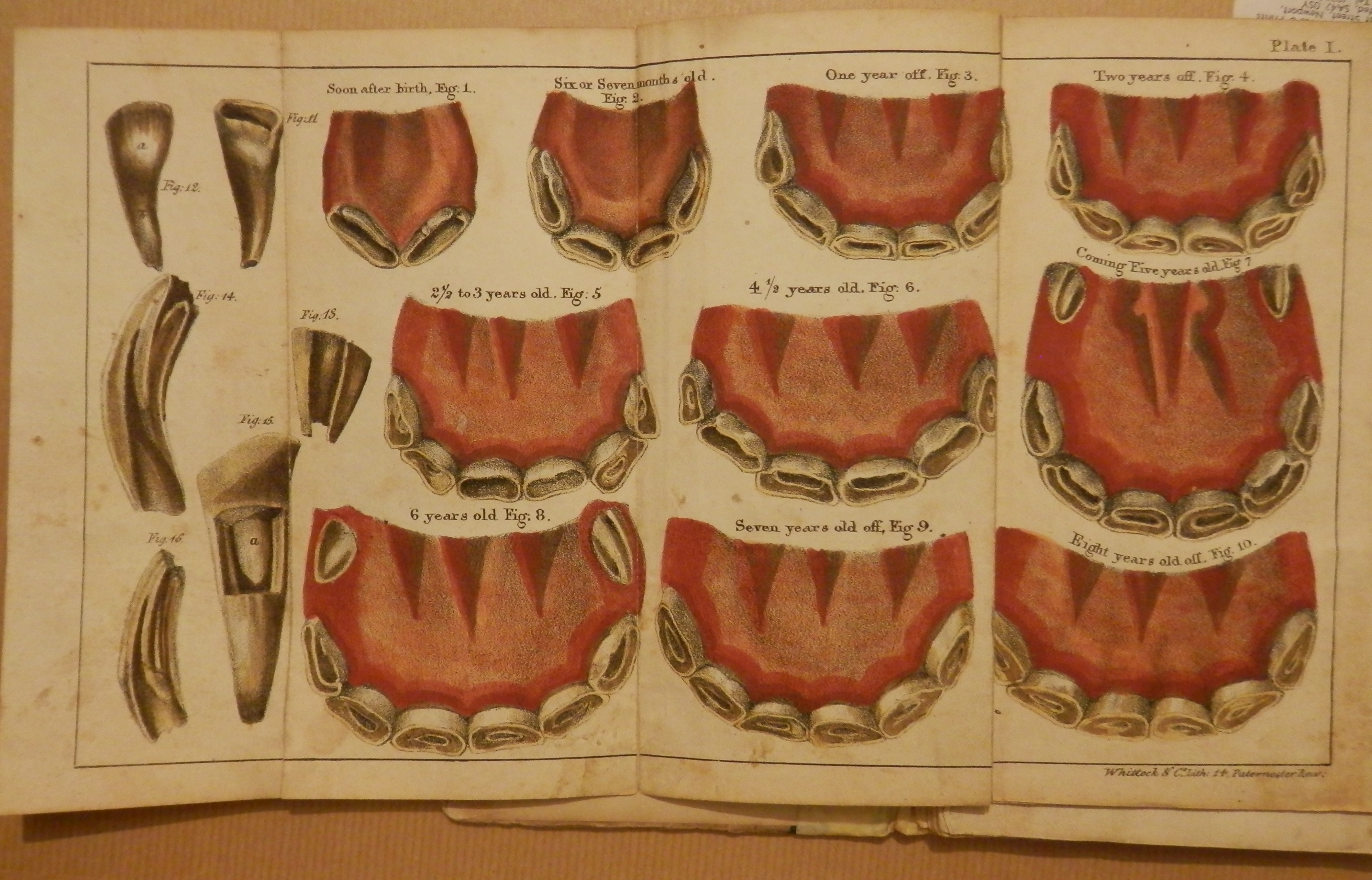
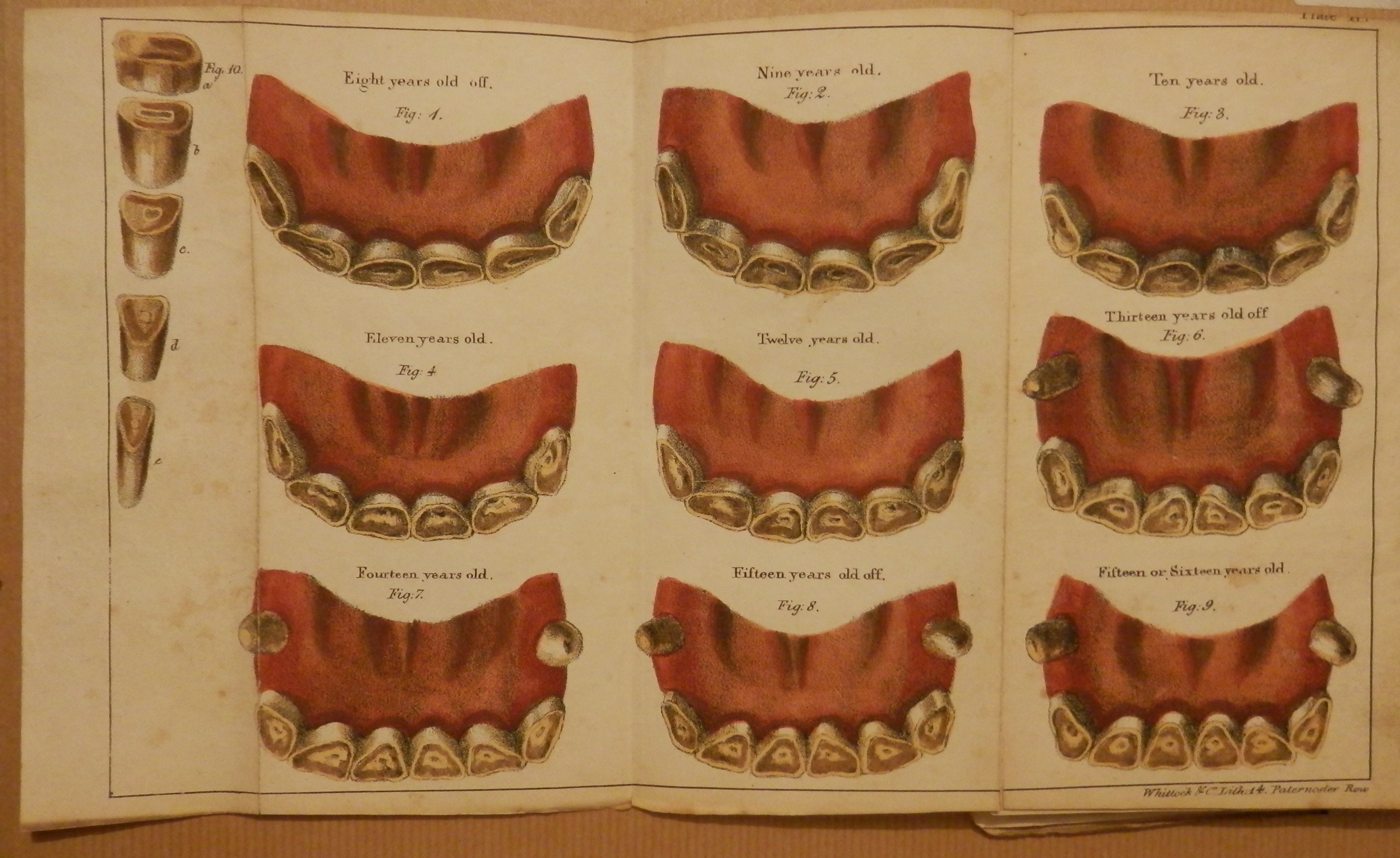
We go to a translation of a treatise by M Girard, Director of the Royal Veterinary School at Alfort.  The translation is by T Irwin Ganly.  This publication from 1829 was to prove most helpful for all veterinarians, breeders, farmers, and all others who worked with horses.  For up to that time no definitive work had been done on horses age past its working prime of 8 years in age.  One really should know if you’re buying a horse which is ten years old or eighteen.  From my 1829 first edition I give you the two plates describing the teeth of a horse.

Girard's Treatise on the Teeth of the Horse 1829 Plate 1,

Girard’s Treatise on the Teeth of the Horse 1829
Plate 1,

Girard's Treatise on the Teeth of the Horse 1829 Plate 2

Girard’s Treatise on the Teeth of the Horse 1829
Plate 2

Posted in Etching, Lino/woodcuts, Lithographs, Mezzotint | Tagged , , , , , , , , , , , , | Leave a comment

Art in Portrait

Since I started collecting art pieces, I have acquired several portraits of fairly well known people. Granted the pieces tend to be fairly old but it is amazing what one can do scratching marks on a copper plate.

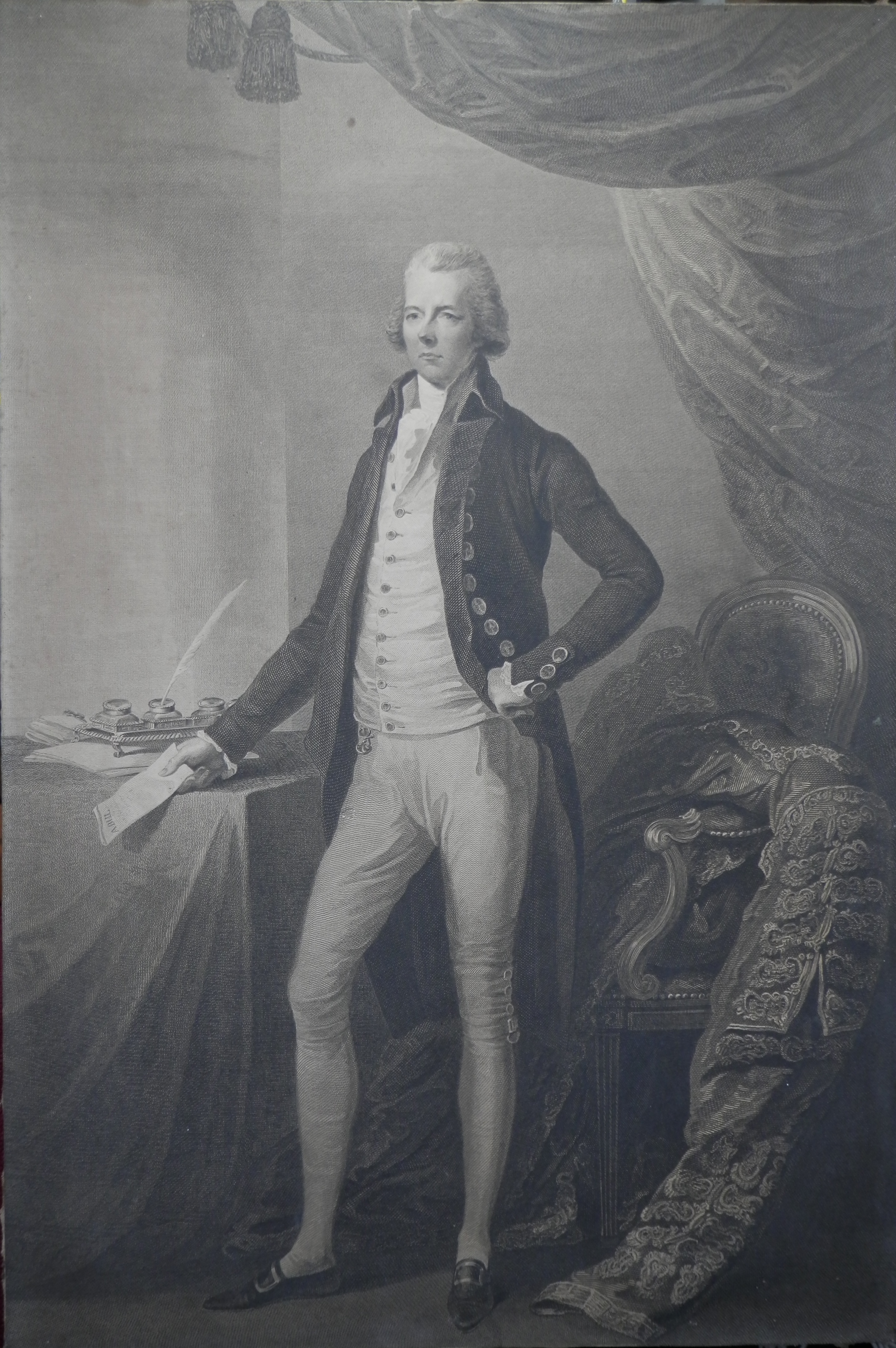
The Right Hon. William Pitt etching by William Bromley 1808

The Right Hon. William Pitt
etching by William Bromley 1808

A fine engraving by WILLIAM BROMLEY (1769-1842) of WILLIAM PITT THE YOUNGER (1759-1806). It was published by Robert Bowyer in June of 1808. Pitt is known as Britain’s youngest Prime Minister.  He is best known for leading Britain in the great wars against France and Napoleon. #WilliamPitt was an outstanding administrator who worked for efficiency and reform, bringing in a new generation of outstanding administrators.  One of Pitt’s most important accomplishments was the revitalisation of the nation’s finances after the American War of Independence.  Pitt helped the Government manage the mounting national debt, and made changes to the tax system in order to improve its efficiency.  There were other not so successful  plans such as his failure to secure parliamentary reform, emancipation, or the abolition of the slave trade (this occured a year after Pitt’s death)

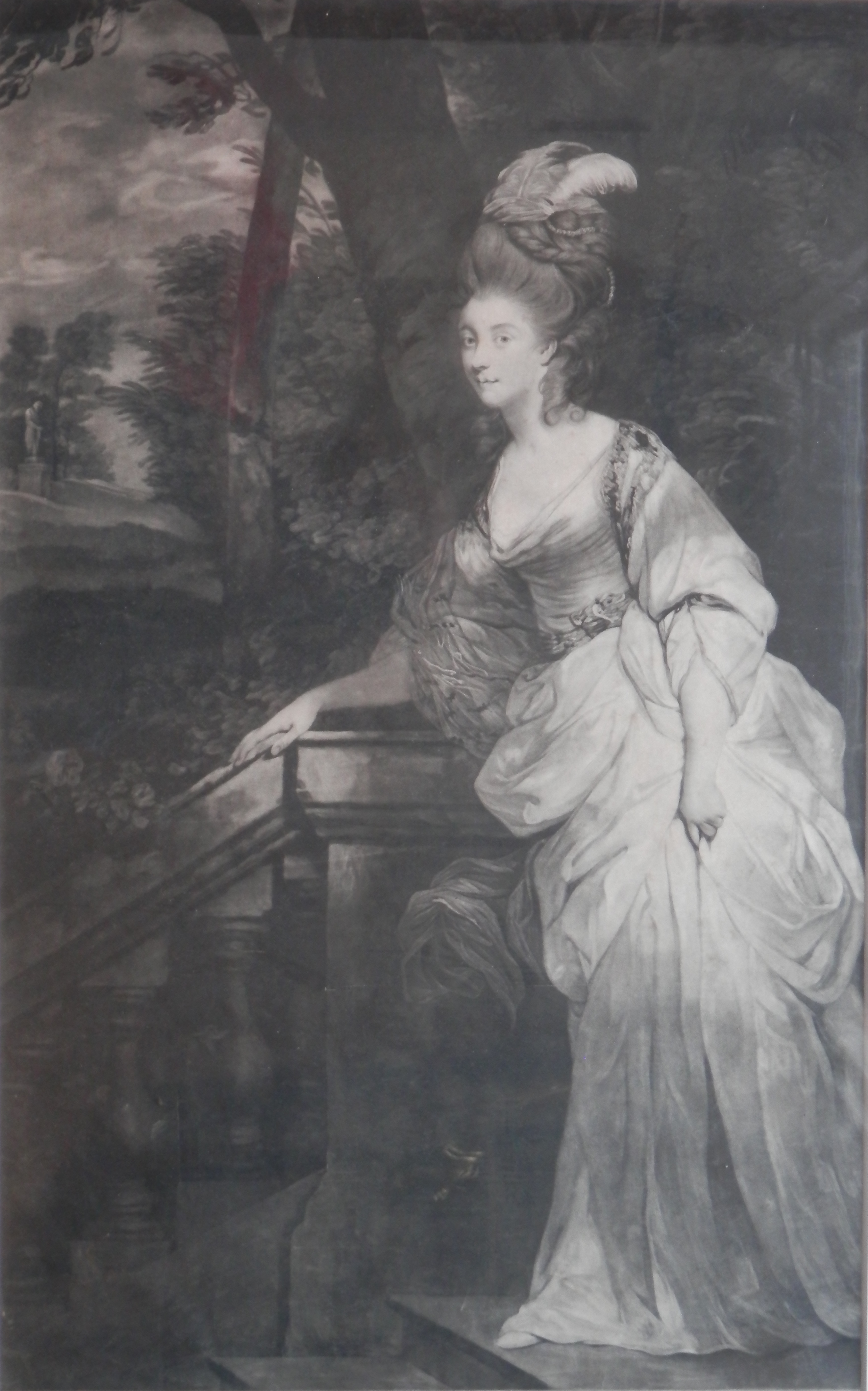
Georgina, Duchess of Devonshire mezzotint by Valentine Green

Georgina, Duchess of Devonshire
mezzotint by Valentine Green

From a copper engraving to a mezzotint by Valentine Green. We see #Georgina,DuchessofDevonshre posing on the patio most likely at Chatsworth House.  The Duchess of Devonshire was of renowned beauty and into her social circle she gathered a great many literary and political figures.

And since I wish for my readers to focus on the art in todays chapter and not the information which I post about them, I will finish with  another mezzotint but this time by William Dickinson.

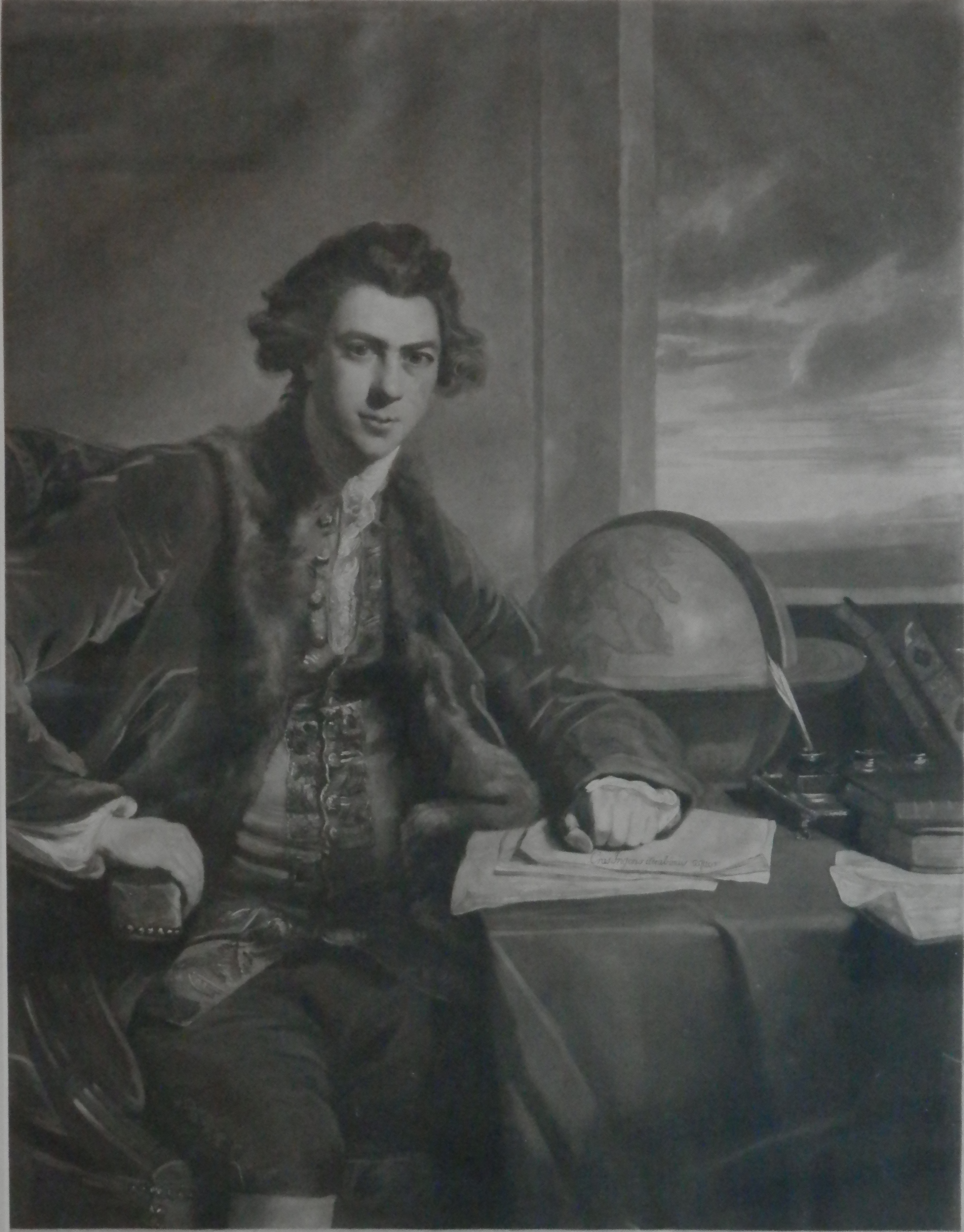
Joseph Banks mezzotint by William Dickinson

Joseph Banks
mezzotint by William Dickinson

Born into a life of privilege, #JosephBanks did not settle down to a life of elegant excess, having ‘married well’.  His passion was for knowledge.  His first research endeavour was to Newfoundland and Labrador from where he returned with many collected specimens, including some 340 plants.  Joseph Banks’ next expedition was one of the great missions of discovery in history, as he joined then Lieutenant James Cook on his first journey to the South Pacific. The primary mission was to record the transit of Venus across the sun. It was the secondary mission of the expedition that held Banks’s interest; to record all manner of plant and animal life encountered.

Three famous personages wonderfully portrayed by artists of sublime skill.

Posted in Etching, Mezzotint | Tagged , , , , , , , , , , , , , , | Leave a comment

Art of Madonna and Child

Throughout history, the Madonna and Child has been a recurring if not favourite image for artists to portray.  In my small collection I have several images of the ‘Madonna and Child’.  From the unknown artist to the world renowned, many have portrayed the image of mother and child in embrace.

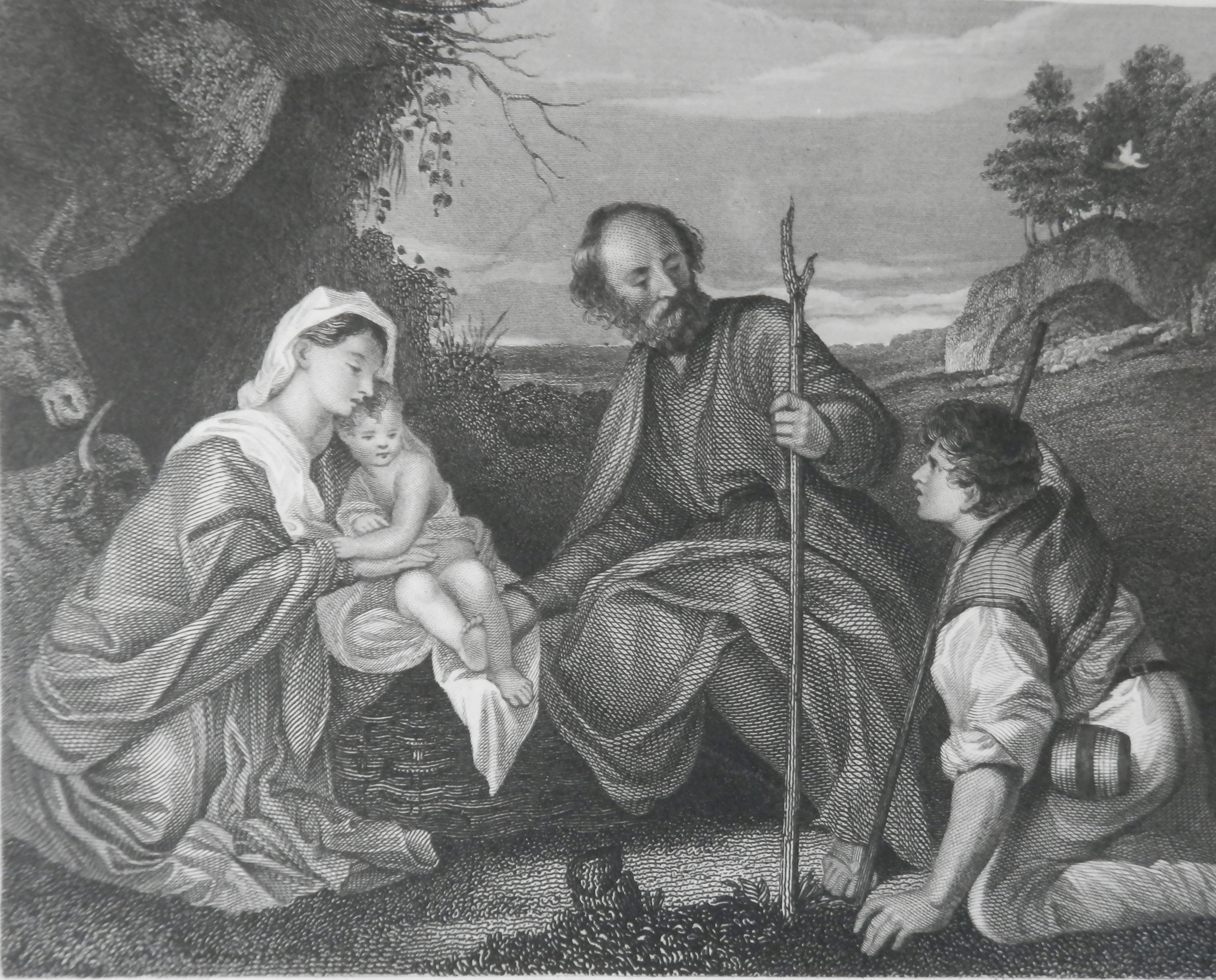
The Holy Family with the Adoration of a Shepherd etched by Joseph Rolls @ 1836

The Holy Family with the Adoration of a Shepherd
etched by Joseph Rolls
@ 1835

Engraved by #JosephRolls in 1835 after a painting by Titian. We see Mary cradling the infant Jesus with Joseph attending while a shepherd pays homage. The original painting by Titian hangs in the National Gallery. Exquisitely etched by Joseph Rolls, the variations in tone and colouring all done by the addition or subtraction of lines of varying depth on a copper plate.  Why only one shepherd – we don’t know but if you look closely above the shepherd boys’ right shoulder you will see the annunciation to the shepherds.

From an etching after a classic by Titian to another artist’s rendering of the Madonna and Child.

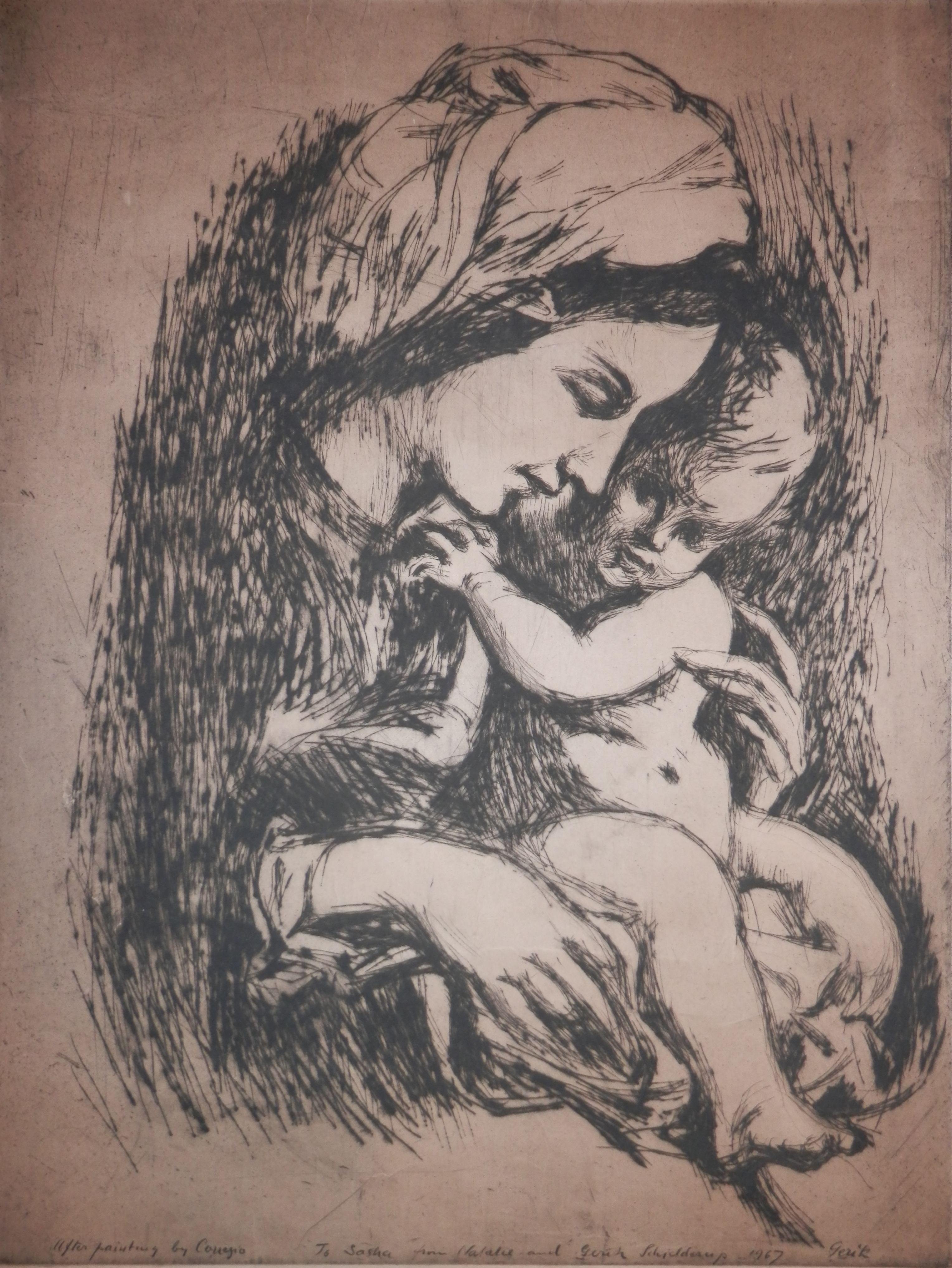
Madonna and Child etching by Gerik Schjelderup

Madonna and Child
etching by Gerik Schjelderup

An etching which I recently added to my collection.  It is after a fresco by Correggio (the ‘Madonna della Scala’). It is etched by Norwegian artist #GerikSchjelderup (1899 – 1985).  I know little about the artist but talent he does have. A confidence of line and a slight over inking adds extra depth to the image.  The over inking also extends a softness and possibly even tenderness to the pairing of mother and child – a bonding beyond description – a hope – a trust – a faith in a future yet to unfold.

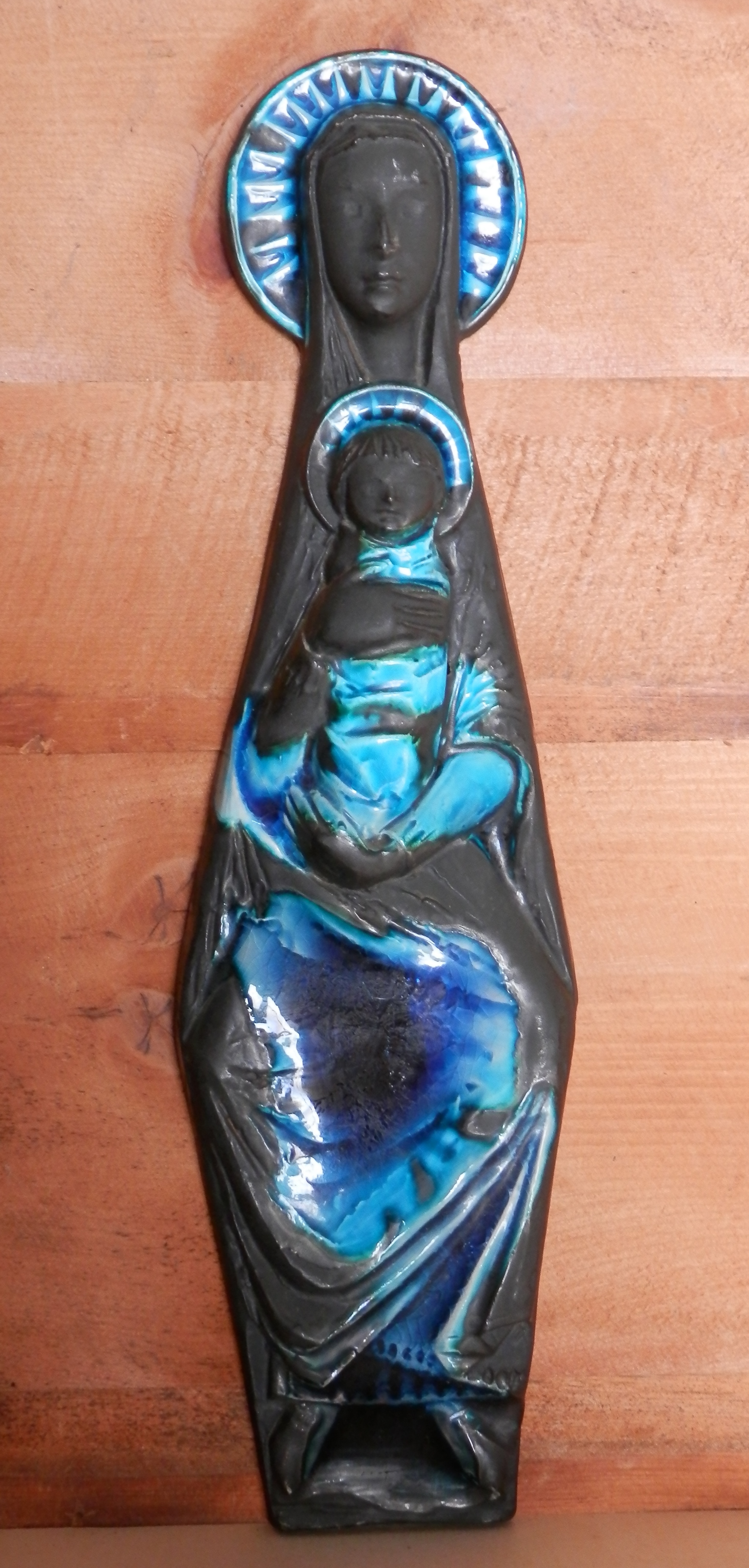
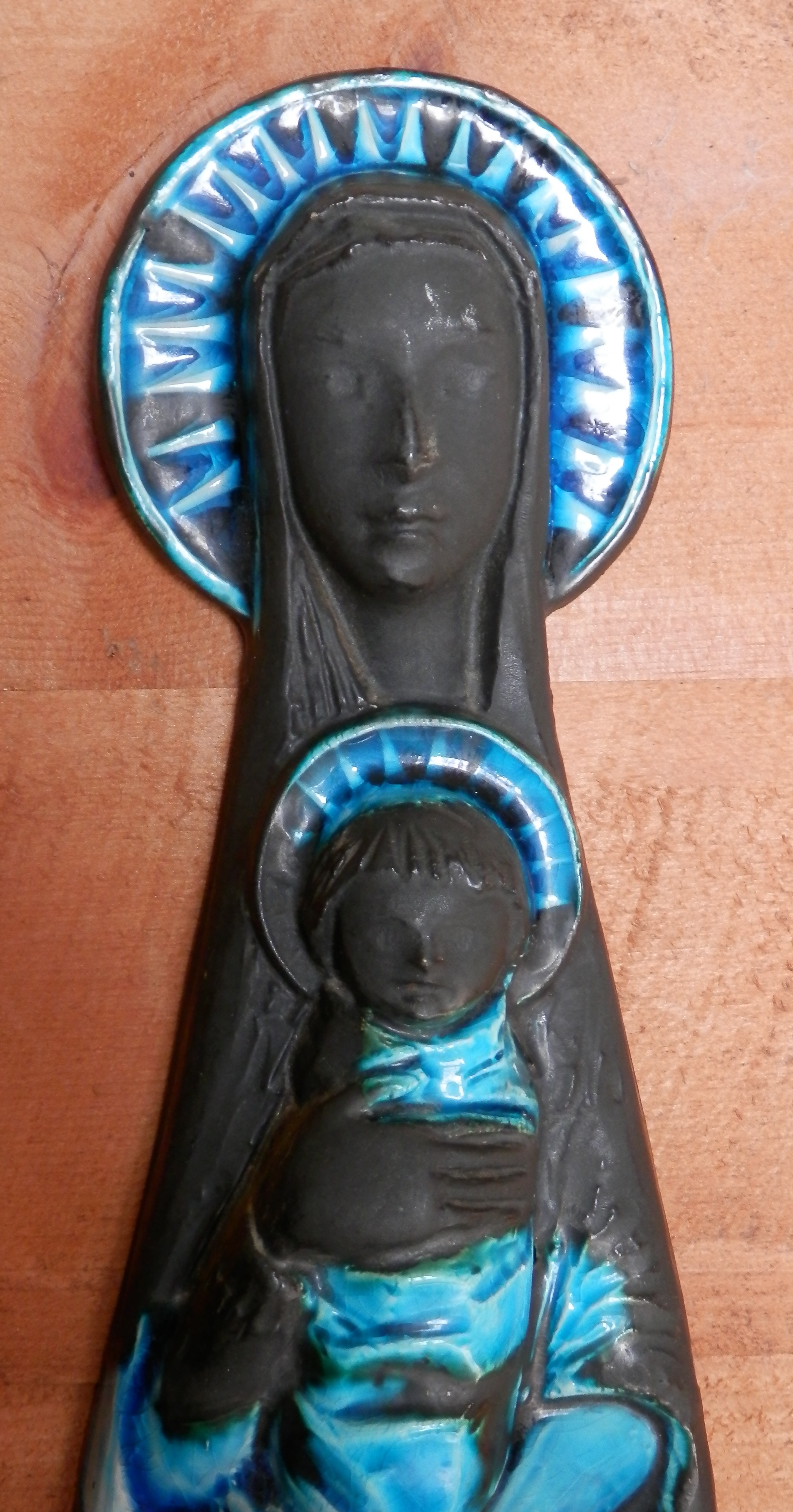
And finally a ceramic sculpture by Polish studio artist #JanuszLewald-Jezierski.  Another artist I know little of but a man who has gifted hands and eyes to create  beautiful things from clay and ceramic.

Madonna and Child by Janusz Lewald-Jezierski

Madonna and Child
by Janusz Lewald-Jezierski

Madonna and Child by Janusz Lewald-Jezierski

Madonna and Child
by Janusz Lewald-Jezierski

Not sure how old this Madonna and Child is – possibly from the 60’s or 70’s. Highlighted in tones of glossy blue – against a flat black image.  I cannot make up my mind if this is a ‘Black Madonna and Child’ or not.  No matter.  It is well crafted and artistically founded.

Posted in Ceramics/Pottery, Etching | Tagged , , , , , , , , , , , , , | 4 Comments

Art Through a Life

Today, I want to talk about a man who worked in various artistic fields during his life.  A pioneer in some aspects – a man willing to explore his different talents and this after being trained as a boot-maker by his father.  Living from 1859 to 1936, Arthur Albert Collings expanded his various artistic talents to become well known in several artistic fields.  Arthur married Keturah Anne Beedle in 1887.  Both Arthur and his wife Keturah had artistic talents and it is possible that they were brought together through their interest in art.  Most probably, at the time of their marriage, Arthur and his wife were working as artists or photographers.

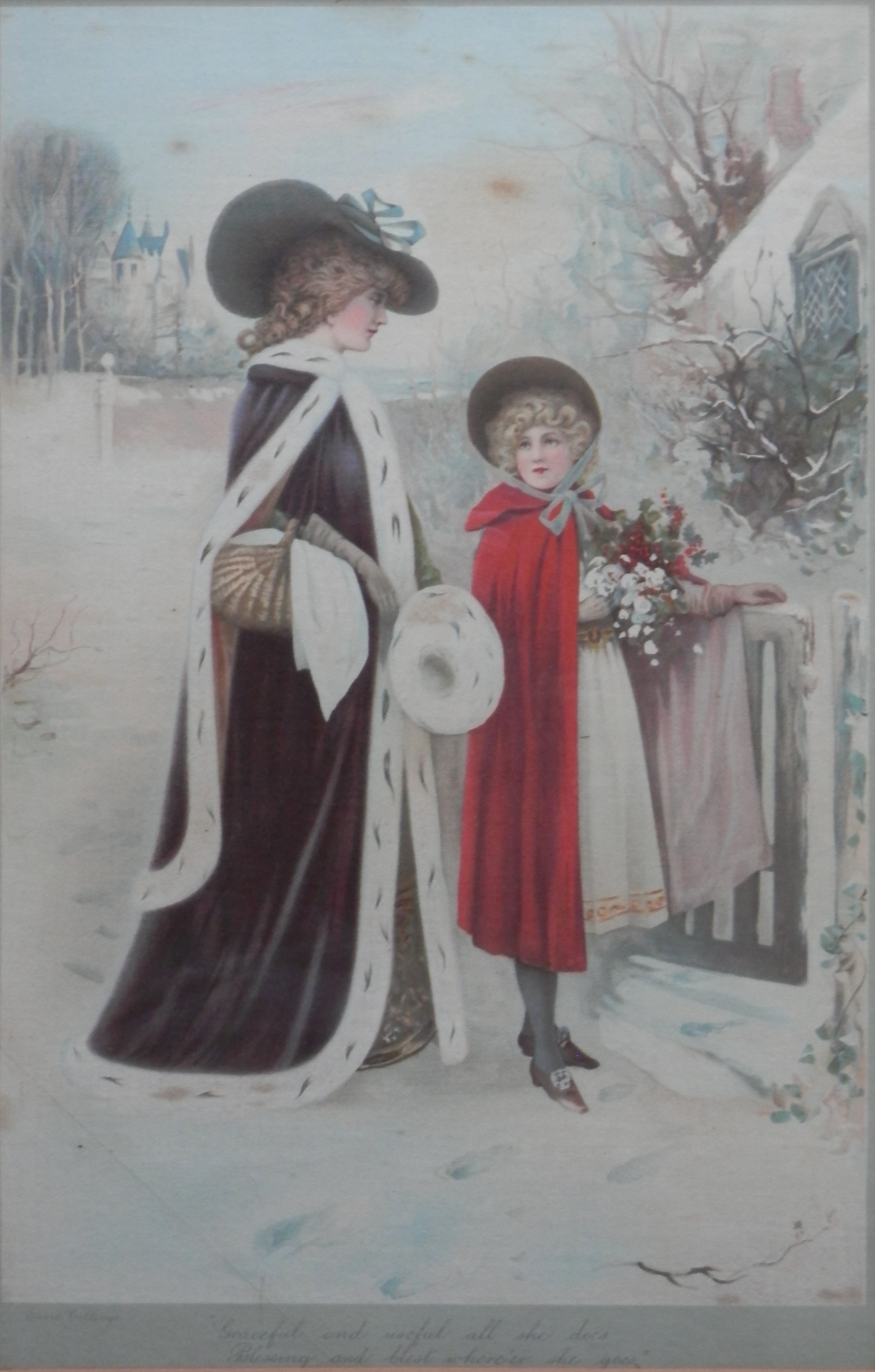
Blessing and Blest watercolour on silk by Esme Collings @ 1890

Christmas Morning – An Errand of Mercy
watercolour on silk
by Esme Collings
@ 1890

Arthur entered into a business partnership with photographer William Friese Greene (1855-1921), who was later to gain some notice as a pioneer in making “moving pictures”.  The partnership dissolved in 1888.  Collings adopted the middle name of Esmé in 1889, and is usually referred to in sources as Esmé Collings.

In 1896, he made a number of films, of which only three are known to have survived.  From a surviving stock list and other sources, it is known that he made at least nineteen films during his first year of production.  As well, he made Woman Undressing, which must have been one of the first erotic films in British cinema.

After the break up of the partnership #ArthurEsmeCollings moved down to Brighton,to take personal charge of the studio at 69 Western Road, Hove.

In 1897 he seems to have abandoned films to devote himself to painting, while continuing to run the Esmé Collings Limited photographic business until at least 1914.  His wife, Keturah Collings, ran a fashionable photographic studio in London and was a watercolourist.  Collings’ chief claim to fame is as one of the first of that small band of South Coast film makers labelled the ‘Brighton School’.  In 1905, the Collings’ moved back to London and each had their own photographic studio.

Christmas Morning - An Errand of Mercy photo section 1 by Esme Collings

Christmas Morning – An Errand of Mercy
photo section 1
by Esme Collings

Christmas Morning - An Errand of Mercy picture segment 2 by Esme Collings

Christmas Morning – An Errand of Mercy
picture segment 2
by Esme Collings

This stunningly beautiful print is done on silk .  It is not a miniature but is 14″ x 9″.  The detail and technique superb –  it is clearly visible why #EsmeCollins was a well known miniaturist painter.

From photographer, to film maker, to miniature portrait painter, and back to photography.  A talented man.  A talent that should be well remembered.

The lines found at the bottom of the painting are from William Cowper’s  ‘To A Young Lady @ 1782

“Sweet stream that winds through yonder glade,
Apt emblem of a virtuous maid
Silent and chaste she steals along,
Far from the world’s gay busy throng:
With gentle yet prevailing force,
Intent upon her destined course;
Graceful and useful all she does,
Blessing and blest where’er she goes;
Pure-bosom’d as that watery glass,
And Heaven reflected in her face”

Posted in Modern prints | Tagged , , , , , , , , , , | 1 Comment

Art Modern

When I look at art today as in the past, I realize that my idea of what is art has not necessarily changed, what has changed is how I look at art and also my appreciation of the talent in that art.  Much of the art that I have collected is by little known if not yet remembered artists.  This does not mean that it is not memorable or good just not yet recognized.

Flowers in a Vase by Brenda King

Flowers in a Vase
by Brenda King

#BrendaKing (b. 1934) has a painting style described as faux-na.   This branch of painting found many followers in the late twentieth century in West Cornwall.  Faux-na characterises itself by its’ crude yet expressive style. It has an earthy, here-and-now quality, with detailing, like wallpaper patterns, foliage, stones in a garden wall painstakingly delineated.  All of the above attributes are clearly seen in the still-life painting shown here.  The white flowers set against the ochre and russet foliage have a natural feel which then supported by the quilt patterned table cloth portrays scene so very normal – so very real.

Impressionism is a style or movement in painting originating in France in the 1860s.  It is characterized by a concern with depicting the visual impression of the moment, especially in terms of the shifting effect of light and colour.

Still Life with Lampshade by M R Wyman 1957

Still Life with Lampshade
by M R Wyman
1957

Impressionism practices the depiction of the natural appearances of objects by means of dabs or strokes of primary unmixed colours in order to simulate actual reflected light.

In the painting by #MRWyman, it is possible to see the short strokes made by the palette knife to lay the paint on the canvas.  The use of an instrument other than a brush gives the painting a coarse, rough feel and appearance.  The mixing of colours is not smooth but hard and sharp.

A portrayal of life just as real but in a varied style.

Still Life by E A Taylor

Still Life
by E A Taylor

And to finish a still life painted with stroke of brush. A lovely bouquet filled with colour and life by #EATaylor.  Colour, light and shadow used to express the beauty in the life that surrounded not only the artist but also ourselves.

Posted in Oil Paintings | Tagged , , , , , , , , , | Leave a comment

Art through a Webb

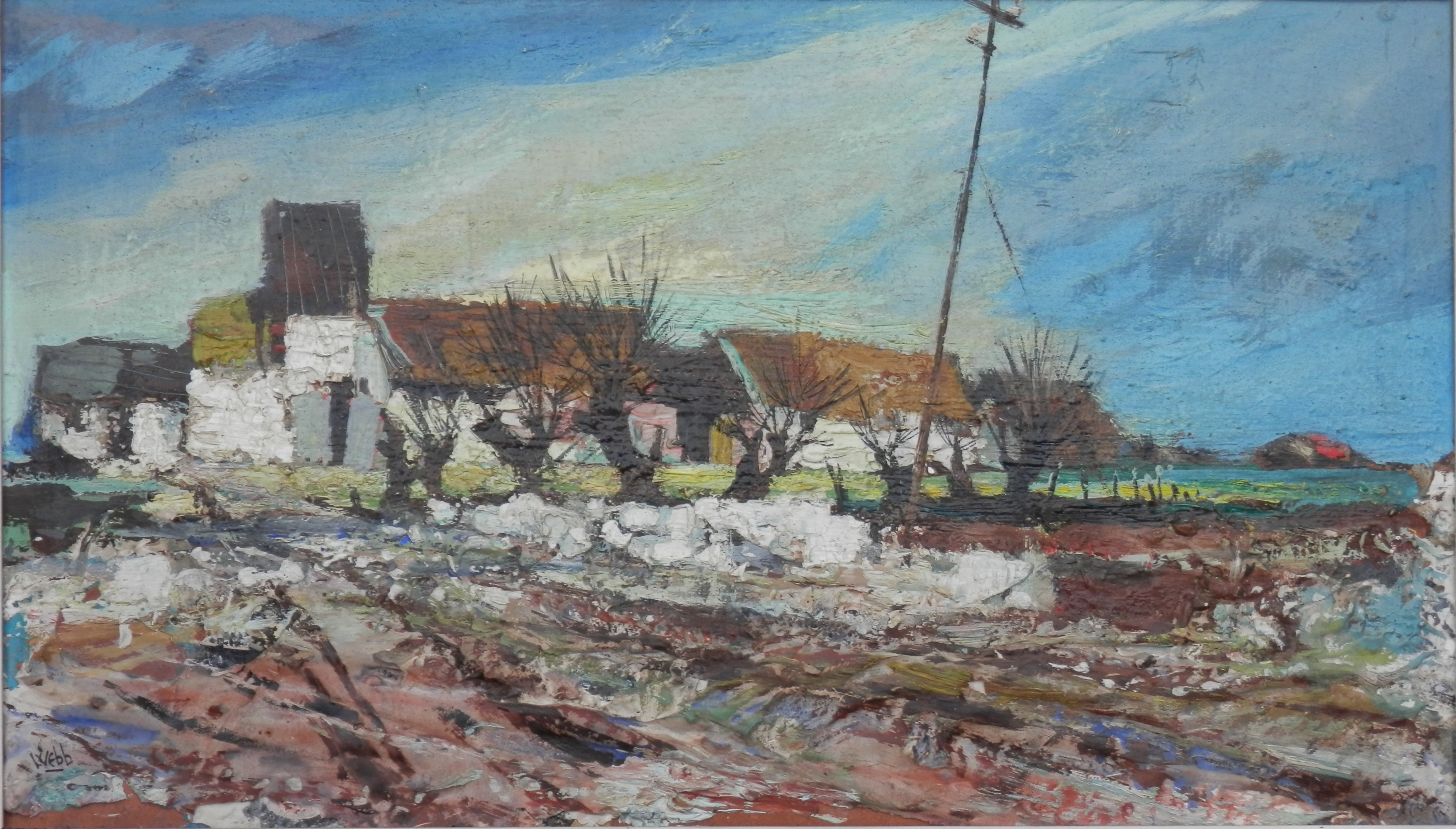
The Webb I refer to is Kenneth Webb (b. 1927).  #KennethWebb is an English painter who has been influenced by colour – colour in nature and in natural forms.  Since 1953, when he was appointed Head of the Painting School at the Ulster College of Art, he has lived in Ireland.  His career has been a fascination to a variety of themes.  He gets hooked onto an idea, exploring it to its’ depths, and has to paint his way out of it. “Whenever I am taken by a theme, I seem to have to start all over and invent my own pictorial structure.”

Farm Buildings, Ulster by Kenneth Webb

Farm Buildings, Ulster
by Kenneth Webb

Webb has an emotional element to his paintings which gives them an atmosphere and mood subtly expressed through colour.  Although flat, Webb has built up the paint in places on this canvas to 1/2 inch or more allowing light and shadow to play its part as one views this painting from different vantages and under differing light.  Webb’s canvases are a balm to the eye and salve to the heart.  If beauty is in the eyes of the beholder, then Kenneth Webb is a graced and gracious beholder.  And I am one who is thankful for his beholding.

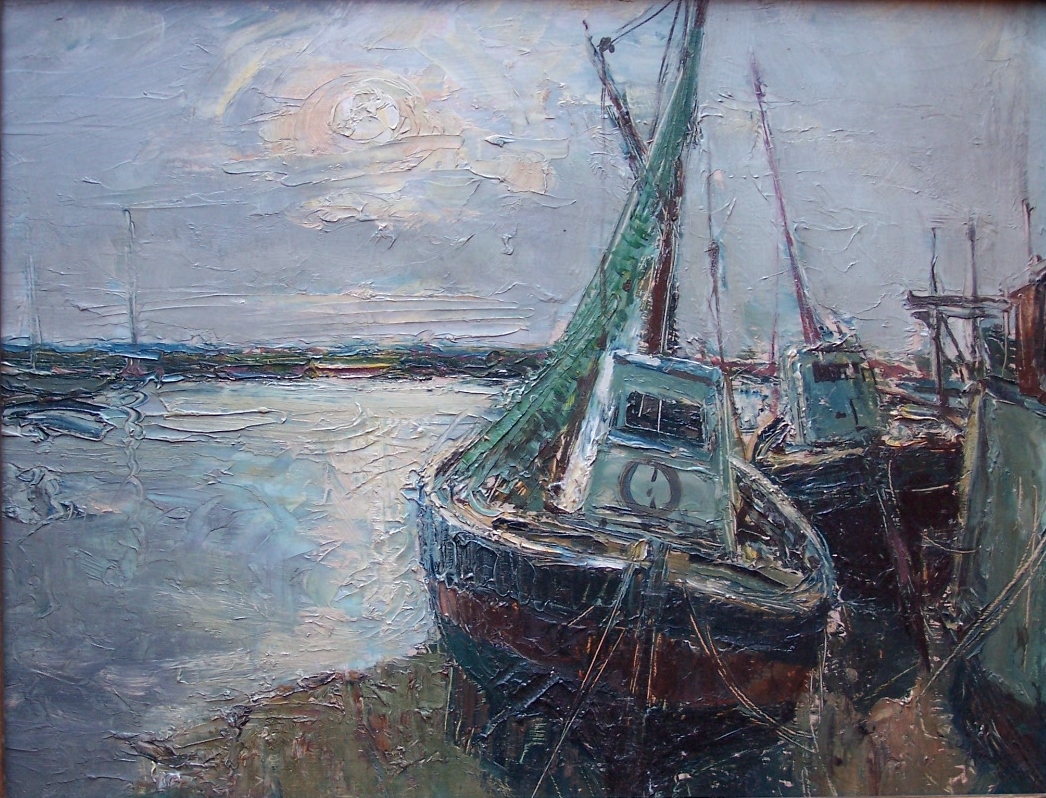
Harbour at Low Tide unknown artist

Harbour at Low Tide
unknown artist

Colour, light and shadow bring life to any painting or piece of art. This harbour scene by an unknown artist exudes a restfulness.  One can smell the sea, the fish, the seaweed.  Do you hear the water as it plays with the sand.  Sun setting – light reflected by the rippling water.  Muted colours expressing a stillness, a waiting for life to begin, for time to restart. Life expressed in colour and colour an expression of life.

Posted in Oil Paintings | Tagged , , , , , , , , , , | Leave a comment

Art Unrealized

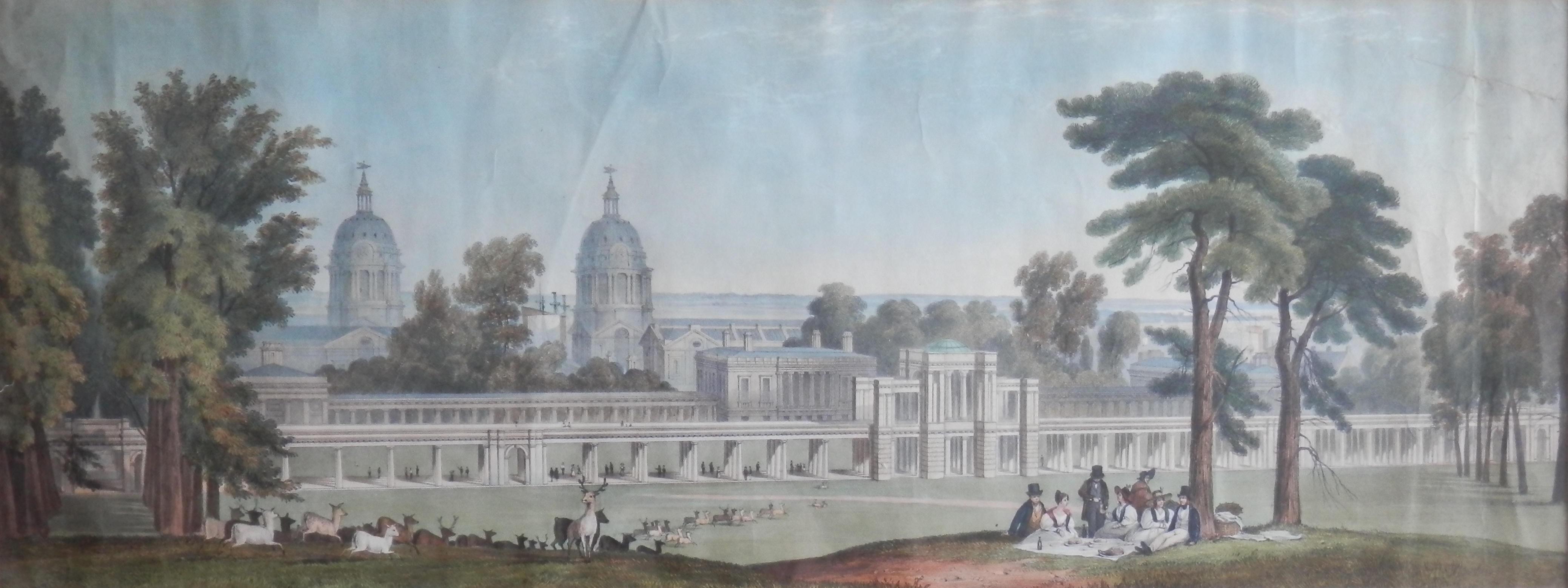
Like architects and designers, artists at times develop and produce sketches and plans for works with which they vie against others to have produced or commissioned.  The other day, I bought an artwork of a proposed rail station by the artist #CharlesJosephHullmandel.

The Proposed Gravesend Rail Road by Charles J Hullmandel @ 1835 coloured etching

The Proposed Gravesend Rail Road
by Charles Joseph Hullmandel
@ 1835
coloured etching

Charles Joseph Hullmandel’s hand-coloured print showing how the Greenwich railway would have crossed the Park south of the Queen’s House.  The railway was London’s first suburban line, which ran from Spa Road, just east of modern London Bridge Station, to Greenwich in 1836.  The design by Charles Hullmandel was not agreed on even though it is quite an impressive structure.  Wonderfully hand-coloured this is a part of history which in a way didn’t happen.

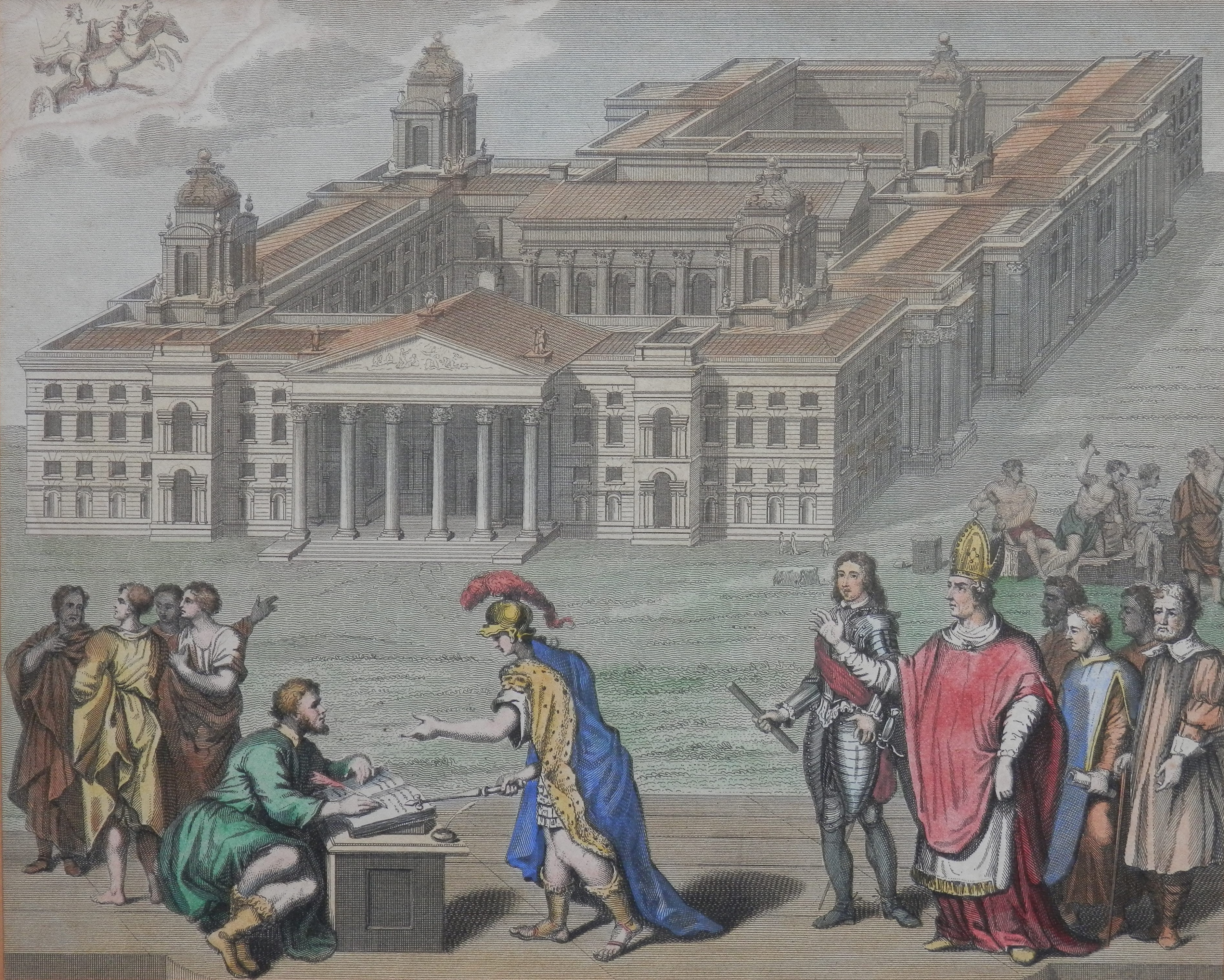
Founders and Benefactors of Brasen Nose College with a Design for the New Buildings by Joseph Skelton @ 1830

Founders and Benefactors of Brasen Nose College with a Design for the New Buildings
by Joseph Skelton
@ 1830

We move to artist #JosephSkelton, who began publishing parts of his ‘Oxonia Antiqua Restaurata’ in 1818. He completed the project in 1820.  The Oxonia Antiqua has a folding engraved plan of Oxford and one hundred and thirty-four plates by Skelton.  This is but a single hand-coloured  print from that publication.  One can easily appreciate the quality of workmanship just from this single image.  Brazen Nose College is of course found in Oxford.  I don,t know whether these plans were accepted or not  but again the building is impressive.

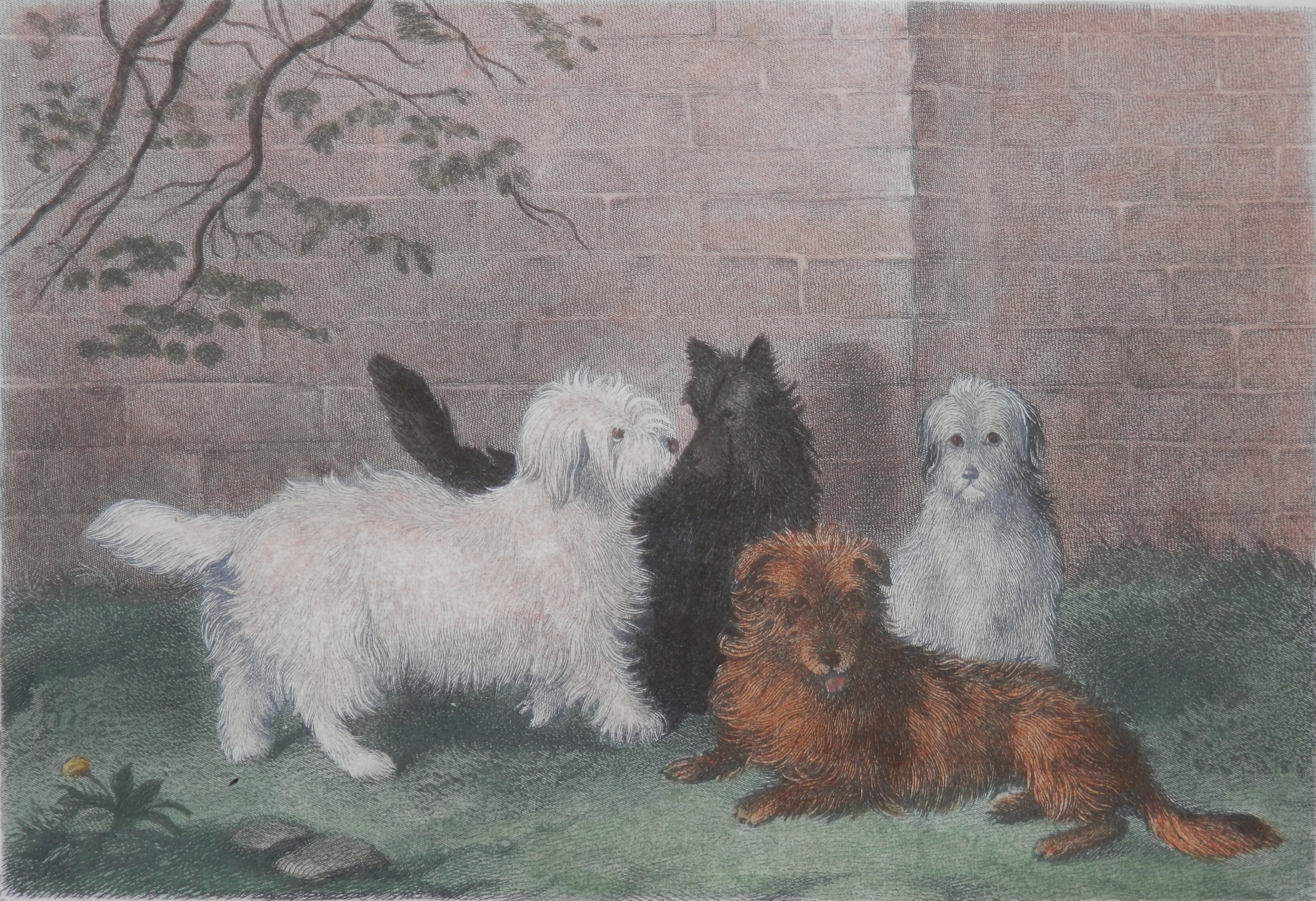
And finally for fun a print by #EdwardHacker called ‘A Rough Lot’ after #WilliamBarraud.

A Rough Lot etched by E Hacker after W Barraud @ 1830

A Rough Lot
etched by E Hacker after W Barraud
@ 1830

Posted in Etching, Lithographs | Tagged , , , , , , , , , , , | Leave a comment

Art Broken

When I began collecting , I decided and have continued with the idea that if an art piece caught my attention it was worthy of being added into my collection.  This actually means that even broken pieces have entered into my gallery.  It also means that when talking about sculpture or porcelain – monetary value certainly does not enter into the picture since completeness/wholeness is a major factor of value.  But just because a piece is broken does not mean it does not retain any allure.  So to the little sculpture I bought.

Il Porcelliino in Verdi Marble unknown artist @ 19th century?

Il Porcelliino in Verdi Marble
unknown artist
@ 19th century?

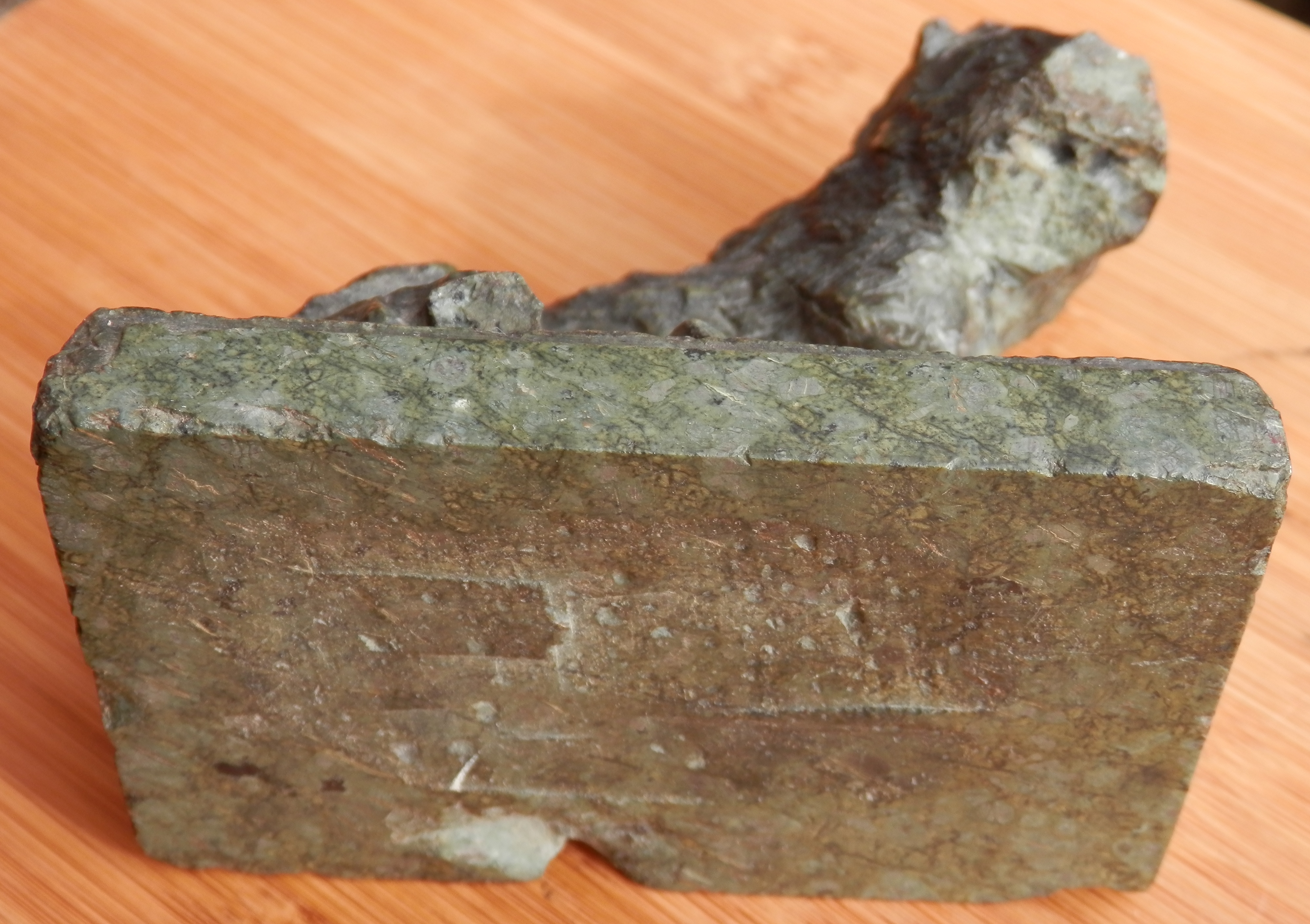
A small piece of #VerdiMarble (4 inches long by 2 inches wide by 4 inches high) out of which has been carved a boar.  This small item is a copy of the larger version which sits in the Mercato Nuovo, Florence.  It is known as ‘Il Porcellino’.  Sculptor Pietro Tacca made the model from which the bronze was cast in the 1630s.  He created his copy from the life-size marble given by Pope Pius IV to Cosimo I de’Medici which now sits in the Uffizi Gallery.  Sculptor Antonio Susini, also, produced smaller-scale bronze versions.  An immensely popular image for all artists, bronze reductions were made throughout the 17th, 18th and 19th centuries.

Il Porcellino2 in Verdi Marble unknown artist @ 19th century?

Il Porcellino2 in Verdi Marble
unknown artist
@ 19th century?

Alas, my little #IlPorcellino has lost both his ears, his snout, his lower jaw, as well as his whole head at one time.  Even in his brokenness, I still like him.  His age could be any thing from the 17th to 19th century.  He is not signed so there is no artist to connect him to.

I am not a sculptor and holding this in my hand I find it amazing that one hits stone with hammer and chisel and something comes out of it.  A slip would mean a chip or crack – a ruined piece.  How hard does one have to tap?

Il Porcellino3 in Verdi Marble unknown artist @ 19th century

Il Porcellino3 in Verdi Marble
unknown artist
@ 19th century

From stone to sculpture by the hands of an artist – even when broken something of the original remains.  Something intangible and yet something which can be felt.

Posted in Sculpture | Tagged , , , , | Leave a comment